A boda boda rider swerves suddenly, his passenger gripping the seat as an oncoming vehicle bears down on them. For a split second, they are in its path. The rider jerks the handlebars and narrowly escapes a head-on collision.
A few metres behind them, another motorcyclist speeds along the wrong side of the road. Nearby, pedestrians wait anxiously for a chance to cross, unsure which direction to watch as vehicles and motorcycles approach from both sides.
For many people in Homa Bay Town, this has become an unsettling part of everyday life.
The new dual carriageway was meant to ease traffic and make movement around the town easier. But with construction still incomplete, the road has become a source of anxiety for motorists, boda boda riders and pedestrians, as some road users ignore traffic rules in an attempt to reach their destinations faster.
Even a short journey on a boda boda can feel frightening for passengers, with motorcycles swerving into oncoming traffic and riders having to make split-second decisions to avoid collisions.
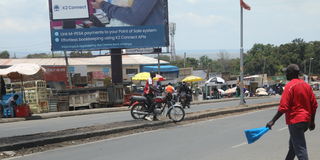
A cyclist is about to cross the dual carriageway in Homa Bay Town on October 12, 2026.
Photo credit: George Odiwuor | Nation
The danger is already taking a toll as three people have died in accidents on the road, according to the Homa Bay County Inspectorate Services, while several others have been injured.
Some motorists and boda boda riders required to keep left have taken to driving or riding on the wrong side of the carriageway. They say the practice saves time and fuel, but it puts their lives and those of other road users at risk.
Riders sometimes pass within inches of one another on motorcycles as they try to avoid collisions. In other instances, they brush against other vehicles, causing riders to crash onto the road.
For pedestrians, crossing the road has also become a test of caution. A person may expect traffic to approach from one direction only for a speeding motorcycle or vehicle travelling on the wrong side to appear unexpectedly.
Walter Muok, the county director of enforcement and security services, said the growing disregard for traffic rules was worrying.
“Riders are disobeying traffic rules when they want to save fuel. This is dangerous not just to them but to other road users,” he said.
Mr Muok said enforcement officers had stepped up road safety awareness campaigns, but some riders continued to ignore the rules, citing rising fuel costs and the lack of adequate U-turns and service lanes.
He recently met leaders of boda boda groups to discuss the risks of riding against the flow of traffic.
Before the dual carriageway was introduced, many road users had become accustomed to travelling along a single road. Mr Muok said the new arrangement required them to change their habits and obey the rules, including riders from other towns.
“This is no longer the case. Even riders from other towns are required to obey the traffic rules,” he said.
The county plans to move from sensitisation to enforcement, with Mr Muok warning that those who continue to flout traffic rules could be taken to court and fined or jailed.
“We have engaged boda boda leadership and urged them to sensitise their members on the laid-down procedures for using the dual carriageway in Homa Bay Town and other roads in the county. Strict adherence to traffic rules will help reduce road accidents and prevent unnecessary confrontations between road users and law enforcement officers,” he said.
However, for riders, the problem is not just a matter of discipline. They claim that the road's layout makes some journeys longer and more expensive, and they are concerned that passengers will be unwilling to cover these additional costs.
Homa Bay Sub-County Boda Boda Association chairperson Richard Opiyo said riders had to use more fuel when following the designated routes.
The five-kilometre stretch from Homa Bay town’s central business district to Junction Kodoyo has only one designated turning point. It is at a junction leading to the county referral hospital and serves vehicles travelling from Junction Kodoyo towards the hospital.
Signage prohibits U-turns on the highway. Motorists travelling away from town who want to return must proceed to the roundabout at Junction Kodoyo before turning back.
Mr Opiyo said some riders were unwilling to make the additional journey, opting instead to use the wrong side of the road to reach their destinations more quickly.
He said passengers were also reluctant to pay higher fares to cover the extra fuel costs, creating pressure on riders to take shortcuts.
“They would rather operate on the wrong side than spend more on fuel. They can as well use the right route, but it will force passengers to pay more,” he said.
Residents say that the danger cannot be addressed through enforcement alone. They are calling for clearer road markings, better signage and designated lanes for boda bodas to help road users navigate the carriageway safely.
Michael Kojo said a roundabout would help regulate traffic and reduce confusion at busy points in the town.
“There is growing traffic in the town and this requires a roundabout. It can promote traffic discipline by forcing drivers to slow down, yield to circulating traffic, and navigate a one-way continuous flow,” he said.
A cyclist is about to cross the dual carriageway in Homa Bay Town on October 12, 2026.
Photo credit: George Odiwuor | Nation
Mr Kojo also called on the Kenya National Highways Authority (KeNHA) to build a pedestrian bridge, saying it would give residents a safer way to cross the busy road.
He added that speed-limit signs were needed, particularly because the road passes through a populated area.
“There should be signs, especially on speed limits. At the moment, vehicles are driven at high speed yet to pass through a populated area,” he said.
KeNHA officials, however, said road designs depended on a road’s purpose and the space available. Some roundabouts, they noted, had been closed because they contributed to congestion.
KeNHA Deputy Director of Corporate Communication Samwel Kumba said U-turns on a dual carriageway required dedicated deceleration and acceleration lanes to allow vehicles to turn without disrupting traffic.
“If you want to do a U-turn, then you must have a decelerating lane so that the vehicle that wants to turn leaves the main carriageway, slows down without slowing the vehicles behind, and then they can turn,” he said.
He explained that a dedicated lane would allow a vehicle to slow down before turning, then accelerate safely before rejoining traffic moving at between 80 and 100 kilometres per hour.
Such an arrangement, he said, requires adequate space, which was not available for the Homa Bay project. The authority also lacked funds to acquire additional land when the road was being built.
Mr Kumba said the five-kilometre stretch had been designed according to its intended purpose and the space available. Motorists who miss a turning point, he added, should proceed to the next designated one rather than attempt to cross the carriageway.
A rider crosses the dual carriageway in Homa Bay Town on October 12, 2026.
Photo credit: George Odiwuor | Nation
He criticised riders who weave between lanes or travel against the flow of traffic in an attempt to save time. He said that the responsibility for enforcing traffic rules lay with the National Transport and Safety Authority (NTSA) and the county government.
“They simply have to follow the rules. You cannot allow them to crisscross. It is just like saying, instead of going 500 metres before you get to a footbridge and cross, you better cross where you are,” he said.
KeNHA maintained that safety had been considered in the road’s design and urged road users to obey traffic rules, while calling on NTSA and the county government to enforce compliance.
Yet, even as motorists, riders and pedestrians contend with the risks posed by traffic, another hazard is emerging along the road: livestock roaming freely through the town.
Cows, goats, sheep and donkeys can be seen wandering beside moving vehicles and motorcycles. Some lie on the road, forcing motorists to slow down or swerve to avoid hitting them.
Mr Muok warned livestock owners against allowing their animals to roam freely in the central business district and major markets, saying they endangered road users and risked damaging traders’ property.