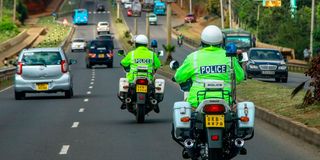
Although no reliable data is easily available, one can safely presume that Raila Odinga Road carries one of Nairobi’s heaviest traffic loads, especially in the morning and evening rush hours.
The approximately 4km stretch between the T-Mall and the Nairobi Funeral Home roundabouts links Langata and Ngong Roads, two of the busiest streets ferrying commuters to and from the capital city’s Central Business District to the western suburbs and beyond.
Of approximately 7,800 kilometres of paved roads in Nairobi County, it stands out as probably the only one that, in nearly 20 years since completion, has never developed a single pothole.
It is also the only significant stretch of public road in the capital, and probably in the entire country, constructed of concrete rather than the traditional asphalt.
If there is one road that fully deserved renaming, then it was the former Mbagathi Way, whose upgrading from a narrow road that had all but fallen to the elements to a sturdy dual-carriageway is a testament to the resilience and tenacity of one man.
Raila Odinga was the Cabinet Minister for Roads and Public Works in President Mwai Kibaki’s government when he single-handedly pushed for an experimental project to rebuild Mbagathi Way using concrete.
He had to overcome a great deal of resistance. Concrete roads are typically 30 to 50 percent more expensive than traditional asphalt. Sceptics and naysayers in government and parliament, and even amongst the construction companies which dominated road development projects during that era, pushed dark stories about possible shady dealings and untested technology.
Mr Odinga stuck to his guns, and the road was done, construction commencing in 2005 and ending in 2007 after he had already left office.
As we mark one year since Mr Odinga passed away, that road that bears his name stands as a living, lasting, indestructible legacy of one of the most impactful leaders of modern Kenya.
One can bet that roads of similar length and traffic volumes built around the same time using conventional technology have long since been reduced to potholed lunar landscapes, or consumed billions in periodic maintenance, resurfacing or complete rebuilds.
Like the man himself, Raila Odinga Road still stands strong and proud, carrying heavy traffic with nary a crack, and with next to nothing being spent on periodic repairs.
The billions saved could have considerably expanded Nairobi’s road network, especially where there is dire need for decent access to the growing urban sprawl of unsightly slums and other unplanned settlements that house the vast majority of the capital’s 5 million population.
Mbagathi Way, as it then was, was constructed as a pilot project. There is no doubt that it has not only stood the test of time, but has also proven itself beyond expectation.
We must thus wonder why concrete has not been more widely adopted for road construction in Kenya, when you can say that the heavier initial cost pays for itself many times over in the long run.
Maybe there is a good reason for that beyond the ken of this layman who never saw the inside of an engineering class.
Anyway, that notable piece of engineering stands as a tribute to an engineer who switched to politics as a full-time occupation, and firmly established himself as probably the most notable figure in the modern history of Kenya.
Mr Odinga was not your ordinary everyday politician who seeks power for its own sake. His driving force was not the pursuit of power, but the higher goals of societal transformation, creation of a society built on the essential pillars of justice and equity.
He never won the ultimate prize, election as president, but no doubt has had much more impact in the shaping of modern Kenya than all the figures who over the years beat him to it - Daniel arap Moi in 1997, Mwai Kibaki in the deeply contentious 2007 polls, Uhuru Kenyatta in 2013 and 2017, and William Ruto in 2022.
All of them, individually and collectively, were no more than dwarfs in the shadow of a giant.
One year after Mr Odinga’s passing, he still casts a giant shadow over the national landscape. Even in absentia, he looms large over the politicking evident heading towards next year's elections, where the large floating vote he left behind is coveted by every political formation.
But he must be turning in his grave observing the motley cast of political desperadoes jockeying to inherit his base, but systematically destroying everything he built, and the values and principles that made him.
Mr Gaitho, an independent journalist, is former NMG Managing Editor for Special Projects. [email protected]