Employers face Sh1 million fine for failing to provide breastfeeding rooms
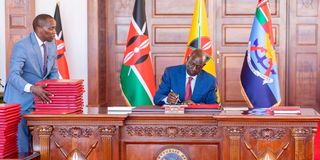
President William Ruto assents to six National Assembly Bills at State House, Nairobi on Thursday, November 26, 2026.

Employers will now be required to provide a private, clean lactation room, provide breastfeeding breaks for breastfeeding mothers, following President William Ruto's signing the Breastfeeding Mothers Bill, 2024, into law.
The Bill was among the six National Assembly Bills that the President Ruto assented to at State House, Nairobi yesterday.
Other Bills include, the East African Development Bank (Amendment) Bill, 2026, Sexual Offences (Amendment) Bill, 2023, Sexual Offences (Amendment) Bill, 2025, Public Service Superannuation Scheme (Amendment) Bill, 2025 and the Environmental Professionals Institute of Kenya Bill, 2024


The new Breastfeeding Mothers Act requires employers to provide flexible working arrangements, and protect mothers from discrimination for breastfeeding,
According to the new law, employers will now be compelled to set up lactation rooms for nursing working mothers, protect mothers from discrimination and improve access to bay-changing amenities in public places.
The new law strengthens support for working mothers by making breastfeeding-friendly facilities a legal responsibility for employers and helping women balance their careers with childcare responsibilities.
The new law also now allows breastfeeding mothers to request for flexible working arrangements such as changing their working hours, flexible work locations that allows them to balance between work and childcare responsibilities.
The lactation room, according to the new law, must have a lockable door for privacy and security, a wash basin with water, refrigerator for safety of storing expressed milk and cleaning equipment.
The room must also have a table and a chair meant to provide comfort to the mother while breastfeeding or expressing milk, adequate lighting and electrical outlets to support breast pumps.
Those who will violate this rule now face up to a fine of Sh1 million or a jail term of up to one year or both upon conviction.
The Bill sponsored by Nominated MP Sabina Chege, protects the rights and dignity of breastfeeding mothers in the workplace.

Nominated MP Sabina Chege at a past event. She sponsored the Breastfeeding Mothers Bill, 2024.
On the other hand, the Sexual Offences (Amendment) Bill 2025 sponsored by Garissa County woman representative Amina Siyad now an Act of Parliament introduces a new Section 40A to expressly provide that offences under the Sexual Offences Act shall be prosecuted exclusively through the formal judicial system.
It further declares void any agreement or settlement purporting to dispose of sexual offences outside the court process.
This proposal is firmly grounded in Article 159(3) of the Constitution, which prohibits the use of traditional dispute resolution mechanisms in matters that are repugnant to justice and morality or inconsistent with the Constitution.
During debate of the Bill, lawmakers who supported the proposed legislation argued that sexual offences are public crimes prosecuted in the name of the Republic, not private dispute between individuals or families hence allowing out-of-court settlement undermines the criminal justice system and defeats the State's constitutional duty to protect its citizens and maintain public order.
According to the lawmakers, criminal liability cannot lawfully be negotiated away through private arrangements
The Sexual Offences (Amendment) Bill, 2023, sponsored by Kisii County Woman Representative Doris Donya Aburi on other hand strengthens the prevention and reporting of sexual offences through nationwide public education and awareness campaigns.
It also safeguards the right to education of victims of sexual violence, including girls affected by teenage pregnancies.
While assenting to the Bills, President Ruto said the two laws would promote a better understanding of the provisions and limitations of the law to ensure that sexual offences are better addressed.
The President also signed into law the Public Service Superannuation Scheme (Amendment) Bill, 2025, sponsored by the Leader of the Majority in the National Assembly Kimani Ichung’wah, which streamlines the governance and administration of the scheme by re-establishing it as the Public Service Superannuation Fund.
The new law allows public servants upon written request, to have their accrued gratuity remitted to retirement savings accounts rather than receive it as a lump sum at the end of their contracts. Employers who fail to deduct or remit contributions will face penalties.
It expands membership to public servants on fixed-term contracts, safeguards pension contributions and provides for additional benefits, including post-retirement medical and mortgage facilities.
The Environmental Professionals Institute of Kenya Bill, 2024, sponsored by Ndaragwa MP George Gachagua, establishes the Environmental Professionals Institute of Kenya to oversee the registration, licensing and regulation of environmental professionals, promote professionalism and uphold standards of practice.
President Ruto pointed out that the law would ensure that professional organisations in the country are managed without imposing a financial burden on citizens while providing a framework for holding professionals accountable for their conduct.
The East African Development Bank (Amendment) Bill, 2026, sponsored by Mr Ichung’wah, aligns the East African Development Bank Act with the Constitution by requiring the approval of the National Assembly and the authorisation of the Controller of Budget before public funds are disbursed to the bank.
By subjecting all expenditure from the Consolidated Fund to parliamentary appropriation and the Controller's of Budget authorisation, President Ruto explained, the law will strengthen transparency and accountability in the management of public resources.
Follow ourWhatsApp channel for breaking news updates and more stories like this.