The High Court has struck out two consolidated petitions challenging the Sh45 billion Public Private Partnership (PPP) between the National Transport and Safety Authority (NTSA) and Pesa Print Limited consortium for the rollout of smart driving licences and automated traffic fines, ruling that it lacked jurisdiction to hear the dispute.
In a ruling delivered on Thursday, November 26, Milimani High Court Judge Nyaundi Patricia Mande said the petitioners should have first exhausted the dispute resolution mechanisms established under the Public Private Partnerships Act before approaching the court.
The judge held that disputes arising from the procurement and contracting of PPP projects must initially be handled by the statutory Petitions Committee, with parties retaining the right to appeal its decisions to the High Court.
“Although the dispute has been framed as one inviting constitutional interpretation, it is evident from the pleadings and the reliefs sought that the Petitioners ultimately seek the annulment of the Public-Private Partnership (PPP) and challenge the procurement and contracting process that culminated in its execution,” Justice Mande ruled.
She said Parliament had deliberately established a specialised mechanism to handle such disputes, adding that litigants could not bypass it and invoke the court's jurisdiction without demonstrating exceptional circumstances.
The consolidated petitions were filed by the Consumer Federation of Kenya (Cofek) and another petitioner, who challenged the legality, transparency and constitutionality of the deal between NTSA and the Pesa Print consortium.
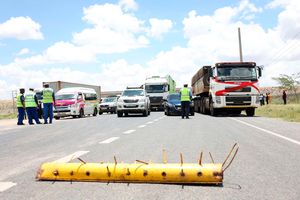
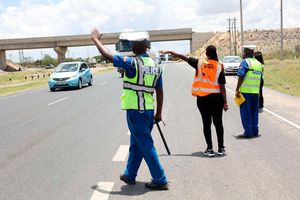
A police officer and an official from the National Transport and Safety Authority inspect vehicles at Salgaa area along the Nakuru-Eldoret Highway on December 4, 2025.
Photo credit: Boniface Mwangi | Nation Media Group
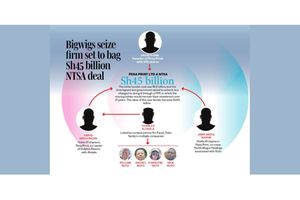
The project, reportedly valued at approximately Sh45 billion and running for 21 years, covers the design, supply, delivery, installation and maintenance of second-generation smart driving licences, automated traffic detection and instant fines enforcement systems.
The petitioners had raised concerns over the alleged lack of public participation, direct procurement of the private consortium, access to critical project documents, data protection safeguards and the financial implications of the agreement.
They also questioned whether the requisite approvals had been obtained and argued that the collection and processing of motorists' biometric information could infringe on their constitutional right to privacy.
Cofek had sought orders stopping implementation of the project and compelling the government to disclose documents, including the feasibility study, PPP agreement, procurement approvals and financial arrangements.
The second petitioner had similarly sought suspension of the project, arguing that its implementation before the determination of the constitutional questions would expose motorists to potential violations of their rights.
However, the respondents and the interested party argued that the dispute fell within the mandate of the Petitions Committee established under Section 75 of the PPP Act.
In determining the preliminary objection, Justice Mande relied on previous court decisions affirming that parties must first exhaust alternative dispute resolution mechanisms established by law.
Photo credit: Nation Media Group
She cited the Supreme Court decision in Sammy Ndung’u Waity v Independent Electoral and Boundaries Commission (IEBC), which emphasised that where the law provides another body with the mandate to resolve a dispute, that process must be exhausted before approaching the courts.
The judge acknowledged that the exhaustion doctrine is not absolute and that courts can intervene in exceptional circumstances, particularly where genuine constitutional questions or violations of fundamental rights arise.
However, she found that the petitioners had not demonstrated sufficient grounds to warrant an exemption.
“To permit parties to bypass the prescribed mechanisms and invoke the Court's jurisdiction long after the statutory timelines have lapsed would undermine the legislative scheme and expose concluded procurement and contracting processes to perpetual uncertainty,” she said.
Justice Mande further noted that the PPP Act provides strict timelines for challenging decisions relating to procurement and project agreements, including seven days to lodge a petition before the Petitions Committee.
A National Transport and Safety Authority (NTSA) vehicle parked outside the agency's offices in Mombasa.
Photo credit: File | Nation Media Group
The committee is required to determine such petitions within 28 days, while an aggrieved party can seek a review within seven days and subsequently appeal to the High Court within 14 days.
She said allowing parties to challenge procurement processes indefinitely would undermine commercial certainty and expose public and private investments to prolonged uncertainty.
“In the circumstances, and absent any demonstrated exceptional grounds warranting departure from the doctrine of exhaustion, this Court finds that the Petitioners were obliged to pursue the remedies provided under the statute before seeking recourse before the High Court,” she ruled.
Having found that it lacked jurisdiction, the judge said she could not proceed to determine the other issues raised in the petitions, including the applications seeking suspension of the project.
“As was stated in Owners of the Motor Vessel ‘Lillian S’ v Caltex Oil (Kenya) Ltd, jurisdiction is everything and, without it, a court must down its tools,” she said.
The judge consequently struck out the petition, adding that she could do no more after reaching that conclusion.
However, she declined to award costs, noting that the matter had been brought in the public interest.
“As the matter was presented in the public interest, there shall be no order as to costs,” she ruled.
The decision means the court did not determine the substantive allegations concerning the legality of the procurement, public participation, transparency or data protection in the NTSA-Pesa Print deal.