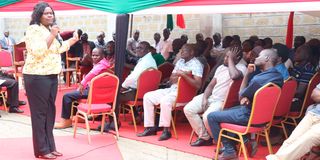
A task force on revenue collection in Homa Bay has identified 12 major obstacles that prevent the county from achieving its desired financial goals.
The team was created by Governor Gladys Wanga on September 20, a week after she ordered a 15-days tax holiday for traders.
It presented its preliminary findings to Ms Wanga on Wednesday, revealing hidden activities that led to Homa Bay being ranked by the Commission on Revenue Allocation among counties that collect less than 20 per cent of the estimated potential in own-source revenue.
Among the issues identified is the lack of a mechanism for collecting revenue from national government agencies.
Others are lack of integrity among some revenue offices, poor debt collection, a weak audit programme and an ineffective revenue administration structure.
Ms Wanga told journalists that the county also failed to collect revenue from the extractive sector and has a static property valuation roll.
Homa Bay was also found to have a vulnerable cash-based system and finance officers manipulated the electronic cash system.
Ms Wanga said the devolved unit lacked corresponding by-laws to the Finance Act 2022 and some people, including in the county government, were interfering with revenue collection.
“In addition, poor service delivery by the county government also depressed the morale for voluntary compliance,” she said.
Homa Bay’s GDP, she claimed, constitutes 1.4 per cent of the national GDP.
“The own-source revenue potential as per the CRA estimates is Sh1.024 billion against an average annual collection of Sh136 million, leading to a negative variance of Sh887 million. This means 87 per cent of revenue collected remains unaccounted for,” Ms Wanga said.
To reverse the trend, the governor said she will take radical action once the final report is out before October 5.
One of the steps is to have a cashless payment system, where traders will pay revenue using their mobile phones to minimise pilferage and theft.
“I will establish enhanced revenue collection oversight, putting in place integrity assurance programmes, providing support to the compliant revenue contributors and taking deterrent legal and administrative measures against both internal and external offenders,” Ms Wanga said.
In the meantime, the tax holiday has been extended by another seven days, with Ms Wanga announcing that revenue collection will resume on October 5.
“As we wait for the full report, we will work on a back-to-work plan for revenue officers who are currently on leave and a reorganised revenue mobilisation structure will also be communicated accordingly,” the governor said.