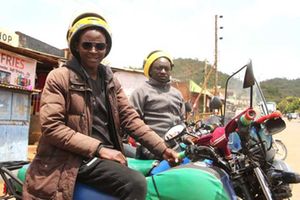
On Monday, August 4, 2025, at 10.30 am, John Omondi, 27, sat on a pavement at the entrance of the busy Kitengela town bus terminus.
Looking deeply disturbed, he stared at dozens of motorcycle (boda boda) riders, with some idling on their saddles waiting for passengers and others racing past, ferrying customers to various destinations.
It was the third day, Daily Nation had been trying to track him down for a glimpse into why he abandoned his motorcycle at Kitengela Police Station in November 2024—just days after buying it—because of a “pimped” exhaust pipe.
“You startled me. I was in deep thought. Life is hard on me,” he said amid yawns, his voice nearly drowned by the roaring revving of motorcycles dropping and picking up passengers nearby.
The father of one revealed that he had borrowed Sh50,000 from a mobile lending app, topped it up with Sh30,000 from his savings and bought a second-hand motorcycle from a friend in early November 2024.
Barely a week into the business, which was earning him at least Sh400 a day, he ran into trouble.
“I was flagged down by a traffic officer along the Namanga Highway. My motorcycle was highly pimped and had a modified exhaust pipe. I panicked, abandoned it and ran. I had no driving licence and the motorcycle wasn’t insured,” said the Kenyatta University Bachelor of Commerce dropout.
“I can’t repay the loan or support my family. I come here to try my luck in case I get a target motorcycle, but for months now, I’ve been unlucky,” he added.
Mr Omondi’s plight mirrors that of thousands of boda boda riders across the country whose motorcycles are locked up in police stations for various reasons—leaving them with mounting debts and no source of income.
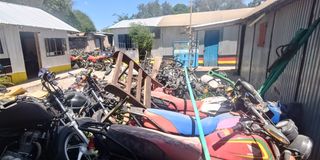
Motorcycles rotting at Kitengea police station, Isinya Sub-County, after the owners abandoned them for various reasons, including accidents and crime.
Photo credit: Stanley Ngotho| Nation Media Group
Boda bodas—commercial motorcycles—are a key mode of transport and a major source of income in Kenya.
The term originates from “border-border,” coined in Busia in 1988 when bicycles and later motorcycles were used to ferry goods and passengers between Uganda and Kenya.
A spot check at Kitengela Police Station on August 4 found about 70 motorcycles chained together and rusting away. Police records show they had been impounded for reasons ranging from traffic offences and accidents to involvement in crime.
Former Isinya Sub-County Police Commander Patrick Manyasi (now retired) explained that abandoned and unclaimed motorcycles are auctioned publicly after a judicial process—provided their owners cannot be traced and there are no ongoing court cases.
"The Officer Commanding Station informs the court of unclaimed property and requests disposal. After court approval, the assets are sold in public auction and the proceeds go to the State," said Mr Manyasi.
He claimed that the county has at least 1,500 motorcycles languishing in police yards, some victims of fake insurance, others allegedly held on trumped-up charges.
“Some officers buy up to five motorcycles for as little as Sh2,000 in secret auctions within police stations,” Mr Gitari alleged bitterly.
Kenya has over 3,000 police stations. If each holds about 30 motorcycles, that amounts to around 90,000 bikes nationwide—potentially generating Sh45 million daily and supporting 360,000 people.
Mr Gitari added that dwindling earnings have worsened the situation, with riders now making about Sh500 daily, down from Sh1,000 a few years ago.
The Boda Boda Safety Association of Kenya (BAK) 2024 data shows a motorcycle costs about Sh180,000 in cash but much more on instalments.
Boda-boda riders and other riders whose motorbikes were allegedly stolen were recently, search for their motorbikes during a display by police at Eldoret Police Station.
Photo credit: Jared Nyataya | Nation Media Group
A typical hire-purchase plan requires a Sh30,000 deposit, then Sh460 daily for 18 months for a 100–125cc bike (total Sh248,400) or Sh580 daily for a 150cc bike (total Sh331,200).
BAK National Chairperson Kelvin Bwire Mubadi acknowledged that some bikes are held for genuine offences but said most riders are victims of corrupt traffic officers.
“Some riders violate traffic rules and must be punished, but many motorcycles are held simply because the rider could not part with a Sh50 or Sh100 bribe,” said Mr Mubadi.
He warned that the practice is hurting the economy—reducing fuel sales and costing the government tax revenue.
Boda bodas consume fuel worth Sh300–Sh500 daily, translating to Sh300 million a day in sales, of which Sh163 million is taxes and levies.
Mr Mubadi has urged Inspector-General of Police Douglas Kanja to audit all motorcycles held in police stations and release those impounded for minor offences like cosmetic modifications.
“This is a double-edged sword. We have rogue police officers and rogue riders. It’s time to separate the wheat from the chaff to stabilise this multimillion-shilling industry, which contributes 3.4pecent tto Kenya’s GDP,” he said.
Motorcycles became widespread in Kenya after the late President Mwai Kibaki’s government zero-rated import duty in 2003, spurring explosive growth.
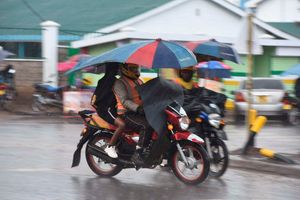
Motorbikes belonging to boda boda operators.
Photo credit: File | Nation Media Group
NTSA data shows 2,394,317 motorcycles were registered by 2022—a 1,777percent increase from 130,307 in 2008. The numbers surged to about 1 million by 2016, dipped to 246,705 in 2020, slightly rose to 285,203 in 2021, and hit 195,656 in 2023—a 16.7perent drop from the previous year.
Across East Africa, more than 5 million motorcycles are registered, with over 2 million in Kenya alone.
For Mr Omondi, however, those statistics are cold comfort. His motorcycle is gone, his debt remains, and his search for a new livelihood continues—one long, uncertain day at a time.
The move follows a closed-door meeting between President Ruto and boda boda officials drawn from across the country at State House on Thursday.
“Boda boda operators are legitimate entrepreneurs whose businesses must be supported,” President Ruto said. “We will work with all stakeholders to enact a law that embraces self-regulation to help spur the sector’s growth.”
The Head of State directed the Ministry of Interior and the Inspector-General of Police to oversee the release of the motorcycles within seven days, effectively granting amnesty to thousands of operators whose bikes have been held at police stations across the country-many for months or years without prosecution.
He has also pledged to push for the removal of taxes on motorcycles in a move he says will significantly lower their cost and make them more accessible to ordinary Kenyans.