How was this allowed to happen? This is the question that Kenyans are asking about the construction of a luxury hotel inside the Ngong Road Forest, which was started without the required approvals from the National Environment Management Authority (Nema).
A construction of this scale requires that the developer undertake an environmental impact assessment (EIA) and submit the report to Nema for approval. According to the authority, the assessment “ensures that appropriate safeguards, management and monitoring plans are put in place to protect public health and the environment and enhance sustainable development”.
Nema states that public participation is a mandatory part of the EIA. The consultant undertaking the process must show proof in the form of attendance lists, questionnaires and meeting minutes.
Yet Mr Peter Oluoch, the consultant contracted by Konyon Company Ltd—the contractor behind the construction of the eco-lodge camps—to undertake the environmental and social impact assessment, publicly admitted that the development does not have a green light from Nema.
“We did a report and submitted it to Nema for decision-making. Up to date, I want to confirm that Nema has not issued any license,” he said.
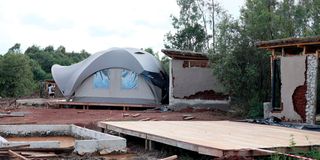
Construction site of a luxury camping facility hotel in Ngong Road Forest, Nairobi, pictured on May 27, 2025.
Photo credit: Bonface Bogita | Nation
Mr Oluoch apologised for not undertaking public participation, but downplayed its need since the project was not “high risk”.
Yet, a few metres from one of the forest gates and close to the ongoing construction of the Talanta City stadium, a line of structures is beginning to take shape on a grassy open field. Eight frames sit in a row, with two more slightly below. In between them, a finished demo tented camp offers a glimpse into what the facility will look like.
The compound itself stands as undeniable proof of a construction site, with scattered materials—from timber planks to piles of stones. Notably, large rolls of tent fabric are already on site, hinting at the scale and luxury that the project promises. Outside each of the structures is a mini pool, not too large for a swimming pool and not too small for a bathtub.
In a meeting held on Tuesday inside one of the halls on the Kenya Forest Service (KFS) grounds at the forest, it was clear the development was unwelcome.
The atmosphere in the room was tense. Voices rose in waves. People swore, cursed at one another while invoking God’s name, and spat out their displeasure. It was not chaotic; it was fervent energy.
And when the convener asked for questions, dozens of hands went up.
“I think the project started last year, it is now seven months down the road that we are having the consultative meeting. Are we here to legalise the project?” a member of the audience asked.
At the bare minimum, residents of the area, environmentalists and some members of the community forest association demand that the entire process start afresh. They argue that the development is illegal and, in their words, null and void.
On one hand, the residents and community forest association members feel blindsided, saying that there was no public participation. They say they were never consulted, and now, a project they never agreed to is taking root at their doorstep.
Construction site of a luxury camping facility hotel in Ngong Road Forest, Nairobi, pictured on May 27, 2025.
Photo credit: Bonface Bogita | Nation
On the other hand, environmentalists are raising an alarm, questioning the government’s decision to allow a private developer into the heart of the forest. They argue that this site is not just any land—it’s an ecological haven, home to sensitive biodiversity that could be irreparably harmed by such a development.
“They are saying that they are constructing the eco-lodge on bare ground. What about the fauna and flora? Did they follow the policies under the International Code of Nomenclature for algae, fungi and plants? If that was not followed, then that project should be cancelled,” argued Lawrence Rapando, an environmental expert, as he poked holes into the presentation by Mr Oluoch.
But, there were even bigger questions. Who is the face behind the company constructing the lodges? Why the rapid timeline, such that in just seven months since applying to KFS for a licence in October last year, construction had already begun?
The site occupies five acres of the 1,224-acre forest. Initially, the reserve had a total acreage of 2,850, but excisions and infrastructural developments have eaten into it.
So, when Mr Vijay Gollarahalli rose during the consultative meeting and introduced himself as a consultant for Konyon, the room went quiet. It was the first time KFS had publicly acknowledged the company behind the tented camp. All eyes were on him.
But he didn’t have the answers. Much like the EAI expert, he quickly distanced himself from the company, claiming he was merely a consultant with no decision-making power.
A search by the Nation for Konyon ownership reveals that it was registered on April 8, 2005. The company certificate shows that the directorship and shareholding are linked to former Bomet East constituency MP Beatrice Cherono Kones.
The former MP holds 500 shares in the company, the same number held by her daughter, Yvonne Chepkirui Kones. Yvonne, who has previously been involved in land tussles, is married to Belgut MP Nelson Koech.
On the sidelines of the consultative meeting, Mr Vijay told the Nation that he was an Indian national, only contracted as a hospitality consultant. “It is the first project I am consulting for in Kenya. I met the company’s representatives last year during a trade expo in the USA.”
According to Mr Vijay, who prides himself on having consulted for different clients worldwide on such projects, this development was poised to be sustainable and eco-friendly. Featuring 10 units, a hexadome restaurant and relaxation facilities like a yoga deck and wellness unit, the entire experience, in his telling, was meant to immerse guests in the sights and sounds of the wilderness.
“We will also consider installing green walls, rooftop gardens or wildlife ponds to enhance local biodiversity. We are also committed to teaming up with local conservation organisations and community groups to support their efforts in protecting and preserving the environment,” explained Mr Vijay.
“The only place where we probably will use a little bit of concrete is to construct the kitchen and the food production area. The material used for the ‘glamping’ resort is a high-tensile strength aluminium alloy frame, and the Ferrari material for the cover of the glamping tents. All these are chemical-free and certified,” he added.
The project may be suspended, but KFS appears unfazed, brushing off the controversy as nothing more than a small issue that’s been blown out of proportion.
To this, KFS deputy chief conservator of forests, Ms Beatrice Mbula, said no one had asked them to do anything.
“We have the name of the company. For me, that’s enough. You can be a person, a company or a corporation, maybe I will find out,” she responded.
Given the controversies surrounding this development, almost every speaker, whether a resident or an environmentalist, who spoke, had a question. How did KFS grant a license to Konyon in the first place? Was the area up for bidding, and if yes, were there other bidders?
“We work through a legal framework of ecotourism development in the public forest. The guiding laws and procedures for approving the development of an ecosystem facility in public forests are in the Forest Conservation and Management Act 2016, which is a public document,” Mr John Njoroge, a licensing officer at KFS, told the audience on Tuesday.
In defence of the move, and issuing a direct rebuttal to environmentalists who opposed any construction within a forest, he quoted a subsection of the Act.
“... the Forest Management and Conservation Act, it says, ‘the service provides that in consultation with relevant stakeholders, develop programmes for tourism and recreational and ceremonial use for public forest’.”
According to Mr Njoroge, the allocation of five acres to build the tented camp is anchored on a management plan that all forests have.
“In consultation with stakeholders, we developed the Ngong Road forest management plan, which runs from 2024 to 2029. In here, it says that the service has further developed an ecotourism development plan,” he explained.
It was on that basis, he said, that Konyon made a request to KFS for the issuance of a special user license to set up the eco-lodge camp in the forest.
“An assessment was conducted, and a technical report submitted to the management for decision making. The technical recommendation was that the site measuring five acres was suitable for the establishment of a forest camp with minimum negative impacts to the environment,” Mr Njoroge said.
After considering the request, the proponent, who KFS did not confirm to be Konyon, was required to submit a bill of quantity and submit the report to Nema.
Construction site of a luxury camping facility hotel in Ngong Road Forest, Nairobi, pictured on May 27, 2025.
Photo credit: Bonface Bogita | Nation
“The report was submitted to the board with the above-mentioned documents for consideration and determination. They considered and approved the request on January 21, 2025, at the Kenya Forest Service headquarters ICT boardroom. The special user’s license was issued on February 3, 2025, upon settlement of the fees,” he said.
According to Ms Mbula, Konyon applied for an early entry and was considered.
“Early entry means you can start the project as you do other things. Because the special license gives you six months to do the EIA. We saw the proponent was on track,” she told the audience.
While defending KFS, she emphasised that the agency was not showing any favouritism toward Konyon and had previously approved another proponent who was unable to pay the required fees. Ms Mbula said that Konyon representatives were invited to the consultative meeting but did not show up.
“As custodians of Kenya’s forests and heirs to the legacy of Prof Wangari Maathai, we will not stand by as our forests are sacrificed for private greed. We are actively exploring legal options to stop this development and protect Ngong Road Forest from irreversible degradation,” said the Green Belt Movement in a statement.