Grade 9 learners will be placed in senior schools starting Monday using the County Revenue Allocation (CRA) formula, currently used to distribute funds to the 47 counties, in a fresh plan the ministry says will ensure fairness, equity, and transparency.
The new plan, to replace the 8-4-4 system, focuses on several key factors: Population, learner performance, poverty levels, distance to schools, and the size and infrastructure of schools are taken into account in the placement system.
This means bigger counties like Nairobi, Nakuru, and Kakamega are likely to get more slots.
Under the old 8-4-4 system, learners were placed in schools based largely on their Kenya Certificate of Primary Education (KCPE) scores.
National schools and other top-ranked institutions enjoyed a strong advantage, and competition was intense, which often left students from marginalised counties at a disadvantage, as placements tended to favour those with higher scores or proximity to top schools.
Under the new formula, 42 per cent of the placement consideration is based on county population, allowing larger counties to receive a proportionate number of slots.
Learner performance contributes 22 per cent, reflecting academic results such as KCSE scores to place students according to merit.
Poverty levels account for 14 per cent, ensuring that learners from marginalised or economically disadvantaged areas are given support. Distance to school makes up 13 per cent, reducing travel barriers and promoting accessibility. Finally, school size and infrastructure contribute 9 per cent, helping to match students to schools that have adequate facilities to accommodate them.
Top performers at Hekima School Kisumu celebrate after results of the 2025 Kenya Junior School Education Assessment were released on December 11, 2025.
Photo credit: Alex Odhiambo | Nation Media Group
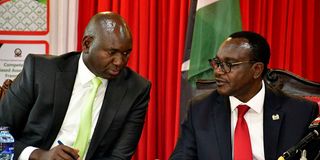
“To ensure fairness in placement across the country. We have adopted the CRA formula of revenue allocation to be able to distribute as fairly as possible students from across all counties in all the four categories of schools so that a child from Northern Kenya can be able to access or get an opportunity, same as a child in maybe Western, to join a school in Nairobi or any part of the country,” Basic Education Principal Secretary Prof Julius Bitok said on Thursday when the Grade 9 Kenya Junior School Education Assessment (KJSEA) results were announced.
The ministry is also banking on the extra class—given senior schools will only have three classes instead of the four secondary schools have always had—to ensure 100 per cent transition.
“The total capacity of the 9,540 Senior Schools is 2.2 million learners. A total of 929,262 learners will be exiting secondary school after KCSE this year. Senior Schools will have an extra classroom(s) left by the fact that we will only have three classes at this level. These classrooms are expected to provide extra space, enabling us to avoid overcrowding,” Education Cabinet Secretary Julius Ogamba said on Thursday.
And on Saturday, Mr Ogamba defended the results and the pace of change.
“All those students, all those graduates, will be in class by the 12th of January, 2026,” he said, adding that concerns from parents and teachers about the pace of change were expected. “All those who are having challenges in adjusting to the new system, it will take time, but we will get there.”
Mr Ogamba dismissed the notion of failure under the new grading model, arguing that the assessment is designed to measure individual progress rather than rank learners against one another.
“All the students passed these exams,” he said. “What is important is that we are trying to measure each one’s expectations. So you cannot say that there is someone who has failed.”
He said the framework allows learners to pursue different pathways based on their strengths, including arts and social sciences, science and technology, or sports.
“You may not be able to meet everyone’s expectations, but the competition is between the child and themselves,” he said. “In your class, you have the capacity to do a pathway in the arts, or STEM (Science, Technology, Engineering and Mathematics).”
He also sought to reassure families worried about placement and continuity: “We anticipate a lot of opportunities for them. As far as we are concerned, we are encouraging pathways so that by the time you are in high school, you already know where you are headed — by the time you are in high school, you are an engineer.”
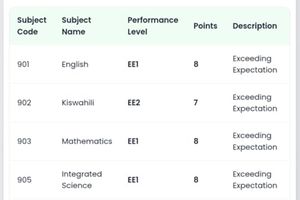
For the first time, learners will be placed in senior schools using the Competency-Based Education (CBE) after the release of the 2025 results.
Florentia Mwango, who scored 71 points, celebrates with her family and teachers at Anestar Prestige Academy in Nakuru County after results of the 2025 Kenya Junior School Education Assessment were released on December 11, 2025.
Photo credit: Boniface Mwangi | Nation Media Group
The CBE also introduces pathways, which guide where students will go: STEM, social sciences, or arts and sports. Top performers will have priority for boarding schools and national schools, while learners who score highest in each track can choose the school they want.
Learners will be placed in senior schools based on a new system that groups schools into clusters. Cluster 1 schools, which correspond to the former national schools under the 8-4-4 system, will offer all three learning pathways: STEM, Social Sciences, and Arts & Sports. Day schools, however, will offer only two of these pathways.
Students have already indicated their preferred schools in a 12-choice selection. Among these, nine schools are boarding institutions—three from the learner’s home county and six from outside their county of residence. The remaining three schools are day schools located within the learner’s home sub-county.
Some schools, particularly those that do not participate in open placements, will allow learners to pre-select them before the official placement process begins. This system aims to balance choice, accessibility, and the new pathway-based learning model.
According to the ministry's document, all schools, both public and private, will admit Grade 10 learners through the Nemis portal and principals will not be allowed to enter a learner into the system before they report to the school physically. The ministry will monitor reporting of the learners daily.
Prof Bitok promised that all learners are expected to know their senior school placement by end of next week, after which the ministry will open a five-day revision window.
“By next week, all students will know where they have been placed, and we will have a five-day window for revisions, similar to the way Kenya Universities and Colleges Central Placement Service allows university students to adjust their choices. The process will be seamless,” Prof Bitok said on Thursday.
Natasha Kinya (left) and Wamuyu Mwangi (right) both from Juja St Peter's School celebrate with family in Nakuru City on December 11, 2025 after they scored 69 and 68 points respectively in this year's Kenya Junior School Education Assessment results.
Photo credit: Boniface Mwangi | Nation Media Group
Kenya Institute of Curriculum Development Director Charles Ong'ondo urged teachers, parents and guardians to engage the learners in meaningful discussions on their career path choices once the KJSEA results are released.
"Because they will now have their results, let's talk to them together with their parents to help them make well-thought-out decisions. We are in discussions at the stakeholder level to allow children some time to revise what they had earlier chosen, "Prof Ong'ondo said.
But despite the ministry’s assurance that there will be no ranking, the popularity of national schools, now classified as C1 institutions, is expected to create fierce competition.
"I’m a bit lost with this new system. Before, we just looked at marks and knew where our children could go. National schools are very popular, and even with no ranking, I know the competition will be tough. Now with this CRA formula and all these factors like merit and equity, I honestly don’t know how it will work or if my child will get a school that suits them." said Peter Ochieng, a parent from Kisumu.