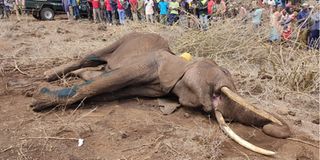
The County Government of Kajiado has challenged the Kenya Wildlife Service's account of the recent elephant deaths in the Amboseli ecosystem, disputing the number of animals that died between June 24 and July 24, 2026, and calling for an independent investigation into the incident.
In a statement, the county, through its Department of Tourism and Wildlife, declared the incident a One Health emergency, warning that its implications extend beyond wildlife conservation to public health, livestock, biodiversity, food security, water resources and the livelihoods of communities that depend on the Amboseli ecosystem.
On July 29, the Kenya Wildlife Service (KWS) broke its silence, revealing that the 15 animals — female adults, their calves and a single male elephant — had died from cyanide poisoning, pointing to agricultural chemicals as the likely cause of the deaths.
Speaking to Nation's Fixing the Nation during World Ranger Day at Tsavo West National Park on Friday, July 31, KWS Director-General Erustus Kanga said preliminary laboratory analysis of samples collected from the carcasses detected traces of cyanide in their digestive systems.
Prof Kanga said that, according to the post-mortem examination report by KWS veterinarians, the animals had ingested pesticides sprayed on nearby tomato farms within Amboseli National Park, Kimana Sanctuary and the Kuku Group Ranch area, where the deaths occurred.
However, after days of silence following the alarm over the elephant deaths, the County Government of Kajiado has come out strongly to challenge KWS's account.
The county argues that the incident extends far beyond the loss of wildlife. It represents a serious concern with potential implications for public health, livestock, biodiversity, tourism, food security, water resources, rural livelihoods and the ecological balance that sustains communities and wildlife across the Amboseli ecosystem. It also suggests the death toll could be higher.
"While fifteen elephant deaths have been confirmed, the possibility remains that the full extent of the mortality may yet be established. We must therefore act with urgency, responsibility and unity as investigations continue to determine the circumstances and underlying cause of this tragedy," read part of the statement signed by Tourism and Wildlife CECM Jeremiah Ole Ncharo.
The county is demanding an independent investigation conducted to the highest standards of rigor, transparency and independence to establish the true cause of the elephant deaths. They suggest the probe should not be limited to cyanide but should extend to a broad range of potential chemical and environmental contaminants, including cyanide and its metabolites, agrochemicals, pesticides, heavy metals, naturally occurring toxins and any other hazardous substances that may have contributed to the deaths.
"Investigators should also reconstruct elephant movements using GPS collar data, ranger patrol records and verified community observations to determine the most likely source, timing and pathway of exposure. The conclusions of this investigation must ultimately be guided by evidence, verified findings and a transparent review process,” said Mr Ole Ncharo.
Further, the county has called upon the National Government to immediately establish an independent multi-agency incident command team to lead and coordinate the response. The team should bring together relevant institutions responsible for wildlife management, environmental protection, pesticide regulation, veterinary services, public health, forensic investigations, water resource management and plant health regulation, together with independent experts and representatives of affected communities and conservancies.
The department has expressed serious concern regarding the measures taken to secure affected sites following the reported elephant deaths and the need to ensure that all potential exposure areas and evidence are properly protected. It also says that, despite samples having been collected several weeks ago, laboratory findings have not yet been communicated. Timely analysis and reporting are critical to preserving evidence, reducing uncertainty and determining whether any ongoing risk remains.
"The County Government expresses serious concern regarding the measures taken to secure affected sites following the reported elephant deaths and the need to ensure that all potential exposure areas and evidence are properly protected. It is also concerned that, despite samples having been collected several weeks ago, laboratory findings have not yet been communicated. Timely analysis and reporting are critical to preserving evidence, reducing uncertainty and determining whether any ongoing risk remains, “Added Ole Ncharo.
The devolved unit wants agricultural activities within the affected landscape to be assessed objectively and without prejudice. It says regulatory authorities should undertake comprehensive reviews of agrovet outlets, distributors and pesticide supply chains to determine whether counterfeit, unregistered, adulterated or illegally decanted chemical products may have entered the food chain and subsequently affected the wider ecosystem that sustains pastoral livelihoods, wildlife, water resources and ecological food chains.
"Once the source and pathway of contamination have been conclusively established, the County proposes a raft of measures that includes strengthening pesticide management systems, establishing appropriate buffer zones along wildlife corridors, rivers and protected area boundaries, promoting Integrated Pest Management (IPM)," said Ole Ncharo.
On Wednesday, individuals who had spoken to the Nation's investigation in confidence suggested the animals had been killed as a sign of "silent protest" over the delayed transition of the park's management from KWS to the County Government of Kajiado.
Three days before President William Ruto handed the Amboseli National Park transfer deed to the County Government of Kajiado on November 14, 2025, before thousands of residents, conservation activists lodged a petition at the Nairobi High Court challenging the move, setting the stage for a fresh legal battle over one of Kenya's most iconic wildlife parks. Under a revenue-sharing formula, the County Government of Kajiado was expected to take over management of the park on July 1, 2026.
Case No E737 of 2025 is active at the Milimani High Court before Justice Gregory Mutai, pending hearing and determination.
Over the years, Amboseli National Park in Kajiado County, which covers 392 square kilometers, derives its name from the Maasai word Empusel, meaning "salty, dusty place" in the Maa language. It remains one of the country's premier tourist destinations and a major economic pillar both nationally and for the local community. At least 80 per cent of the wildlife lives outside the park. Animals surveillance has been intensified after the incident.