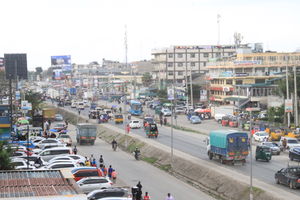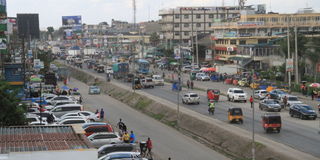
Aerial view of Kitengela town.

A fortnight ago, when Jacinta Wamiti, 42, lost her father at a private hospital in Ong’ata Rongai following a freak road accident, she wanted his body preserved in a private mortuary. Instead, she was referred to a facility on Thika Road in neghbouring Nairobi County.
Ms Wamiti's story is one that has befallen many bereaved families living in the populous Kajiado County, which has towns like Ngong, Kiserian, Ong’ata Rongai, Kitengela and Kajiado town.
Surprisingly, despite morgue services being in high demand, records from the Kajiado County Department of Health show that there isn't a single private mortuary or health facility offering this to the bereaved.
The growing population of the county depends on overstretched public facilities including the Kajiado Referral Hospital Morgue, which has a cold room capacity of just 24 bodies. Kitengela, Ong’ata Rongai and Ngong Sub-County hospitals each have morgues with a capacity of 12 bodies. The vast Kajiado South Sub-County is served by a single 24-body capacity mortuary at Loitokitok Sub-County Hospital.
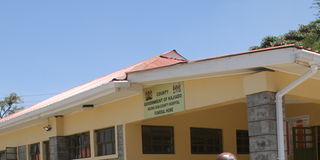
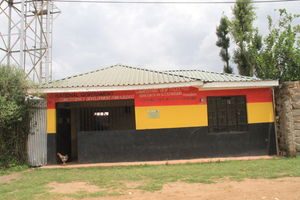
Ongata Rongai Sub-County Hospital Mortuary.
For this reason, Kajiado residents often seek private mortuary services in Makueni, Nairobi or Machakos counties, which are several kilometres away, thus incurring additional transport and logistical costs.
“Considering the private facility where my dad died only had a temporary body holding store, we had either to move the body to a public morgue or ferry it to a private morgue in Nairobi. We opted for the latter. The time is ripe for such facilities,” said Ms Wamiti.
She added: “The private funeral home dispatched a hearse for an extra fee to collect the body. Despite the additional cost, body preservation is key for a loved one.”
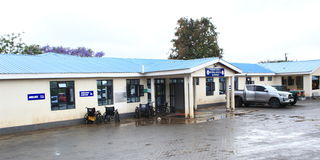
The Kajiado Referral Hospital.
Following public outcry over this gap, Ngong and Ong’ata Rongai funeral homes were commissioned in 2024. They charge a preservation fee of Sh600 per day and an embalming fee of Sh2,500, excluding dressing and autopsy charges.
The charges
Private morgues within the Nairobi metropolitan area generally charge between Sh2,000 and Sh2,500 per day for body preservation. These costs are in addition to initial mortuary fees, embalming and preparation charges.
Embalming is charged at approximately Sh5,000 depending on the condition of the body. Washing and dressing is between Sh1,500 and Sh2,800. Some private morgues offer in-chapel services at around Sh2,000 per hour, with additional charges for viewing before burial, making it a lucrative investment.
Kajiado County has a rapidly growing population, with the 2019 census putting it at 1,117,840 people. By 2024, projections indicated it would increase to about 1,298,000.
Cultural myths, barriers
Aerial view of Kitengela town.
Yet, despite the growing population and need for private morgue services, cultural myths associated with death and poor infrastructure are seen as deterrents to investors, despite the county having plenty of land suitable for such a business.
For instance, community elder Stephen Nkabashi, 67, told the Nation that the Maa community has long held beliefs against profiting from death.
“Despite modern shifts to Christianity and contemporary lifestyles, the Maa community is generally opposed to profiting from the dead. Elders won't allow the construction of a morgue in their neighbourhood. However, the trend is slowly changing, considering we now have people selling coffins in satellite towns and near public hospitals,” he said.
Opposed morgue
Mr Wilson Karoi, a retired chief, said that in the 1990s the local community opposed the construction of a morgue in Kitengela town, which later became a supermarket.
“The investor who had dared to dream big is now said to own a high-end private mortuary in Nairobi. The idea of the first middle-class private mortuary was arguably conceived in Kitengela, but it materialised in Nairobi,” he said.
“The Kajiado satellite towns are fertile ground for such investments, but past resistance and limited exposure have made investors adopt a wait-and-see approach,” he adds.
Kajiado County Executive Committee Member for Health, Mr Alex Kilowua, said the department is partnering with development partners to improve existing public mortuaries.
He said the need for modern mortuary facilities outweighs traditional beliefs and myths in the 21st century, especially in a cosmopolitan county like Kajiado.
“The health department is moving to upgrade existing public mortuaries and increase capacity. With the population surge, we welcome private investors, especially in satellite towns. The construction of Ong’ata Rongai and Ngong mortuaries faced resistance from some locals, but we had to explain their importance as medical facilities,” said Mr Kilowua.
Follow our WhatsApp channel for breaking news updates and more stories like this.