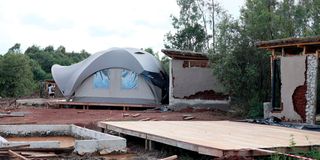
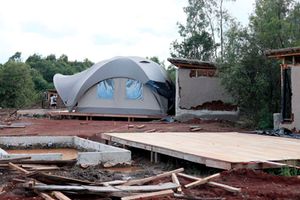
Members of Parliament have outlined at least six questions they want the Ministry of Environment and Forestry to answer over the building of a luxury hotel inside Ngong Forest.
As the lawmakers, who sit in the National Assembly Environment, Forestry and Mining Committee, plan to visit the forest next week, they want to know how Konyon Company Ltd was granted a special licence to build a hotel in the forest.
The committee, chaired by Mwala MP Vincent Musyoka, claimed that Konyon Company Ltd got the licence because it is owned by well-connected individuals.
The lawmakers want a detailed explanation of the processes followed both by the ministry at the national level and by the Kenya Forest Service (KFS) in granting permission to Konyon Company Ltd.
“Our forests have been attacked by people who are well connected. The reason Konyon Company was given the licence—because the area doesn’t have trees—does not arise, because even shrubs are part of the forest,” said Kacheliba MP Titus Lotee.
Secondly, the committee wants the ministry to provide a detailed report on whether there are other countries that have successfully allowed the building of various amenities in their forests and made financial gains from it.
“Do we have success stories in other jurisdictions that we can use as a basis in this case?” asked Mr Musyoka.
Construction site of a luxury camping facility hotel in Ngong Road Forest, Nairobi, pictured on May 27, 2025.
Photo credit: Bonface Bogita | Nation
In the third question, the committee wants both the ministry and KFS to clarify whether environmental concerns raised by various stakeholders—and the impact environmental assessment report by the National Environment Management Authority (Nema)—were considered before Konyon was granted the licence to proceed with the project.
During a meeting with Cabinet Secretary for Environment, Climate Change and Forestry Deborah Barasa on Thursday, Turkana Central MP Joseph Emathe claimed that all the environmental concerns raised by stakeholders before the project began were ignored by both the ministry and KFS.
The fourth question on the table is evidence that Konyon Company Ltd paid the special licence fee that had apparently locked out the Green Belt Movement from establishing a site for a children’s museum consisting of an exhibition pavilion, walkways, picnic areas, a café, and a museum shop.
Documents tabled before the committee indicate that in 2022, the Green Belt Movement (GBM) had applied to the Kenya Forest Service, which manages the forest, to establish a site for the museum.
The request, according to the documents, was approved on March 8, 2022, by the KFS board.
However, the Green Belt Movement did not pay the prerequisite fees and charges for issuance of the Special Use Licence and hence could not proceed with its intended plan.
It was upon the failure to pay this special licence fee that, in November 2024, the Kenya Forest Service received a Special Use License application from Konyon Company Ltd seeking to develop a unique glamping eco-lodge and wellness retreat.
Construction site of a luxury camping facility hotel in Ngong Road Forest, Nairobi, pictured on May 27, 2025.
Photo credit: Bonface Bogita | Nation
KFS conducted an appraisal of the area where the company wanted to construct the hotel and noted that it was covered with grass, scattered bushes, and shrubs.
Further, KFS—according to the documents—granted the request by Konyon Company because the site was not a water catchment area or water source. It also had no endangered species, no cultural or scientific attributes, and the materials that the company intended to use were deemed eco-friendly, hence expected to have minimal impact on the environment.
On January 21, 2025, the board reviewed and approved the request during a meeting held at the KFS headquarters. A conditional Special Use Licence (SUL) was issued on February 12, 2025.
However, on May 15, 2025, members of the public, the Green Belt Movement, and other institutions voiced concerns on social media over alleged encroachment into Ngong Forest for the proposed construction of a hotel, citing potential threats to the area’s flora and fauna.
The committee noted that what was conspicuously missing in the ministry documents was evidence that Konyon Company paid the special use licence fee that had locked GBM out of the deal.
“I don’t see any attachment here indicating that Konyon Company paid this fee. It is not in your documents before us. Mr Chairman, can we be shown that the fee was actually paid?” said Mr Emathe.
The committee also wants the ministry to provide a status report on what is happening in other forests in the country, and more specifically, Karura Forest.
Lastly, the committee wants the ministry to explain why it deviated from the government’s plan to plant 15 billion trees and instead granted permission to build a hotel in an area they deemed to have no trees.
“We owe it to the coming generation—the Gen Zs—that we need to conserve our forests. But it is sad that we are now not planting trees; we are building hotels,” said Njoro MP Charity Kathambi.
This question arose after PS Gitonga Mugambi, who accompanied the Cabinet Secretary, defended the building of the hotel in the forest, saying it was being done in an area with minimal tree cover.
“We target the areas without trees because we also need to create jobs for our people,” Mr Mugambi said.