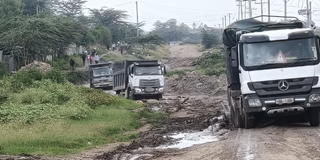
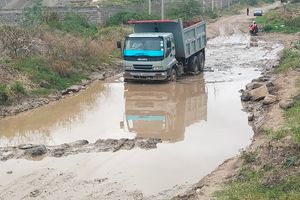
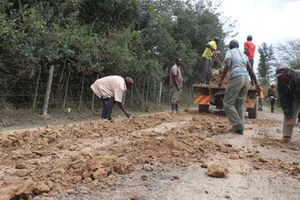
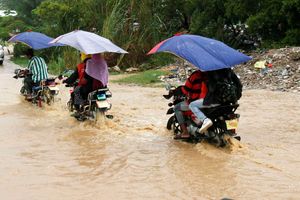
In the afternoon of May 5, 2026, dozens of trucks laden with cement-making raw materials inched along the flood-ravaged Kitengela–Ong’ata Rongai bypass in Kajiado East sub-County, their slow, grinding movement exposing the harsh reality of a road reduced to a muddy, potholed stretch after years of neglect.
For over a decade, gaping potholes have turned the road into a nightmare for both locals and transporters of construction materials. The ongoing rains have worsened the situation, temporarily cutting off some villages along the road.
During each electioneering period, both local and national politicians use the Ong'ata Rongai–Kitengela bypass as a campaign tool that locals claim evaporates into thin air after the elections.
"This road has been a masterstroke card for politicians every five years. It is a major economic artery that has the potential to bolster the entire region in dozens of ways. Still, our leaders continue to abandon it," said Nancy Macharia, a Noonkopir resident.
The 30-kilometre road connects the rapidly growing town of Kitengela in Kajiado East sub-County to Ong'ata Rongai township in Kajiado North Sub-County. It extends to parts of Machakos County in the Embakasi neighbourhood.
Trucks ferrying cement-making raw material and other construction materials wade along a deplorable, muddy Kitengela-Og'ata Rongai bypass on May 5, 2026.
Photo credit: Stanley Ngotho| Nation Media Group
It also connects to dozens of quarries for quarry stones and pozzolana—key ingredients for cement processing—in both Sholinke and Nkurunka villages. Most cement processors outsource pozzolana from these areas.
The road further runs parallel to the Nairobi National Park boundary and the Standard Gauge Railway (SGR) line to the Tuala neighbourhood. It snakes past African Nazarene University to the SGR Ong'ata Rongai station, extending to Limpa and finally connecting to Magadi Road.
However, following years of unfulfilled promises by the national government, construction materials producers are reportedly suffering reduced business as investors relocate due to high transport costs and frequent truck breakdowns.
According to records, the road was last rehabilitated by the Kenya Rural Roads Authority (Kerra) in 2014 for Sh232 million through the Ministry of Nairobi Metropolitan.
In early 2025, when the Nation first highlighted the locals' anguish, the tarmacking of the road had been advertised several times by both Kerra and the Kenya Urban Roads Authority (KURA) over a decade before hitting a snag. The road is classified as a Class C road under Kerra
Kajiado County Resident Engineer Washington Mugambi maintains that the tarmacking of the road has been hindered by a lack of funding allocation over the past three financial years, with the project initially estimated at Sh1.56 billion.
A spot check by the Nation on Tuesday indicated the road was in a pathetic state, with no signs of imminent tarmacking. Early in 2025, the Nation had highlighted the residents' plight, but the road has deteriorated further. It is currently impassable in some sections, prompting transporters to trespass onto private land at a fee of between Sh100 and Sh200 per trip, depending on how many parcels are crossed.
In one stretch, John Mulwa, a truck driver, sat helplessly by the roadside after his truck’s springs snapped. The wheels were fully submerged in mud. It was his third similar mishap in a fortnight, he said.
The deplorable, muddy Kitengela-Og'ata Rongai bypass on May 5, 2026.
Photo credit: Stanley Ngotho| Nation Media Group
"Ferrying raw materials along this road has become untenable. No mechanic is willing to come and fix trucks due to the high volumes of mud. I was supposed to make three trips, but I am not sure I will make even one today," said a dejected Mulwa.
Most truck drivers who spoke to the Nation said the number of trips per day has reduced from five to two due to the deplorable condition of the road.
At least 400 trucks ply the route daily. The Kajiado County Government charges Sh1,600 per truck ferrying pozzolana and Sh500 for trucks ferrying other building materials. The trucks operate six days a week—Monday to Saturday.
Mr Jeremiah Kaloi, Athi River Ward MCA, said hundreds of residents living along the bypass sometimes use stone-laden trucks for transport to either Kitengela or Ong'ata Rongai towns, risking their lives, as no PSV vehicles ply the route. The only alternative is the expensive and time-consuming Kitengela–Nairobi–Ong'ata Rongai route.
"We have always expected our proximity to Nairobi to give us a head start in property value, but the bad road has been a major deterrent. A good road remains a key artery for regional growth—that is what is lacking," said Kaloi.
Trucks ferrying cement-making raw material and other construction materials wade along a deplorable, muddy Kitengela-Og'ata Rongai bypass on May 5, 2026.
Photo credit: Stanley Ngotho| Nation Media Group
Mr Sawe Rotich said the economic backbone of both expansive Nkurunka and Sholinke villages, which stretch from Kitengela township to Ong'ata Rongai, is quarrying. The area boasts some of the largest stone and pozzolana quarries in the county.
"The brisk stone and pozzolana business is on the verge of collapse, dashing hopes for hundreds of families that depend on it. Political goodwill is missing, extending locals' suffering," said Rotich.
The road is significant to the Kajiado County Government, as multiple landowners along the route have turned parts of their land into quarries. The county charges a minimum of Sh100,000 annually per quarry as an operating fee.
On February 28, 2026, President William Ruto, while attending a homecoming ceremony for the Principal Secretary for Justice and Constitution in Mashuru, promised that the bypass was among the major roads his administration would prioritise after persistent appeals from local leaders. He also pledged the reconstruction of the equally deplorable Isara–Imaroro Road, which was previously tarmacked by the Jubilee administration.