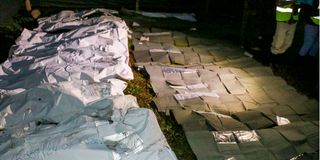
Detectives have also widened investigations to Nyamira County, where they are probing burial records in what could be a case linked to the Kericho incident.
Government pathologist Dr Richard Njoroge on Thursday said that 25 children’s bodies had already undergone autopsy.
“We will conduct autopsies on Friday on the remaining eight bodies and the six body parts that were exhumed on Tuesday,” Dr Njoroge said.
He revealed that some of the children’s bodies were fresh, while others were at advanced stages of decomposition.
“There were 10 female bodies, eight male, while the gender of seven could not be immediately determined,” he said.
Preliminary findings indicate that nine cases involved premature births and 10 were mature births. Four bodies had head injuries, while two cases were classified as having an unknown cause of death.
By Thursday, no one had come forward to claim the bodies or report missing persons, at least by press time.
Senior police officers in Kericho and Nyamira counties confirmed that no reports of missing persons had been filed in relation to the exhumed bodies.
“So far, as far as we are concerned, we have not received any report of a missing person in the county,” said Kericho East Sub-County Criminal Investigations Officer Martin Mwenda.
The developments have sparked calls for a broader probe into possible additional burials at Makaburini cemetery.
Nominated Senator Joyce Korir urged detectives to follow up on claims by grave diggers that more bodies had been buried at the site in previous months.
“Since it has become clear that the grave diggers were truthful about the burial of bodies at the cemetery, investigators should follow up on their claims that more bodies were disposed of there two months ago and last year,” she said.
She described the discovery as “heart-wrenching,” noting that the number of bodies recovered far exceeded initial reports.
The autopsies are being conducted at Kericho County Referral Hospital under tight security, with the Director of Homicide at the Directorate of Criminal Investigations (DCI), Martin Nyuguto, overseeing the process alongside detectives and Ministry of Health officials.
The exercise began at around 11am, with brief breaks taken for meals. Access to the mortuary remained restricted throughout the day, with controlled movement of people and vehicles.
Members of the public who had gone to collect the bodies of their loved ones experienced delays but were later allowed access in the afternoon.
Nakuru-based advocate Bernhard Kipkoech Ngetich said investigators must address critical questions, including the origin of the six mismatched body parts recovered.
“When a person dies, there must be a report and documentation by the Registrar of Births and Deaths. Where there is suspected foul play, a report should be made at a police station and a court order obtained. The manner in which these bodies were disposed of without following due process raises serious questions,” he said.
Mr Ngetich warned that the situation could point to serious crimes, including possible extrajudicial killings, human trafficking or even organ harvesting, particularly given the discovery of mismatched body parts.
“The state has a duty to inform the public about deaths, including advertising unclaimed bodies so that families can come forward. What we are seeing here suggests possible concealment of information,” he said.
On Wednesday, it also emerged that the mass grave had been left uncovered after the exhumation, with cartons of syringes reportedly found abandoned at the site by unknown individuals.
The case first came to light on Saturday when police reported that 14 bodies had been secretly buried at the cemetery, which is owned by the National Council of Churches of Kenya (NCCK), an organisation that has since denied knowledge of the burials.
However, after the DCI obtained court orders to exhume the bodies, investigators discovered 33 bodies, eight male adults, 25 children and six body parts, more than double the initial figure.
The discrepancy has raised serious concerns about possible failures or deliberate concealment within the system.
Investigations have since revealed that the bodies were stuffed into gunny bags, transported from Nyamira to Kericho in a government vehicle and buried in a mass grave without following legal procedures.
Two suspects Nyamira County public health officer David Araka Makori and Richard Towett, also known as Ezekiel, have been arrested and detained for 30 days to allow investigators to complete their inquiries.
Court documents indicate that the bodies were buried on March 20, 2026, with Nyamira County officials admitting that 13 bodies had been transferred to Kericho for burial.
However, it has since emerged that the burials were conducted without the required permits, in violation of the law.
Detectives are now investigating the authenticity of the public notices and court orders that allegedly authorised the burials, as the probe widens.