Sandwiched between Kericho’s central business district and the sprawling Nyagacho residential estate lies Makaburini cemetery.
The Tiony Soet River separates Nyagacho estate from the cemetery. On the eastern side stands a newly constructed three-storey residential house, while a perimeter wall is coming up a few metres away, an indication of ongoing development in the area.
Goats and sheep graze freely on the open fields as residents move to and from town using footpaths that cut across the cemetery, avoiding the official tarmac road running past Kiprugut Chumo Stadium and the main Kericho market. The scene reflects a bustling town in rural Kenya, still adjusting to rapid urbanisation that is steadily reshaping its way of life.
But a secret burial of 32 bodies over the weekend has thrust the cemetery into the national spotlight, with many questions about the circumstances surrounding the interment still unanswered.
The cemetery sits on two acres of land owned and managed by the National Council of Churches of Kenya (NCCK) since the 1970s.
It lies adjacent to another cemetery used by the Muslim community, while a few metres away is a cremation facility used by the Asian community.
It has since emerged that Kericho County does not have a public cemetery of its own, and residents largely rely on the NCCK-managed facility.
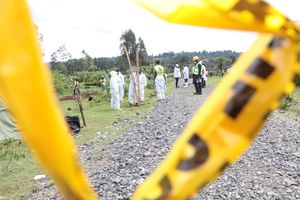
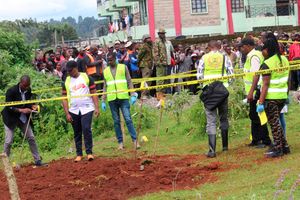
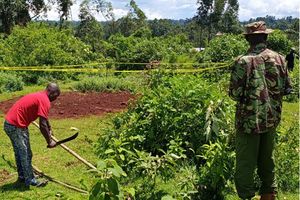
Police officers at Makaburini cemetery in Kericho that has been thrust into the national headlines after 14 bodies were buried in a mass grave, in this photo taken on March 24, 2026.
Photo credit: Vitalis Kimutai | Nation
“It is true, the county government of Kericho does not have a public cemetery in the town, which is its headquarters,” a senior county official said.
He added that the county only has a cemetery in Kapkatet, Bureti Constituency, which is rarely used by either the government or local residents.
“Members of the local community the Kipsigis sub-tribe of the Kalenjin do not bury their loved ones in cemeteries due to deep-rooted cultural beliefs. The bodies are buried in private farms belonging to the deceased or their relatives,” said Mr David Ngetich, a resident.
“It is considered taboo to bury someone in a cemetery as it is seen as abandoning the body. It is believed such a spirit may haunt family members,” he added.
As a result, setting aside land for a public cemetery was not prioritised during town planning under the defunct local authorities or even the current county government.
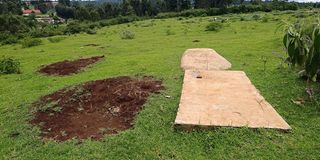
Freshly dug and covered graves dot the cemetery, alongside older burial sites some marked with tombstones, others with wooden inscriptions and many unmarked. Flowers scattered across the grounds indicate recent burials.
Reverend Andrew Tum of the Anglican Church in Kericho confirmed that the cemetery belongs to NCCK and that there are clear procedures governing burials at the facility.
“One must present the relevant government permits and demonstrate that the body intended for burial is that of their kin,” Reverend Tum said.
He explained that once the documentation is verified, a bill is issued and payment received before the caretaker is notified of the intended burial. The records are then filed at NCCK offices.
“The caretaker of the cemetery is informed after all documentation is confirmed and filed,” he added.
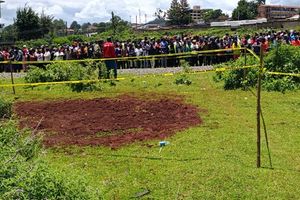
The Makaburini cemetery in Kericho, in this photo taken on March 24, 2026, overlooking Nyagacho estate (in the horizon), where 14 bodies were buried in a mass grave without legal documentation.
Photo credit: Vitalis Kimutai | Nation
Reverend Tum confirmed that the recent burial was conducted without NCCK’s approval and that the news caught officials by surprise.
It also emerged that families are free to hire gravediggers—usually youths who seek casual work around the cemetery.
On Sunday, Kericho Governor Erick Mutai said the county government would assist the church in fencing off the facility.
Bishop Allan Kiombe of Evangelical Jesus Centre said the incident has caused anxiety among residents amid conflicting claims.
“The national and county governments should quickly clear the air, especially in the context of past incidents like Shakahola. People are living in fear,” he said.
“NCCK has confirmed it was not involved in the burial. It is also taking too long for the government to exhume the bodies and conduct forensic investigations,” Bishop Kiombe said.
For the past four days, the area has remained under tight security, with police guarding the fresh mass grave ahead of the planned exhumation of the bodies.