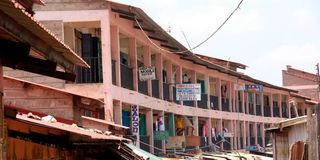
Kenya Railways has accused occupants of 229 housing units in Kibra’s Laini Saba of illegally occupying public property and subletting the houses for up to Sh20, 000 a month.
This could generate Sh4.58 million in monthly rental income as hundreds of families displaced by railway projects continue to wait for homes and business premises promised under a government resettlement programme.
Kenya Railways Corporation Managing Director and Chief Executive Officer Philip J. Mainga before the Senate Roads, Transportation and Housing Committee at Bunge Tower in Nairobi on October 14, 2026.
Photo credit: Dennis Onsongo | Nation Media Group
Managing Director Philip Mainga has told the Senate Standing Committee on Roads, Transportation and Housing that political interference and attacks by youths mobilised by local politicians had frustrated attempts to evict the alleged illegal occupants. Some of the occupants, he said, were subletting the units to other tenants while demanding additional houses.
“There is a lot of political interference in the area, and the moment we as KR go to evict the illegal occupants, we are attacked. It has become difficult for us,” Mr Mainga told the committee, accusing local politicians of mobilising youths to frustrate the corporation’s efforts.
Although the housing units were designed to provide affordable accommodation to displaced families at subsidised rents of between Sh500 and Sh1, 000 a month, Kenya Railways said some occupants were subletting them for as much as Sh20, 000 despite failing to pay the corporation even the Sh1, 000 monthly rent.
The allegations emerged as residents and traders displaced by Kenya Railways projects appealed to the committee, chaired by nominated Senator Hamida Kibwana, to intervene over stalled resettlement programmes, incomplete houses and inadequate trading facilities. This is years after the government embarked on a project intended to remove encroachment from railway land while providing alternative accommodation and business premises for affected families.
Mr Mainga said some occupants had sublet the houses to other individuals, creating a situation in which people allegedly occupying public housing unlawfully were earning rental income while legitimate beneficiaries remained without accommodation.
He described the situation as both a governance and security concern, arguing that the continued occupation of the railway reserve posed risks to residents and interfered with railway operations.
“The situation there is deplorable. We have told these people to get out of the railway line, but they have not adhered,” he said, warning of the danger posed to children and other residents living close to active railway tracks.
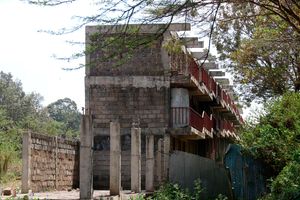
One of the housing units constructed by Kenya Railways in Laini Saba, Kibra, in this photo taken on March 22, 2022.
Photo credit: Lucy Wanjiru | Nation Media Group
“What is more painful? What will happen when a child will have their legs cut off? What if an accident happens on the rail? How many lives will we lose? Are we going to sit down and watch cartels benefiting at the expense of protecting human dignity?” he asked.
The corporation’s allegations come as the Senate examines complaints from residents and traders who say the resettlement programme has left hundreds of intended beneficiaries waiting for houses and business premises, with some of those already allocated units struggling with inadequate basic services.
The petitioners, led by Victor Wamae, told senators that, of the 1,432 residential occupants enumerated in Laini Saba, only 256 had received houses. Of the 833 business occupants identified, 583 had received stalls, leaving hundreds still awaiting resettlement.
Those who have not received houses continue to live in temporary or decanting sites, while some traders have been forced to conduct business in unsuitable locations, including areas close to roads and railway tracks.
Mr Wamae said some beneficiaries who had received houses were also living in deplorable conditions because the units lacked water and sewer connections, rendering basic sanitation facilities unusable.
“You know how to use the washroom. They can’t use the toilets because there is no sewer connection. There is no water, and that’s why some people have now even invaded those toilets and they are using the toilets as houses, as unbelievable as it sounds,” he told the committee.
The petitioners said some houses handed over under the Resettlement Action Plan remained incomplete, while traders complained that certain stalls were too small or poorly located to support their businesses.
But Mr Mainga defended the housing units, saying residents had been consulted throughout the construction process and had participated in decisions on the project’s design and implementation.
“These houses were done with consultation from the people. They were involved in the process step by step. It is now too late since the houses have already been constructed,” he said, arguing that the quality of the units was demonstrated by the number of civil servants living in them.
“There are a number of civil servants who stay in these houses because they are good. If you go there in the evening and see the cars parked there, then you will know what we are talking about,” he said.
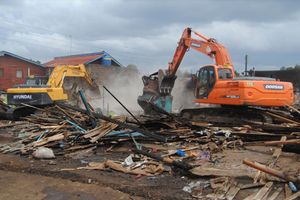
Houses constructed by Kenya Railways between Jamhuri and Ngando to house families evicted from railway corridors in Soweto East, Laini Saba and Mashimoni kibera, Nairobi in this photo taken on March 22, 2022.
Photo credit: Lucy Wanjiru | Nation Media Group
The petitioners also raised concerns over stalled Phase Two construction at Jamhuri, behind the Nairobi City County Inspectorate Trading Centre, saying the project had reportedly run out of funding and left traders who had won ballots stranded at the Magade decanting site.
Kenya Railways said the wider Kibera and Mukuru Resettlement Action Plan began in 2013 under the World Bank-funded East Africa Trade and Transport Facilitation Project, with the aim of removing encroachment from the railway reserve while providing alternative housing and business premises.
The programme targeted the construction of 4,380 residential units and 3,445 business units in the two informal settlements, alongside boundary walls, water and sanitation facilities, footbridges, underpasses, footpaths, two informal schools and 12 garages.
However, the World Bank programme’s credit period expired on September 30, 2015, when the project was approximately 85 percent complete, according to the corporation.
By 2020, 3,037 residential units and 1,990 business units had been completed, but the government subsequently advised that the project be closed because of inadequate budgetary allocations to finish the outstanding works.
Kenya Railways further told the committee that construction of relocation units in Laini Saba had been affected by court disputes filed by the contractor, delaying completion of the houses.
The corporation said it was collaborating with the State Department for Housing and Urban Development to complete the stalled units, while discussions were under way on constructing additional housing under the government’s social housing development programme.
Mr Mainga warned that extensive encroachment within the 60-metre railway reserve posed a major safety risk, obstructed railway operations and forced trains to move through the affected area at low speeds.
The committee called on Kenya Railways to provide a list of occupants of the housing units to establish who was entitled to remain and who should be evicted.
Marsabit Senator Mohammed Chute said the committee would work with the Inspector-General of Police to ensure that those found to be occupying the houses illegally were removed so that the units could be allocated to deserving beneficiaries.
“We need the MD to give us the list of the 209 occupants and the 20 occupants. We will work with the Inspector-General of Police to make sure that the people are evicted so that those who deserve the houses can get them,” he said.
The committee chairperson said the committee would visit the affected sites to establish the actual conditions on the ground before making an informed decision, including examining the state of the houses and the circumstances surrounding the residents’ complaints.