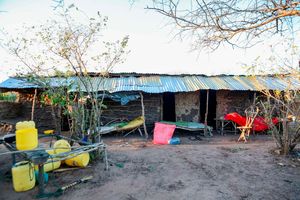
It was a few minutes past noon in the sleepy hamlet of Kwa Bi Nzaro, Kilifi County, when Kanze Kenga’s quiet afternoon turned into a moment that would expose one of the darkest secrets hidden in the bushes of Chakama Ranch.
She had just finished lunch when a stranger— a tall and lean man dressed in a white shirt and black trousers, and clutching a machete— knocked on her door.
He introduced himself as Jairus Otieno, and although he was a total stranger, the frantic phone call he was about to make using her mobile phone would set off a chain of events that peeled back the layers of mystery surrounding the Kwa Bi Nzaro sect.
A cordoned off area at Kwa Bi Nzaro where shallow graves were discovered.
Photo credit: Billy Ogada | Nation Media Group
“He asked for a phone, saying he had lost a friend in the forest. He tried calling twice with no success, but the third call went through. He spoke rapidly in Luo, a language I didn’t understand, but I could see he was deeply troubled,” recalls Kenga.
Otieno’s short conversation, the woman would later learn, was to his elder brother James Oduor back home in Siaya County.
Within minutes, shortly after Otieno left, Oduor called back, warning that his sibling was in grave danger— allegedly being pursued by disciples of Paul Mackenzie, the jailed preacher behind the Shakahola massacre that claimed more than 400 lives.
In the seven-minute call made on July 18 between 12:25 and 12:32 pm, Kenga said, Otieno revealed to Oduor that all his six children had died in the Kwa Bi Nzaro wilderness, echoing the horrors of Shakahola forest just a year earlier. Both crime scenes are within the Chakama Ranch.
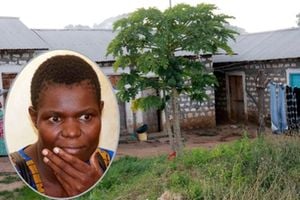
Residential houses at Kaoyeni Village in Malindi, Kilifi County, where the Kwa Bi Nzaro prime suspect Sharlyne Anindo Temba (inset) lived.
Photo credit: Kevin Odit | Nation Media Group
Kenga’s husband, Gona Charo, was away at the time these jarring calls were being made, but upon returning, she narrated what had transpired.
Charo immediately contacted Safari Kenga, a respected village elder, and shared Oduor’s number. Soon, Charo was on the phone with Oduor, who repeated Otieno’s claims.
“Otieno told his brother that his children were dead. To me, it felt like another Shakahola unfolding right here in Kwa Bi Nzaro,” Charo later told investigators.
Speaking to the Nation last week, Oduor described the desperation in his brother’s voice during that frantic call.
“When I received my brother’s call on July 18, I knew something was wrong,” he said in a phone interview with the Nation .
“I am his elder brother and he knows I am strict, so he feared me and did not fully open up. He just told me to help him leave the Shakahola Forest and that he was in trouble. I am glad he was found in Kwa Bi Nzaro before he died there,” he said.
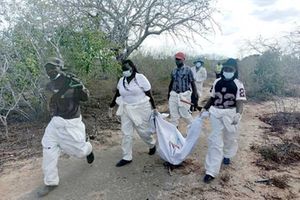
A homemade stretcher used to carry bodies of cult victims of Kwa Binzaro tragedy to the graves pictured on August 30, 2025.
Photo credit: Billy Ogada | Nation Media Group
According to Oduor, his brother left their Siaya home on March 30, 2025, with his wife Lucy Akinyi and their six children aged between one and 15. None survived.
“He told me all his children died in Kwa Bi Nzaro and he doesn’t even know where they were buried. We hope the DNA tests on the exhumed bodies will help us find them,” Oduor explained.
“They were not small children—the firstborn was 15, then 13, 10, six, four, and the youngest was one. Two boys and four girls, all gone.”
The grief of not knowing where the children were buried has left the family restless. In Luo culture, proper burial rites are central to closure.
“Our pain is doubled because we cannot even perform the last rites. In our tradition, you cannot heal until you know where your child lies. These children just vanished into the wilderness,” Oduor said.
During the interview, Oduor recounted how he had filed a missing-persons report at Siaya Police Station in April after discovering Otieno’s house turned upside down— an indicator that he had indeed left home, for good.
Morticians carry the remains of a person exhumed at Kwa Bi Nzaro village within the vast Chakama Ranch in Kilifi County on August 28, 2025 as part of investigations into a suspected cult.
Photo credit: Brian Charo | Nation Media Group
“When our mother heard he had joined a cult in Kwa Bi Nzaro, no one could believe it. It was devastating. We just want to get our children and bury them at home,” he said.
“He said when the sixth child died, he felt his soul breaking apart. That is when he resolved to escape and make that call back home,” Oduor said.
For Otieno, life in Kwa Bi Nzaro was suffocating. Investigations show that by the time of his arrest, he had already been sidelined for not being fully engaged in the sect’s teachings.
Armed with a machete, more for protection than violence, Otieno told Kenga that he slipped out of the compound and stumbled to Kanze’s house— his last hope.
“He was like a man who had seen death and was running from it,” Kenga said.
Back at Charo’s house on July 18, the entire household was shaken by Otieno’s revelations. Jointly, Charo, his kin Karisa Gona, and elder Safari Kenga decided to act.
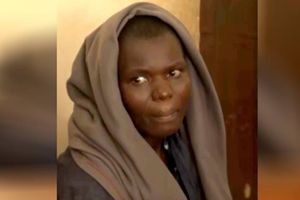
Sharlyne Anindo Temba, who is suspected to be the “chief priestess” of the Kwa Bi Nzaro cult.
Photo credit: Pool
Disguised as NGO workers compiling lists for food aid, they infiltrated the sect’s homestead.
There, they met Akinyi, Otieno’s wife, who claimed to be in charge. She handed them her ID card, which Charo discreetly photographed. It is this photo of the ID that the police took from his phone and used to positively identify Akinyi.
That small act of courage became the turning point. With proof in hand, they alerted the chief, who escalated it to police.
A sting operation followed, sending many cult members fleeing into thickets. But Otieno and his wife were caught as they tried to slip away.
Ironically, the three men who helped expose the sect were soon arrested themselves. Authorities accused Gona, Karisa, and Kenga of harbouring links to the cult.
Gona was taken in for allegedly showing a woman, Sharlyne Anindo Temba, a piece of land in the forest
Investigations have now revealed that Temba was the mastermind behind the Kwa Bi Nzaro cult after Mackenzie’s flock in Shakahola was scattered in 2023.
To outsiders, she appeared devout, austere, and humble, but to insiders, she was an absolute commander.
Investigators say Temba grip on the sect was reinforced by her three aides: Kahindi Kazungu Garama, Thomas Mukonwe and James Kazungu.
These four, sleuths say, played key roles in reviving radical teachings after fleeing Shakahola, where at least 454 followers of Paul McKenzie’s Good News International Church died through forced starvation.
Together, they formed a machinery of fear and manipulation, crushing dissent, luring new souls to the sect and controlling resources while strictly obeying Temba’s word without question.
The persistence of cults in Kilifi has raised questions about Kenyan government’s failure to curb the recurrence of such tragedies in the region.
In 2023, Shakahola shocked the nation, yet just two years later, nearby Kwa Bi Nzaro produced eerily similar horrors.
Having covered hundreds of kilometres in the stomach of Kilifi County, the Nation could figure out that a mix of poverty, marginalisation, and weak surveillance is largely to blame for the misuse of the county’s lands.
Vast tracts of land like Chakama Ranch are sparsely policed, making them ideal for clandestine settlements.
Inspector-General of police Douglas Kanja and DCI Director Mohammed Amin are shown around Kwa Binzaro village within Chakama ranch in Kilifi County.
Photo credit: Kevin Mutai | Nation
Religious regulation remains toothless, with cult leaders able to register organisations and operate unchecked until disaster strikes.
For locals like David Karisa, Kenga’s nephew, the sect is not the only problem they face
“We have lived here all our lives, but drought has left us hungry. Elephants from Tsavo East invade our farms, destroying our crops. We want land titles, water, roads, and electricity. Instead, we are known for cults and disappearances,” he said.
His words cut to the heart of the matter: neglect and poverty make local communities ripe for manipulation and exploitation by charismatic preachers.
Looking back, the events of July 18 now seem almost predestined. A machete-wielding stranger appeared at a woman’s door. She lent him her phone. He called his brother, and that call set off ripples that grew into a tidal wave.
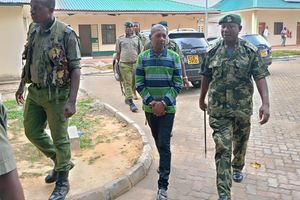
Today, Otieno and his wife remain in custody. Temba and her three aides are being interrogated at separate police stations within Kilifi, even as they appear in court when needed.
The three Binzaro men— Charo, Gona and Safari Kenga— were eventually released on free bond by the court on September 12, under strict conditions.
They must report to the Makongeni assistant chief’s office twice weekly and to investigators biweekly while refraining from contacting witnesses or interfering with evidence.
For Kanze, Kenga’s wife, the memory is raw.
“That was my first and last day seeing Otieno. He was like a man running from death. I do not know what will become of him now, but I know his call helped the State know what was happening and many lives were saved as a result. The government must not forget those who risked everything to help.”
The story of Kwa Bi Nzaro is still unfolding. But one thing is clear: it all began with a knock at the door and a borrowed phone.