As the clock keeps ticking away, September is fast turning into a defining month for preacher Paul Mackenzie, with the date that could determine the next chapter of his long-running legal battle over the deaths of his followers in Shakahola Forest drawing closer.
It was in September 2025 that his long-awaited murder trial over the deaths of 191 children in Shakahola Forest began. Exactly a year later, September now looms large on the calendar as the month the court is expected to deliver its judgment, which could either see Mackenzie convicted or acquitted of the murder charges he faces over the deaths of 191 children.
He faces the charges alongside 30 others, whom the prosecution has accused of playing key roles in the deaths of the children. The trial was extraordinary, with both the Bible and the Constitution cited extensively by the prosecution and the accused as they sought to advance their respective positions.
The Quran was also brought into the proceedings. While Mackenzie and his group cited Bible verses to justify their stay in the forest and the deaths that followed, the state relied on biblical references to argue that even during the time of Jesus Christ, certain forms of medicine existed to deal with illnesses and emergencies and that people did not rely entirely on prayer for healing.
At some point, the Shakahola murder trial turned into a theology class, with questions raised over whether those who allegedly fasted to death in the belief that they would go to heaven and meet Jesus were actually in heaven.
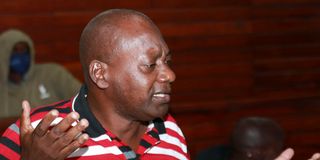
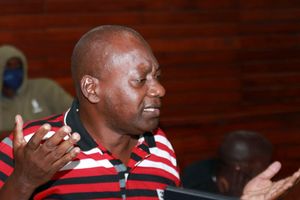
Kilifi suspected cult leader Paul Mackenzie (in white and blue stripped shirt) follows proceedings at the Shanzu Law Courts.
Photo credit: File I Nation Media Group
There was, however, no definitive answer, as neither Mackenzie nor anyone else could say with certainty what fate befell those who died through starvation.
The prosecution dismissed such questions as theological matters, insisting that its interest was not in determining matters of faith but in proving the criminal elements of the conduct that turned tragic.
In its submissions, the prosecution has urged the High Court to find Mackenzie guilty of murder, arguing that it has proved beyond reasonable doubt the deaths, their causes, Mackenzie’s role in causing them, and his state of mind at the time.
The prosecution says forensic and post-mortem evidence established starvation as the predominant cause of death among the victims.
“Although the cause of death for some bodies could not be medically established because they were severely decomposed or skeletonised, the court can infer that they too died from starvation based on the circumstances surrounding the deaths,” said Deputy Director of Public Prosecutions Jami Yamina.
The prosecution’s case is that Mackenzie preached and enforced a religious doctrine in which followers were encouraged to fast to death in preparation to meet Jesus. The acts, the prosecution says, led to the death of over 450 other followers of the preacher's Good News International church and ministry.
It relies on testimony from survivors and other witnesses, sermons, electronic evidence, and the circumstances surrounding the burial of the bodies to argue that the deaths formed part of a common plan or agreement.
The prosecution further argues that Mackenzie and the other accused knew that denying children food would probably cause their deaths. It points to evidence that children were withdrawn from school, denied medical care, and subjected to fasting, allegedly as part of a wider apocalyptic belief system.
The State has rejected the defence argument that the fasting amounted to a voluntary exercise of religious freedom, arguing that the right to life cannot be overridden by religious belief where conduct results in death.
The prosecution has also relied on evidence of the concealment of deaths and burials, arguing that such conduct contributed to gaps in forensic evidence and that the accused should not benefit from circumstances allegedly created by their own actions.
“On the basis that the standard of beyond reasonable doubt has been satisfied, the duty of the court is to convict all other accused in all counts for the offence of murder,” Mr Yamina submitted.
Evidence tabled by the State showed that 48.9 per cent of all the bodies examined, both adults and children, died from starvation, while the cause of death in 45.9 per cent remained unascertained.
Among adults, 123 deaths were attributed to starvation while 75 remained unascertained. Among children, 85 deaths were attributed to starvation while 120 remained unascertained. The age of four victims could not be established, with the prosecution charging those four counts as manslaughter.
The defence, however, has asked the court to acquit Mackenzie and the other accused, describing the case as one wrapped in tragedy, marked by loss and heavy with emotion.
Defence lawyer Lawrence Obonyo cross examines a witness at the High Court in Mombasa on October 8, 2025 during the hearing of a case in which Pastor Paul Mackenzie and his co-accused are charged with the murder of 191 Children in the Shakahola Massacre.
Photo credit: Kevin Odit | Nation
The defence argued that the mere occurrence of death, however tragic, does not automatically translate into criminal culpability for the accused. They accused the prosecution of seeking to make a dangerous leap from suspicion to guilt, association to liability, and tragedy to conviction.
“Appearances can be deceiving. The mere fact that something slithers does not make it a snake. In the same breath, the mere occurrence of death, however grave, does not, without more, translate into criminal culpability on the part of the accused persons,” the defence submitted.
Mr Obonyo insisted that criminal liability is personal and that each accused must be judged individually rather than as part of what he described as a “collective shadow."
The defence also challenged the prosecution’s reliance on common intention, arguing that there was insufficient evidence establishing direct participation by each accused or an unbroken chain of causation connecting them to the deaths.
Mr Obonyo urged the court not to allow the scale of the Shakahola tragedy to overshadow what he described as weaknesses and gaps in the prosecution’s evidence.
“For to do so would not be justice; it would be conjecture clothed as conviction,” he submitted.
Invoking the principle that an accused person must be proved guilty beyond reasonable doubt, the defence argued that it would be better for guilty persons to escape than for an innocent person to suffer.
The defence maintained that the central question before the court was not whether a tragedy occurred, but whether the prosecution had proved beyond reasonable doubt that each accused was criminally responsible for it.
“If that question invites even the slightest doubt, then the law is clear, and the duty of this Court is even clearer, to return a verdict of not guilty,” Mr Obonyo submitted.
The prosecution called 120 witnesses to prove its case, while the defence called more than 21 witnesses to support its position.
The defence witnesses included forensic experts, religious leaders from both the Muslim and Christian faiths, as well as the accused persons themselves, who took the stand to deny the charges and explain their respective positions.