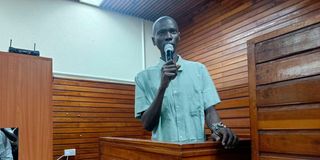
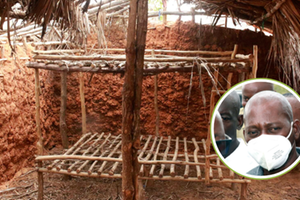
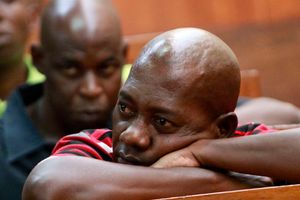
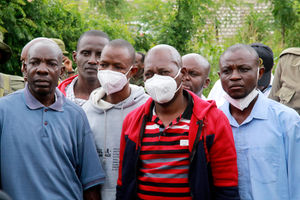
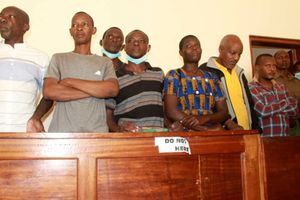
A suspect facing manslaughter charges alongside preacher Paul Mackenzie over the Shakahola deaths stunned a Mombasa courtroom after appearing in person and insisting that reports of his death were false.
Moses Karema, also known as Charif, said that he was alive and dismissed an earlier testimony made in court by his father that he was dead.
"I am not dead. Yet it had been said that I was dead and that my body had been released to my father for burial," Karema told the court.
Karema is among the 95 suspects charged with manslaughter over the deaths of 238 followers of Mackenzie's Good News International Church in Shakahola, Kilifi County. The manslaughter case is one of several prosecutions arising from the cult-related disaster.
The suspects, now on their defence, used their testimony to challenge key aspects of the prosecution's case.
Building on his claim that he had been wrongly declared dead, Karema mounted his defence by portraying the prosecution's case as one riddled with errors in the identification of victims, arguing that those mistakes undermined the credibility of the evidence against him.
He recalled being summoned from Shimo la Tewa Prison to appear before the High Court after his father, Charo Mwathethe Mulewa, testified in a separate Shakahola murder trial that Karema had died, undergone a postmortem examination and been buried.
According to Karema, his father had been presented with documents indicating that he was dead and had mourned and buried him, only for the court to later establish that he was alive.
"I left prison to come to the High Court because it had been alleged that I was dead. My father testified that he had been given my body. He had a postmortem showing I was dead and that he had buried me," he told the court.
Pastor Paul Mackenzie follows proceedings when High Court Judge Justice Wendy Kagendo visited his homestead within Shakahola Forest in Malindi Sub-county June 24, 2026.
Photo credit: Kevin Odit | Nation Media Group
He said he was only shown a different postmortem report during the current proceedings, indicating that it was his brother, Emmanuel Charo, whose body had allegedly been identified and released to the family.
"The document I have seen today showing my brother Emmanuel as the one who died had never been shown to me before. I am surprised to see that it is now my brother, and not me, who is said to have died and been buried. They made my father mourn me while I was still alive," he said, arguing that investigators had confused members of his family.
He further disputed the prosecution's assertion that his sister, Sidi Charo Mwathethe, died in Shakahola, insisting that she died years before he was born.
"Sidi died before I was born, so there is no way her body could have been exhumed in Shakahola in 2023. It surprises me that they say her body was exhumed in Shakahola, yet she was buried at our home in Malindi," he said.
He also rejected claims that his brother Emmanuel and sister Winnie died in the forest. Karema testified that when he relocated to Shakahola in 2020, he left the two siblings behind in Malindi after Emmanuel declined to accompany him.
Although he acknowledged that he had been in custody for the past three years and could not account for their current whereabouts, Karema maintained that he believed both siblings were still in Malindi.
"If they said I was dead and yet I am here, then even what they have said about Emmanuel cannot be true. I know he is in Malindi," he told the court.
Karema acknowledged owning four acres of land in Shakahola, where he lived with his mother, Ann Kadzo, and his sister Janet, both of whom are his co-accused in the manslaughter case. He maintained that they were the only members of his immediate family who lived with him in the settlement.
"I did not have a family of my own in the forest. My mother and Janet are the only people who were with me in Shakahola. I want to be freed so that I can go home. I will go back to Shakahola because I have land there," he said.
The prosecution's evidence presents a markedly different account. Court documents show that five members of Karema's family were initially reported missing and that DNA analysis and other evidence linked several of them to the Shakahola exhumations.
According to the prosecution, Karema, his mother and his sister Janet survived and are now facing trial, while his siblings Sidi, Winnie and Emmanuel died.
The prosecution also produced evidence showing that Winnie was living in Shakahola with her husband, Alex wa Mashamba, contradicting Karema's claim that she remained in Malindi.
Prosecutors further told the court that Emmanuel's remains were identified from the exhumations and released to the family. However, Charo Mwathethe Mulewa declined to bury his son, reportedly because he had separated from Emmanuel's mother many years earlier.
Emmanuel was eventually buried by his uncle because his remains, like many others recovered from Shakahola, consisted largely of skeletal bones due to advanced decomposition.
The prosecution maintains that the earlier confusion over Karema's reported death stemmed from his father's mistaken identification of Emmanuel's remains during the identification process in the separate High Court murder case.
According to the prosecution, its records and scientific evidence clearly distinguish those who died from those who survived.
DNA samples obtained from Karema's mother were subsequently used during the identification process, with prosecutors maintaining that the scientific evidence consistently identified Emmanuel, not Karema, as the deceased family member.
High Court Judge Justice Wendy Kagendo when she visited Shakahola Forest in Malindi Sub-county on June 24, 2026.
Photo credit: Kevin Odit | Nation Media Group
According to the Directorate of Criminal Investigations, Winnie is also dead, although her body has not yet been identified, while their records indicate that Sidi also died.
Another accused person, Faith Beli, used her defence to explain the personal convictions that led her to abandon formal education and eventually join Mackenzie's church, offering the court an insight into the worldview she said shaped many of the decisions she made before settling in Shakahola.
Beli told the court that her distrust of education stemmed from what she viewed as irreconcilable contradictions between science and the Bible. She argued that the two offered fundamentally different explanations of humanity's origins, leaving her convinced that formal education could not be relied upon as a source of truth.
"I have never seen one species turn into another. Education is deceptive. Half a lie and half a truth lead to confusion. The Bible tells me I was created, yet science teaches that humans evolved from primate ancestors. Those contradictions made me believe that education is deceptive," she said.
She testified that her decision to abandon school was also influenced by a traumatic experience after a fire broke out in her school dormitory, killing some of her fellow students. The incident, she said, left her terrified of returning to school.
"One day a fire broke out in our dormitory. I saw fellow students burnt to death. I became scared of going back to school because I imagined I could have been one of those killed in the inferno," she told the court.
Beli said she first dropped out while in Class Seven before returning briefly and leaving school again in Class Eight at the age of 16.
After staying at home for some time, where she spent much of her time watching television, she eventually started attending Good News International Church in Makongeni, Nairobi, before relocating to Shakahola in 2022 at the age of 19.
She told the court that although she informed her guardian that she no longer wished to continue with her education, she faced no objection to her decision.
Beli also clarified that her decision not to apply for a national identity card was not driven by her religious beliefs but by disagreements with her parents, adding that she nevertheless obtained a Huduma Namba.
Her testimony also touched on her religious views regarding healthcare, maintaining that faith alone was sufficient for believers.
"If you believe God, there is no need to take medication," she said.
The prosecution has previously argued that such teachings formed part of the belief system embraced by followers who settled in Shakahola and are central to the case before the court.
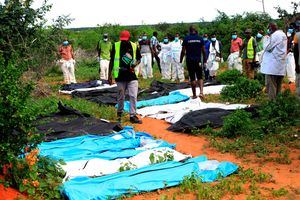
In the case, the suspects face 238 counts of manslaughter arising from the deaths of 238 followers of Good News International Church, whose remains were among the more than 450 bodies recovered from the Shakahola forest.
The prosecution alleges that, in furtherance of a suicide pact, the accused jointly caused the deaths of the 238 victims and others who are not before the court.
The offences are alleged to have been committed on diverse dates between January 2021 and September 2023 in the Shakahola area of Malindi Sub County, Kilifi County. All the accused have denied the charges.