Walk into the Shakahola massacre trial for the first time without any knowledge of the case, and you could easily mistake parts of the proceedings for a Bible study rather than one of Kenya's biggest criminal trials.
Whether in the murder case before the High Court or the manslaughter and radicalisation cases before the magistrates' courts, scripture has featured with unusual prominence throughout the proceedings.
References to Jesus Christ, the Kingdom of God, salvation, the end times and fasting have become a recurring feature of the hearings, with biblical passages often cited alongside legal arguments.
At times, the prosecution, the accused and the presiding judicial officers watched recorded sermons that had been admitted into evidence as part of the trial.
Yet despite this distinctive courtroom dynamic, the proceedings have remained firmly what they are, criminal trials in which prosecutors seek to prove that religious teachings were allegedly interpreted and applied in ways that resulted in criminal conduct, while the accused insist that their actions were grounded in scripture.
As the two-and-a-half-year trial draws to a close in Mombasa, one feature has consistently set it apart from most criminal proceedings.
Bible verses have flowed freely, with entire exchanges revolving around competing interpretations of scripture before returning to the legal questions the court must ultimately determine.
The prosecution team's challenge has often extended beyond presenting evidence and interpreting the law.
The team repeatedly found themselves confronting biblical arguments advanced by followers of controversial preacher Paul Mackenzie, many of whom have demonstrated an extensive knowledge of scripture and relied on it to explain virtually every aspect of their conduct.
Save for the testimony of expert witnesses such as crime scene investigators, forensic specialists and government pathologists, much of the evidence presented has centred on biblical interpretation.
Whether discussing prolonged fasting, withdrawal from society, refusal to seek medical treatment or obedience to church teachings, the suspects' answers were frequently supported by chapter-and-verse references delivered from memory.
One of the clearest illustrations of this unusual courtroom dynamic emerged during the defence case, when Grace Achando, one of the accused in the manslaughter trial, was asked why she had said her husband, Joseph Buyuka, had "slept" instead of saying he had died.
Rather than offering a conventional explanation, Ms Achando turned to the Bible.
"'To sleep' is not an invention of GNI church or any of the accused. It is biblical language used to refer to those who have died in Christ. They are considered asleep and not dead. It is found in Mark 5:38-39," she said
The passage refers to the account in which Jesus arrives at the home of Jairus after his daughter has died. Despite the mourning around Him, Jesus tells those present that the child is "not dead but asleep" before raising her back to life.
To Ms Achando, the passage explained why believers in Shakahola commonly used the word "sleep" to describe death.
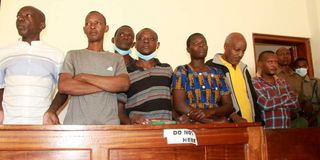
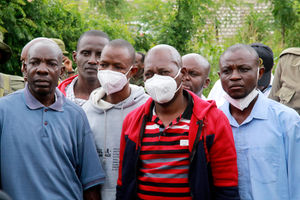
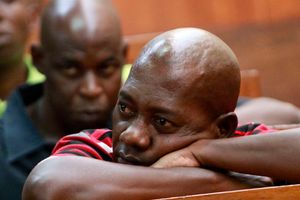
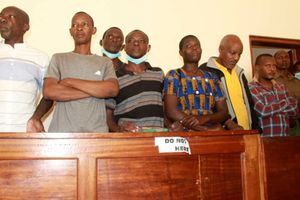
Pastor Paul Mackenzie (right) with his co-accused in a Mombasa court on October 8, 2025. They are charged with the murder of 191 Children in the Shakahola Massacre.
Photo credit: Kevin Odit | Nation
Lead prosecutors Jami Yamina, Victor Owiti and Betty Rubia maintained that their concern was not the choice of words but the circumstances surrounding the deaths under investigation.
Their line of questioning sought to distinguish between biblical expressions and the factual issues before the court, an exchange that reflected a recurring pattern throughout the trial.
On numerous occasions, prosecutors posed questions aimed at establishing facts surrounding the deaths, only for witnesses and accused persons to answer by citing scripture as the basis for their actions or beliefs.
Rather than simply denying allegations, many sought to explain their conduct through biblical teachings. In doing so, the proceedings frequently moved between legal examination and theological interpretation.
The prosecution's position has consistently been that the case is not about Christianity or the Bible, but whether the accused interpreted religious teachings in a manner that encouraged conduct amounting to criminal offences under Kenyan law.
The accused, however, insisted that their actions were guided by sincere religious conviction and supported by scripture.
That contrast often placed prosecutors in the unusual position of responding not only to factual claims but also to biblical interpretations advanced from the witness stand.
During witness questioning by both the prosecution and their layer Lawrence Obonyo, the witnesses cited biblical passages from Old to New Testaments to explain prolonged fasting, separation from society, rejection of formal education, refusal to seek medical treatment and their understanding of death.
For the prosecution, the legal task remained to establish whether those beliefs, regardless of their religious basis, resulted in criminal conduct under the Kenyan laws.
The prosecution maintained that any interpretation of the Bible that leads to harmful or unlawful conduct amounts to a misinterpretation of scripture.
The most sustained theological exchanges emerged whenever the court turned to fasting, the welfare of children, education and medical treatment.
For many of the accused, these were not merely personal choices but matters they believed were expressly addressed in the Bible.
When questioned about prolonged fasting, several accused persons insisted that fasting itself was a recognised biblical practice and could not, on its own, be treated as evidence of criminal conduct.
"Jesus fasted for 40 days. Suppose I decide to fast for 40 days, and my body is later recovered. A pathologist concludes that I died of starvation and dehydration. Would you say I had engaged in harmful conduct?" prosecutor Yamina asked defence witness Steve wa Mtwapa.
To support that position, the defence witnesses repeatedly referred the court to Bible verses on fasting such as Esther 4:15–17, where Queen Esther called upon the Jews to fast for three days before she approached King Ahasuerus to plead for the survival of her people.
Moses Karema, alias Sharif, one of the accused, drew a parallel with a hunger strike undertaken by GNI followers while they were being held at a rescue centre.
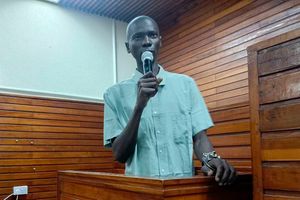
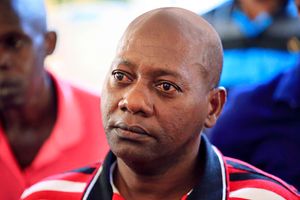
Moses Karema, also known as Charif, testifies in his defence before a Mombasa court hearing the Shakahola manslaughter case. Karema, who had previously been alleged to have died, challenged the prosecution's evidence on the identification of victims.
Photo credit: Brian Ocharo | Nation
"We fasted for more than three days while at the rescue centre to push the authorities to respond to our grievances. After the hunger strike, the prosecution eventually brought us before the court and preferred charges," he said
The prosecution, however, argued that the issue before the court was not whether the Bible permits fasting but whether the evidence pointed to followers starving themselves or others to death under the guise of religious observance.
Several accused persons maintained that children are capable of faith and that parents have a God-given responsibility to teach and guide them in spiritual matters.
In support of that position, they cited passages including Deuteronomy 6:6–7 and Proverbs 22:6, which instruct parents to raise their children in God's ways.
Prosecutors responded that while parents are free to raise their children according to their religious beliefs, Kenyan law places legal responsibilities upon them that cannot be displaced by religious conviction.
The prosecutions sought to explain that children, particularly those of tender age, cannot lawfully consent to decisions that place their lives or health at risk.
According to the prosecution, the court was required to determine whether the conduct alleged in Shakahola amounted to neglect, cruelty or other criminal offences under Kenyan law, irrespective of the religious beliefs relied upon to justify it.
Some of the accused testified that they rejected formal education after concluding that it promoted human wisdom at the expense of God's wisdom.
They cited passages such as James 3:13, which speaks of wisdom demonstrated through humility and good conduct, and Colossians 2:8, which warns believers against "hollow and deceptive philosophy" founded on human traditions rather than Christ.
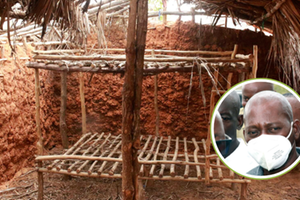
Graves discovered at Kwa Bi Nzaro area, within Shakahola Forest, Kilifi County on August 15, 2025.
Photo credit: File | Nation Media Group
Faith Beli told the court that she abandoned school in Class Eight (now Grade Eight) because she believed formal education conflicted with biblical teaching.
"The Bible tells me I was created, yet science teaches that humans evolved from primate ancestors. Those contradictions made me believe that education is deceptive," she said
For the prosecution, however, the legal issue was straightforward that Kenyan law guarantees every child the right to basic education, and denying that right cannot be justified on religious grounds.
Several accused persons referred to passages describing Jesus healing the sick through prayer and His disciples continuing that ministry.
They argued that true healing comes from God and that believers should place their trust in divine healing rather than modern medicine.
"If you believe God, there is no need to take medication," Ms Beli told the court.
Again, prosecutors did not challenge the existence of biblical accounts of healing.
Instead, they argued that refusing necessary medical care where it results in death or suffering may attract criminal liability if it amounts to neglect or contributes to the commission of an offence.
Throughout these exchanges, the courtroom repeatedly returned to the central question of where the constitutionally protected right to freedom of religion ends and criminal responsibility begins.
It is that question, not competing interpretations of scripture, that now lies at the heart of the court's determination.
Throughout the proceedings, prosecutors have maintained that the case before the court is not a trial of religion or of the Bible but a criminal prosecution seeking to determine whether religious teachings were interpreted and applied in a manner that resulted in offences under Kenyan law.
According to the prosecution, the evidence demonstrates that some followers embraced extreme religious beliefs and conducts that amounted to criminal offences.
The accused, on the other hand, have consistently maintained that they merely practised what they sincerely believed the scripture teaches.
That contrast has produced one of the most unusual courtroom dynamics in recent Kenyan legal history.
In most criminal trials, witnesses are primarily challenged on facts and legal principles. In the Shakahola proceedings, prosecutors have often had to navigate lengthy biblical explanations before returning to the evidence they sought to test.
The result has been a courtroom where the Constitution, the Penal Code and the Bible have frequently been cited in the same proceedings, each serving a different purpose.
Both the prosecution and the defence have concluded presenting their evidence in the four criminal cases facing Mackenzie and his co-accused arising from the tragedy, in which more than 450 bodies were exhumed from Shakahola Forest in 2023.
The cases include the Tononoka Children's Court matter, where Mackenzie and 30 others face various charges, including torture of children and denying them their right to basic education.
In the High Court, Mackenzie and 29 others are charged with the murder of 191 children.
In the manslaughter case, Mackenzie and 95 others are accused over the deaths of 238 followers of the GNI church
The prosecution alleges that these offences contributed to the deaths of hundreds of followers in Shakahola Forest, some of whose remains are yet to be identified through DNA analysis.
With both sides having closed their cases, the parties are now expected to file and highlight their final submissions before the courts set dates for judgment.