It was not his first such trip, having left his home in Tsagwa village, Kilifi County, to broker land deals in Junju.
Sumra was also a familiar figure in the area, as many villagers bought milk from his dairy farm in Kikambala Amkeni.
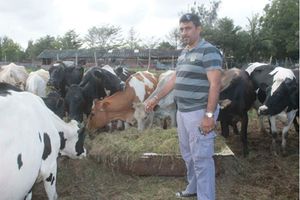
Sidik Sumra with his cattle in his Kilifi farm in 2016. Sumra was killed in 2021 together with his driver Rahil Mohamed and land agent James Kazungu.
Photo credit: File/ Nation Media Group
Unproven allegations of organ trafficking targeting children and land grabbing would see all three men killed that evening.
Only one person, nightclub owner Robert Mwagosha Mganga, was convicted for the murder of Mzungu after stating that the crime was heinously committed.
His punishment? Three years of probation and an order for financial compensation to Mzungu’s family – a directive that remains dishonoured to date.
Early morning on July 7, 2021, the chirping birds and majestic sun had fooled Mzungu's wife, Elizabeth Ndei, as she thought it would be another ordinary day in their modest home.
Ndei did not, in her wildest imagination, think that it would be the day she would become a widow and be forced to see the justice system let her husband’s killer walk away with a slap on the wrist.
The late Sidik Anverali Sumra, a Kilifi-based dairy farmer killed alongside his driver and land broker, James Kafani Mzungu(right).
Photo credit: NMG
Before leaving, Mzungu cracked a few jokes on the phone with his sister, Frida Malidzo, whom he always called when travelling to Junju.
At around 6 pm, a mob attacked and brutally killed Mzungu, Sumra and Mohamed, setting their bodies on fire inside their grey Toyota Fielder.
Late land broker James Kafani Mzungu.
Photo credit: Pool
Ms Malidzo was shocked by allegations that the trio was organ traffickers, targeting children’s eyes. Further allegations were that they were land grabbers.
“I told them, ‘You know my brother was a land agent. How can you falsely accuse him of harvesting human eyes just to justify killing him?’” she recalls confronting the locals.
A team with officers from the General Service Unit, regular police, and Administration Police was deployed to the village, leading to the arrest of 17 people, mostly women and children.
Further investigations saw nine people, including former Junju Ward Representative Onesmus Gambo Karisa, charged with three counts of murder. All pleaded not guilty.
Others were Robert Mganga Mwagosha, Kennedy Mwangemi Shume, Victor Kole alias Ngate, Daniel Karisa alias Mboso, Anthony Wanje alias Mganga, Laban Mwatata, Cliff Ngombo, and Mzungu Shume Mwangemi alias Said Chote.
Mzungu Shume, one of the accused persons acquitted of the tripple murders in Kikambala, Junju during an interview at his home.
Photo credit: Brian Ocharo| Nation Media Group
The trial then began, exposing huge cracks in the investigations. The multi-agency team descended on Junju, harassing the entire community and arresting villagers who had not committed any crime, including children.
Many villagers abandoned their homes, with some taking refuge in the forest.
The court heard that some of the suspects were found in the forest, with some being released.
Evidence remained scant in court, as most witnesses spoke only about a land dispute.
The case concluded in 2025 without an answer to who murdered Sumra and his driver, and why.
The court observed that it was not in doubt that the deceased died from the encounter that they had that evening, as there were no intervening circumstances such as medical negligence.
“From this, we find that there was an attack on the two Asians, by various people with multiple weapons, and subsequently the bodies were set on fire. We are, therefore, not able to say exactly what each accused person's role was. This is more so in respect to Mr Karisa. He is only said to have assisted,” said the judge
Mganga received an unusual punishment for Mzungu’s murder – three years of probation, with compensation to be supervised by the probation department.
In delivering its decision, the court explained that the victim’s family had reconciled with the accused and were amenable to restorative justice.
“This was a very unfortunate incident, but the court has been advocating Alternative Dispute Resolution and restorative justice, and we should not be seen to blow both cold and hot,” the court said.
More questions than answers
For the families of the victims, and for the public, the question is unavoidable: was justice truly served?
Ms Ndei believes it was not. To the woman in her late 50s, her husband’s brutal death was not adequately punished, and the convicted offender was not sentenced in a manner commensurate with the gravity of the offence.
“The court made its decision. I do not know how to put it, but it was an injustice to us. Three years’ probation for such a murder is an injustice. It is not enough punishment,” she says.
She adds that the lenient sentence suggests inequality before the law, and that her husband’s life did not matter to those tasked with delivering justice.
“The murderer is at home, going about his life, while we are struggling. Our breadwinner was taken away. Our children are supposed to be in school, yet we constantly lack money. This is injustice from a court that is meant to deliver justice,” she says.
She maintains that she is dissatisfied with how the case was handled, arguing that the judicial process should have resulted in a severe sentence, particularly because an eyewitness placed Mganga at the scene, armed with a panga. Interestingly, the family has neither received the compensation outlined in the court order nor been informed of any arrangements regarding it.
“I have heard of people being jailed for murder. They remain in prison, not walking free like the man who killed my husband in cold blood,” she says.
Ms Ndei refers to the testimonies of two key witnesses. One, testifying under the name Peter Kalaa, told the court that he witnessed the entire incident. He described how the victims were interrogated, their pleas for mercy ignored, before they were butchered one after another. He identified Mganga as the ringleader, the man who struck Mzungu first, causing him to collapse in a pool of blood.
“One of the Asians realised his life was in danger and asked to be allowed to pray before he was killed. Mganga urged him to pray quickly,” the witness testified.
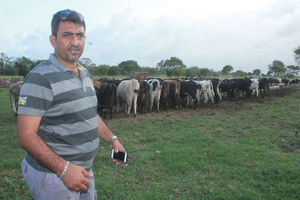
The late Sidik Anwarali Sumra at his Kikambala-Amkeni farm.
Photo credit: File | Nation Media Group
“Mganga had a panga which he used to hack the Asians. The vehicle was also set ablaze,” he told the court.
Another witness, Emily Mgoi, a former employee at Mganga’s Club Signature, also gave a detailed account.
She recalled that Mganga received a phone call and left abruptly. Moments later, screams were heard from the direction he had taken.
Shortly afterwards, some men arrived and instructed them to close the club. Mganga later returned and confirmed that he had interrogated Mzungu and the two Asians about the purpose of their visit.
“He said one of the Asians responded arrogantly and asked if he knew who he was,” she testified, adding that Mganga later said he had paid Sh300 to have the bodies removed from his club.
“I am satisfied that the injuries sustained by the deceased led to his death. Mganga struck him on the head with a panga, and there is no evidence of anyone else attacking him. It is therefore safe to conclude that Mzungu died from the injuries inflicted by Mganga,” the judge ruled.
The case further exposed serious investigative shortcomings. Notably, post-mortem reports for Sumra and Mohamed were never produced in court.
The doctor expected to present them, Dr Gabriel Mungola, appeared briefly, claimed he had the wrong report, and never returned. No explanation was given, nor was another witness called to fill the gap.
Without these critical documents, the court could not sustain murder charges for the two.
Even more concerning were claims from locals that a key suspect, allegedly found with one of the victims’ phones, was never arrested.
The court also criticised the much-publicised multi-agency operation in Junju village following the killings. Seventeen people, mostly women and children, were arrested, yet little evidence emerged.
According to the families, in regions where land disputes and suspicion often trigger violence, the absence of firm consequences risks emboldening future attacks.
“It is such negligent acts which give the justice sector a bad name, and often the judiciary is left to take the blame,” the judge said.
For the families of Sumra and Mohamed, closure remains out of reach.
“How do we bring closure for the families of the victims who have waited so long? They set out on a business venture to improve their lot, and we cannot answer what happened to them," the judge remarked.
To prevent similar miscarriages of justice, the court recommended prosecution-led investigations to ensure offenders are properly identified and prosecuted.