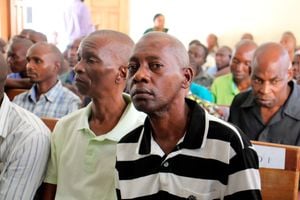
They stepped in to help, but two years later the trauma still haunts them. It is etched in their minds, manifesting through nightmares, visions of rotting corpses, and a torment so deep that not even alcohol can offer temporary relief when night falls.
They were ordinary boda boda riders, young men in their 20s, only used to navigating the dusty terrains of rural Kilifi County, not morgue attendants or trained emergency responders.
Around March 2023, when the government called for help to retrieve bodies from the mass graves of Shakahola forest, they responded. The deceased were followers of controversial preacher Paul Mackenzie of Good News International Church.
Suspected Kilifi cult leader Paul Mackenzie in Mombasa Law Court on January 23, 2024
Photo credit: Kevin Odit | Nation Media Group
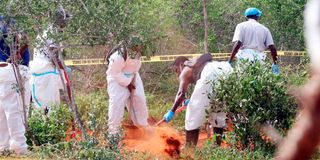
For months, they bravely dug through shallow graves in the forest and pulled out over 450 decomposing bodies, including children, barely recognisable.
What began as a simple call to duty turned into a prolonged nightmare. Two years later, the riders confess to living with deep psychological scars. They remain haunted by recurring nightmares, flashbacks of decaying bodies, and overwhelming mental distress.
While most people who were indirectly involved in the exhumation may have moved on from the Shakahola tragedy, this group of riders has not.
They did not lose loved ones in the tragedy, but the psychological effects of the year-long exercise have left their lives in disarray.
Although they received a daily stipend during the operation, the long-term cost has been a permanent scar on their mental wellbeing.
Most of them were boda boda operators stationed at Shakahola Madukani, approximately 56 kilometres inland west of the Malindi–Lamu road, a journey of about 45 minutes to an hour depending on speed. The route is dusty and riddled with potholes. Madukani is roughly 13 kilometres from the Malindi-Sala Gate road linking Malindi town to Tsavo East National Park.
Hired labourers clear way the bushes in one of the graves in Shakahola Forest.
Photo credit: File | Nation Media Group
Madukani is a small, dusty trading centre with only two fuelling stations, mainly selling diesel. It is a modest marketplace with only essential commodities available.
Here, we met some of the men who took part in the exhumations. When we arrived at Madukani, our source informed us that many of them had abandoned the boda boda business due to stigma and moved into the forest to burn charcoal.
Their experience in Shakahola is a subject they rarely discuss. In this small centre, they have been isolated and labelled as “grave diggers wa Mackenzie”.
After some minutes of explanation about the purpose of our visit and the importance of sharing their story, even though we could not provide immediate mental health support, they agreed to speak with us.
Salim Charo sat his Kenya Certificate of Secondary Education (KCSE) in 2022 and was hopeful of pursuing further education. When the Shakahola tragedy happened, he was focused on commercial farming to raise funds for college.
One morning in March, news of malnourished people being found in the forest spread across the village. Area leaders called upon the youth to assist in the search and rescue of missing persons.
“That is how I ended up in the forest. The search turned into an exhumation exercise. We began scooping soil and retrieving mostly skeletal remains,” he recounts.
At first, he thought he would help retrieve a few bodies then return to his farm. He never expected to take part in all five phases of the exhumation.
“At times I would exhume up to twelve bodies from one grave. My job was to scoop the soil and pull out the bodies, which were often wrapped in blankets or black nylon bags,” the 26-year-old explains.
Bodies exhumed from mass graves in Shakahola forest, Kilifi County on May 12, 2023.
Photo credit: File | Nation Media Group
When the exercise ended, the images of the bodies he retrieved refused to fade.
“I cannot sleep. When I do, I see the dead charging towards me. The images are fresh. After waking up from such nightmares, it is hard to sleep again,” he says. He often sees faces of the malnourished people they encountered in the forest, some of whom later died.
The trauma has cost him not only peaceful nights but also his relationship. He had a girlfriend he intended to marry, but they broke up soon after he returned from the forest.
“We were called Shakahola grave diggers. That is why she left,” he says. He blames the psychological distress on the inadequate counselling provided by the government appointed psychologist.
He says the sessions were brief and conducted in groups instead of each one of them meeting the counsellor privately.
“We would leave the graves in the evening and attend a short counselling session in the same environment. Then, the following morning, we were back in the forest. It was pointless,” he says. The last session he attended was on July 23, 2023.
“I feel used and abandoned. More counselling should have been organised. More importantly, they should have honoured the promise to give us jobs,” he says.
Emmanuel Ngolo abandoned the boda boda business and now helps on his father's farm due to the stigma attached to his past role.
Locals from Shakahola Centre help dig up graves at Shakahola Forest part of the 800 acres linked to Paul Mackenzie of Good News International Church in this past photo taken on June 6, 2023.
Photo credit: File I Nation Media Group
“I did not know what I was getting into. A customer would hear someone calling me a grave digger and choose another motorbike. Our competitors took advantage and isolated us,” he says.
The community has stigmatised them. Riders, who once enjoyed local support, are now shunned by their own clients.
“Add the nightmares and mental torture, and we are left empty.” He assumed he would not be affected because he was not familiar with some of the deceased person but he was wrong.
“Recently, I dreamt of a corpse I had pulled out chasing me. I woke up in a panic and could not sleep again. Other nights, I dream of the living who later died. These are frequent nightmares, not fiction,” he says.
Most of his dreams revolve around Shakahola. He either sees himself exhuming bodies or being pursued by the dead.
“My wife left me due to pressure from her friends. No one wants to be associated with a grave digger. Some think we were followers of Mackenzie,” he says.
Their partners believed their work made them emotionally detached, even dangerous and capable of murder.
Jefa Juma says they are regarded with suspicion in the village because of the number of bodies they exhumed. The stench they endured still lingers in his memory.
“That smell is fresh in my nose. I delay going to bed so that I fall asleep faster,” he says.
He stopped playing football after being ridiculed. “During games, opponents would mock us saying we can’t score a goal because we had been fasting like Mackenzie’s followers. If we lost, I got blamed for bringing bad luck from the graves,” he says
Stephen Safari believes he exhumed the most bodies. People now view him as mentally unstable because of his experience in the forest.
“Even casual conversations with friends are dismissed because they think I am confused,” he says.
He used to be a mason but stopped due to injuries sustained during the exhumations. He also lost a hotel job after the premises were demolished.
Now, he struggles with constant nightmares.
“If you argue with someone, they say you went mad in the forest,” he says.
All the grave diggers we spoke to are dissatisfied with how the government treated them. They openly shared the psychological impact the exhumation had on their lives.
They are now pleading with the government to honour its promise of employment and provide proper counselling.
“Life has not been easy. We are stigmatised in a community that once embraced us,” says Mr Safari.
Today, many of them have turned to alcohol and drugs as a coping mechanism to deal with the trauma, the memories of lifeless bodies, and the stench that defined their time in the forest.
“There is no drug I have not used. It helps me catch some sleep and gives me temporary peace of mind,” Safari says.
Dr Frank Njenga, a psychiatrist with many years of experience and the founder of the Chiromo Hospital Group, confirms that the nightmares described by the grave diggers are symptoms of Post-Traumatic Stress Disorder (PTSD).
“That is exactly what you find in situations like these ones. It is the nature of this condition. That is why it is called post-traumatic, after the trauma,” he says.
Consultant Psychiatrist and Chairman of Chiromo Hospital Group Dr Frank Njenga.
Photo credit: File | Nation Media Group
Dr Njenga explains that this condition can occur up to six months after the trauma or traumatic event itself.
“It typically starts after one month, but sometimes after six months or even years afterwards, because it is a very traumatic experience for the human mind,” he adds
The psychiatrist says he could not comment on whether the counselling given to the grave diggers was sufficient or not, but noted that interventions in such cases require highly specialised and experienced individuals.
“There is no prescribed duration of counselling because everybody comes into this work with their own pre-existing traumas. So those who had severe traumas earlier or mental health conditions their duration of therapy necessarily has to be more comprehensive than those who have no pre-existing issues,” he says.
Dr Njenga also notes that the extent of recovery depends on how much social support the grave diggers have, such as family, supportive organisations, or stable churches, which are key factors in determining how much help they will need to restore their mental health.
“Follow-up needed now is for the grave diggers to look for a mental health specialist. We should never have gone to hell, so we should not be discussing coming back from hell,” he says.