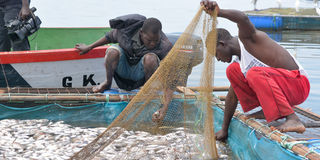
A recent spate of fish deaths at Dunga Beach in Kisumu has devastated the local fishing community and sparked widespread public outrage, with conservationists accusing regulatory bodies of neglect and inaction. Thousands of tilapia perished in 12 cages at the weekend, casting a long shadow over the delicate ecosystem of Lake Victoria and the livelihoods it supports.
Nicholas Oyete, chairman of the Dunga Beach Management Unit, confirmed that the deaths began on Sunday, affecting 12 out of 150 cages. The estimated financial loss, including fish stock, feed and labour, is Sh9.6 million.
Nicholas Oyete, the chairman of the Dunga Beach Management Unit (BMU), speaks to journalists at Dunga Beach, Kisumu County on September 29, 2025.
Photo credit: Alex Odhiambo | Nation
“This is a devastating blow. Each cage represents an investment of around Sh400,000 and yields up to Sh800,000 at harvest. But we want to assure Kenyans that no dead fish will enter the market. All affected fish remain in the cages and will be disposed of under strict supervision,” Mr Oyete said.
While one person attributed the deaths to oxygen depletion, others see a deeper, festering wound: pollution.
Dead fish float on the shores of Dunga Beach in Lake Victoria, Kisumu County on September 29, 2025.
Photo credit: Alex Odhiambo | Nation
Hezbone Okoth Owino, Secretary of Friends of Dunga Swamp, described the disaster as both predictable and preventable.
“This tragedy did not come as a surprise,” he said, holding up a letter dated July 7, 2025 that his organisation had sent to the director-general of the National Environment Management Authority (Nema). In it, they had warned of untreated industrial waste being discharged into Lake Victoria via the Nyamasaria River, just a few hundred metres upstream of the cages at Dunga.
Hezbone Okoth Owino, Secretary of Friends of Dunga Swamp, speaks to journalists at Dunga Beach in Kisumu County on September 29, 2025.
Photo credit: Alex Odhiambo | Nation
Mr Owino claimed that the letter was also sent to the County Government of Kisumu, the National Water Authority, Nature Kenya and even the Office of the President. It highlighted Dunga’s dual importance as a critical fish landing site and a growing tourist destination.
“It is not just fish that are at risk. Polluted water is being used to clean fish sold to the public. People are being exposed to waterborne diseases and, potentially, long-term illnesses such as cancer. This is no longer just an environmental issue, it’s a public health and economic crisis,” he said.
Fish farmers retrieve dead tilapia from cages at Dunga Beach, Kisumu County on September 29, 2025.
Photo credit: Alex Odhiambo | Nation
Back at the beach, the pain is palpable. At the usually bustling Dunga fish market, stalls were empty. The familiar chatter of fishmongers had been replaced by anxious silence.
“I have no fish to sell today. If this continues, I won’t be able to pay school fees for my children. This lake is our lifeline," said Beatrice Achieng.
Fish farmers retrieve dead tilapia from cages at Dunga Beach, Kisumu County on September 29, 2025.
Photo credit: Alex Odhiambo | Nation
Just metres away, fisherman Joseph Omondi sat mending his nets.
“We were told cage farming would save us after wild fish stocks disappeared. Now even the cages are dying. We’ve started selling fish from unaffected cages just to recover something before it is too late. If the government doesn’t act on this pollution, we are finished,” he warned.
Tourists have also taken notice. Anna Njeri, who is visiting from Nairobi, was shocked by the sight of the dead fish being pulled from the lake.
“I came for the Dunga tilapia experience; now I’m left wondering whether it’s even safe to eat anything from these waters,” she said.
Mr Kenneth Onyango, the Kisumu County Executive Committee Member for Agriculture, Fisheries, and Livestock, speaks to journalists at Dunga Beach, Kisumu County on September 29, 2025.
Photo credit: Alex Odhiambo | Nation
In response to the crisis, Kenneth Onyango, the County Executive Committee Member for Agriculture, Fisheries and Livestock, led a team of health officers and fisheries experts to Dunga, pledging swift containment measures.
“Our priority is to ensure no contaminated fish reaches the market. Scientists from KMFRI are on site collecting samples. Once we establish the cause, we will act decisively to prevent a recurrence," he said.
Caroline Okoth, a public health officer, speaks to journlaists at Dunga Beach, Kisumu County on September 29, 2025.
Photo credit: Alex Odhiambo | Nation
Public health officials confirmed that they are overseeing the removal and disposal of dead fish at Kisumu’s Mamboleo dumping site.
However, cage fish farmers and environmentalists claim that similar promises were made following previous fish deaths three years ago, and little has been done since then.
“We were told the deaths were due to low oxygen then, too, but nothing was done to prevent it from happening again. We need more than investigations; we need enforcement. And we need support to restart our businesses,” Mr Oyete demanded.
Community leaders are now calling on Nema to release water quality data from the Nyamasaria River and disclose whether industries upstream are complying with waste management regulations.
“If the industries are clean, let Nema prove it. If they are polluting, let them be named and held accountable. Our people cannot keep suffering because someone upstream is cutting corners,” said Mr Owino.
Fish farmers retrieve dead tilapia from cages at Dunga Beach, Kisumu County on September 29, 2025.
Photo credit: Alex Odhiambo | Nation
Fish traders and cage farmers echoed this demand, calling for stronger enforcement of riparian protection laws, improved sewage control, and compensation for losses incurred.
With capture fisheries in Lake Victoria in sharp decline — from three tonnes a day a decade ago to less than 50 kilogrammes today — cage farming had emerged as a beacon of hope. However, this hope is fading with each dead fish.
“If this continues, cage farming will collapse, and with it, Kisumu’s fish economy,” Mr Owino warned.