Cage fish farms blamed for nutrient pollution and habitat loss in Lake Victoria
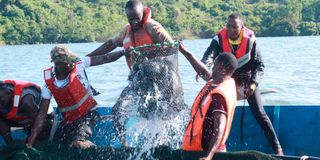
Fishermen harvest fish from cages in Lake Victoria off Nyagina Beach on Rusinga Island, Homa Bay County, on May 16, 2025.

What you need to know:
- A new study warns that cage fish farming on Lake Victoria threatens ecosystems despite soaring fish demand.
- Kenya’s declining fish stocks and rising aquaculture practices have sparked debate over environmental sustainability and food security.
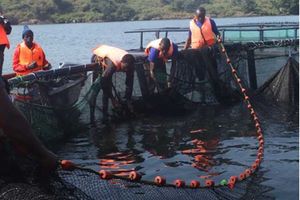
Mr Charles Okello, a fish farmer, slowly and gently rows his boat towards the shores of Lake Victoria—an activity he has faithfully engaged in for years.
After docking his boat, Mr Okello hops onto a motorbike loaded with the remaining fish feed, ready to travel back home following a successful feeding session at the cages. If all goes well, he expects a bumper harvest during the festive season. For communities living around Lake Victoria, fish cages are a common sight, positioned a few metres from the shore.
The cages, made using high-density polyethylene and nylon nets or metal tubes, plastic drums and wire mesh, together with anchors, floaters and ropes, have for years been one of the most convenient methods fish farmers have turned to in order to meet the growing demand for this protein source.
Recent reports, however, reveal a dwindling supply of fish in Africa’s largest freshwater lake due to several factors, including overfishing, illegal and unregulated fishing, and pollution.
According to the latest report by the Kenya National Bureau of Statistics, fish production in Kenya dropped from 86,400 tonnes in 2022 to 70,300 tonnes in 2023. Further statistics indicate that Kenya faces an annual deficit of 365,000 tonnes against a national demand of 500,000 tonnes.
A recent study review, however, highlights that cage farming poses several environmental challenges, including eutrophication, disease transmission, changes in aquatic biota and degraded water quality. “These environmental challenges threaten the ecological balance of aquatic ecosystems, which is vital for the communities that depend on them,” it notes.
Rise in consumption
The review, titled Environmental Impacts of Cage Fish Farming, was authored by the Executive Director of the National Environment Management Authority alongside six other Ugandan experts. Published this month in the International Journal of Fisheries and Aquatic Studies, the findings argue that global fish consumption has risen significantly, driven by population growth.
Aquaculture has emerged as an essential solution to meet this rising demand, particularly in the face of declining capture fisheries and constrained terrestrial food production. According to the review, fish cage culture has been identified as a strategic practice with significant potential to increase fish production.
The review examined the impact of cage fish farming on the environment and the economic contributions of aquaculture. It also assessed the balance between the development of cage fish farming and environmental sustainability, emphasising the need for effective management practices to mitigate the negative impacts and ensure the long-term health of aquatic ecosystems.
It argues that although cage farming offers economic opportunities and bolsters food security, it also raises serious environmental concerns, including water pollution, eutrophication, disruption of water transport, loss of aquatic biodiversity and the risk of disease transmission to native fish populations. The expansion of aquaculture has also led to conflicts with traditional fishing practices and environmental degradation, according to the study.
“Despite the rapid growth of the cage fish farming sector, many concerns have been raised regarding its environmental effects, specifically its impact on water quality and the biotic composition of water bodies,” the review states.
“Cage fish farming relies on natural water sources and food chains, and its expansion could negatively affect water quality. In addition, cage fish farming releases significant quantities of nutrient-rich waste—including faecal matter, uneaten feed and metabolic by-products—into the water in high concentrations, severely impacting water quality both directly and indirectly.”
The review notes that, like other animal production sectors, aquaculture generates waste, and managing fish farming waste is both challenging and costly, as it disintegrates and dilutes in the culture water. Waste generated from uneaten feed and faecal matter leads to increased nutrient loading in surrounding waters.
Excessive nutrient loads result in eutrophication, characterised by uncontrolled algal growth, increased turbidity and, in severe cases, anoxia. Increased turbidity reduces light penetration, negatively affecting phytoplankton production and hindering photosynthesis in benthic aquatic vegetation.
Furthermore, anoxia—the complete absence of oxygen—leads to the death of aquatic organisms, disrupting ecosystems and causing biodiversity loss. “Nutrient enrichment often encourages the growth of invasive species such as water hyacinth, which further disrupt local ecosystems. Waste products from cage fish farming can spread pathogens and parasites, infecting fish and other aquatic organisms, while unutilised protein-rich feed elevates ammonia levels,” the review notes.
It further explains that cage fish farming facilitates the rearing of large numbers of fish within confined spaces, increasing oxygen demand in the rearing environment while reducing oxygen availability in surrounding waters.
Escaped caged fish may also introduce diseases and parasites into wild populations. “A thorough understanding of the impacts of cage fish farming on aquatic ecosystems is essential for the sustainable use of water resources,” it emphasises.
The authors call for the creation of a sustainable aquaculture strategy and for future developments to integrate advanced waste management and environmental monitoring systems. “By doing so, the aquaculture sector can contribute not only to economic growth but also to the long-term sustainability and resilience of aquatic ecosystems,” the review concludes.