On the evening of June 3, 2021, Jackline Akinyi was going about her usual business of selling mutura at Mamboleo Junction in Kisumu County.
As dusk settled, a man she had known for years as a regular customer suddenly grabbed her silver kitchen knife from atop a jiko. Less than 15 minutes later, he returned the seemingly clean knife as frantic screams pierced the air.
“Ame muua, ame muua, Sebby ameua Omosh! ” - He has killed him, he has killed him, Sebby has killed Omosh.
Among those who witnessed the chilling incident was Stephen Nyanjua Haggai, a resident of Kanyakwar. Recalling the events of that fateful evening, Nyanjua would later narrate to the court that between 6.30 pm and 7.00 pm, while taking tea at a hotel near the Mamboleo Interchange, he saw Sebby Roy Oyugi, the man who would later take the life of David Omondi Haya, walking past while talking to himself in Dholuo.
“Rita aduogo” - Wait, I am coming back.
Moments later, Oyugi returned wielding a knife and went after Omondi, who fled upon seeing the weapon.
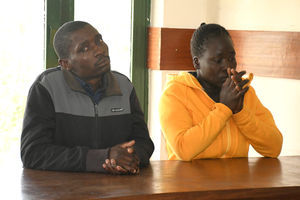
Sebby Roy Oyugi was convicted of the murder of 31-year-old David Bob Haya at Mamboleo Junction on June 3, 2021. Listens during sentencing at the Kisumu Law Courts on June 8, 2026. Justice Joe Omido Mkutu sentenced him to 50 years in prison.
Photo credit: Alex Odhiambo| Nation Media Group
“He caught up with him and stabbed him once on the left side of his back,” Nyanjua recounted.
During his testimony before a sombre Kisumu High Court, Nyanjua described watching in horror as Oyugi, who was standing trial for murder, wiped blood from the weapon on the grass before returning it to a woman selling mutura nearby.
The entrance of the Kisumu Law Courts on June 8, 2026.
Photo credit: Alex Odhiambo| Nation Media Group
“Sebby declared that he had eaten Omosh’s heart as he walked away to a nearby open-air market where he bought tomatoes and disappeared from the scene,” he told the court.
Another witness, Levy Okech Okele, a boda boda operator and close friend of Omondi, observed the attack from about 10 metres away. Moments earlier, he had overheard what appeared to be the motive behind the confrontation.
According to Okele, Oyugi confronted Omondi, demanding to know why he was operating a motorcycle belonging to a non-Luo man whom he disliked. The brief exchange ended with Oyugi threatening to kill him. A few minutes later, he carried out that threat.
After the brazen and deadly assault, Oyugi vanished from the area and remained on the run for nearly seven weeks as police searched for him.
Sebby Roy Oyugi was convicted of the murder of 31-year-old David Bob Haya at Mamboleo Junction on June 3, 2021. Listens during sentencing at the Kisumu Law Courts on June 8, 2026. Justice Joe Omido Mkutu sentenced him to 50 years in prison.
Photo credit: Alex Odhiambo| Nation Media Group
However, on July 20, 2021, officers received information that he had been spotted in Homa Bay County. Acting on the tip-off, detectives travelled to Sena, where they found him working at a construction site. He was arrested, photographed and the image sent to Kondele Police Station for identification and confirmation.
A post-mortem examination carried out on the body of Omondi, later revealed a stab wound that had penetrated the chest cavity and damaged the left lung, causing massive internal bleeding. The cause of death was determined to be excessive blood loss resulting from the injury.
Nearly five years later, Omondi’s family finally found justice when the Kisumu High Court sentenced Oyugi to 50 years in prison for murder.
Justice Joe Omido delivered the sentence on June 8, 2026, after finding Oyugi guilty of murdering Omondi on June 3, 2021, at Mamboleo Junction in Kisumu East Sub-County.
Justice Omido stated in his sentence that Oyugi deliberately armed himself with a knife, pursued the unarmed Omondi as he attempted to escape and fatally stabbed him.
“Medical evidence showed that the knife pierced the victim’s lung, causing severe bleeding that ultimately claimed his life,” he said.
Speaking from the United States, Denis Haya, father of the late Omondi, said the family had finally found a measure of peace after years of anguish.
“At least my son can now rest in peace. Since the day he was murdered, our family has never been the same. We have carried pain, anger and unanswered questions for years.
“Nothing can bring David back, and no sentence can fill the void he left in our lives. However, knowing that justice has finally been served gives us comfort. We now believe that wherever he is, he can rest peacefully.”
Sebby Roy Oyugi was convicted of the murder of 31-year-old David Bob Haya at Mamboleo Junction on June 3, 2021. Listens during sentencing at the Kisumu Law Courts on June 8, 2026. Justice Joe Omido Mkutu sentenced him to 50 years in prison.
Photo credit: Alex Odhiambo| Nation Media Group
Omondi’s brother, Isaac Haya, described the judgment as a triumph of justice.
“We thank the court for standing with the truth and delivering justice to our family. It is heartbreaking that our brother was killed in cold blood by someone he knew so well and for no apparent reason,” he said.
According to him, the loss has devastated the family.
“Today’s decision sends a strong message that human life matters and that those who take it unlawfully will be held accountable,” he added.
Isaac Haya, brother of the late David Bob Haya, speaking to the Nation after the sentencing of Sebby Roy Oyugi to 50 years in Prison by Justice Joe Omido Mkutu on June 8, 2026, at the Kisumu law Courts.
Omondi’s grandfather, Patrick Jagino, said the sentence had restored the family’s faith in the justice system.
Patrick Jagino, a relative of the late David Bob Haya, speaking to the Nation after the sentencing of Sebby Roy Oyugi to 50 years in Prison by Justice Joe Omido Mkutu on June 8, 2026, at the Kisumu Law Courts.
Photo credit: Alex Odhiambo| Nation Media Group
“As a family, we are happy with the judgment because justice has been served. We have waited patiently for this day, and now we feel that the court has heard our cries. We pray that no other family experiences the pain we have endured. The person responsible for David’s death will not have another opportunity to harm someone else,” he said.
In mitigation, Oyugi told the court that he had reformed while in remand, embraced Christianity and participated in religious and rehabilitation programmes.
He expressed remorse for the killing and appealed for a non-custodial sentence. He also urged the court to consider the period he had already spent in custody while awaiting trial.
However, Justice Omido ruled that the gravity of the offence far outweighed the mitigating factors.
“Sentencing is one of the most solemn responsibilities entrusted to a court of law. It requires the court to balance the circumstances of the offence, the personal circumstances of the offender, the interests of the victim and the victim’s family, and the interests of society,” the judge said.
The court acknowledged that Oyugi was a first offender and had participated in religious and rehabilitative programmes while in custody. However, Justice Omido noted that sentencing must also reflect the seriousness of the crime committed.
“Mitigation must be weighed against the nature and gravity of the offence committed. Sentencing is not solely concerned with the circumstances of the offender. It must also reflect the seriousness of the offence, the harm caused and the need to uphold public confidence in the administration of justice,” he said.
The judge observed that the murder had been preceded by threats and that the accused had made a conscious decision to arm himself before carrying out the attack.
“The evidence further established that the accused deliberately armed himself with a knife which he obtained from a nearby mutura vendor. Having armed himself, he pursued the deceased as the latter attempted to flee.”
“After inflicting the fatal injury, he did not seek assistance for the deceased nor did he exhibit concern for the welfare of the person he had attacked. Instead, he left the scene, fled and was eventually arrested in Homa Bay County several weeks later,” he said.
While the court accepted that Oyugi had expressed remorse and made efforts towards personal reform, it found those factors insufficient to warrant a lighter sentence.
“The court accepts that the accused has expressed remorse for the death of the deceased and has made efforts towards personal reform while in custody. Those are matters that are taken into account in his favour. However, the weight to be applied to those factors is substantially diminished by the seriousness of the offence and the circumstances under which it was committed,” Justice Omido ruled.
Rejecting the request for a non-custodial sentence, the judge said such an outcome would undermine the objectives of justice.
“The court is persuaded and satisfied that a non-custodial sentence would be wholly inappropriate. Such a sentence would neither reflect the gravity of the offence nor meet the objectives of punishment and deterrence.”
Justice Omido described the killing as one of the more aggravated murder cases to come before the courts.
“The prior threats, deliberate acquisition of a knife, the pursuit of a fleeing and unarmed victim, the targeting of a vulnerable and vital part of the body, the loss of human life and the accused’s conduct after the offence place this case among the more aggravated instances of murder that come before the courts,” he said.
The judge further directed that the 1,444 days the accused had spent in custody awaiting trial be deducted from the sentence and informed him of his right to appeal within 14 days.