Premium
Got Alila, Koru locals welcome Sh20bn dam but seek land compensation
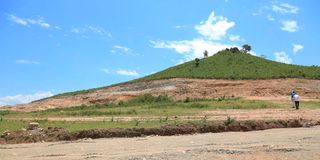
The changing face of Got Alila Hills in Koru, Kisumu County, on August 24, 2023.

From one big crime scene that detectives cordoned off way back in the 90s, Got Alila in Koru, Kisumu County, now carries with it hope to thousands of residents who have for decades suffered folowing devastating effects of perennial flooding.
After his murder on February 13, 1990, the partly burnt body of the late former Foreign Affairs Minister Robert Ouko was discovered at Alila Hills, about three kilometres from his home.
As the police quickly embarked on a mission to unearth the killers of former President Daniel Moi’s powerful government official on February 16, 1990, a number of locals who lived in the area hastily moved to other areas for fear of what would befall them for witnessing the high-level crime.


But 33 years down the line, the laying of the Sh20 billion Koru-Soin multipurpose dam foundation at the foot of Got Alila Hills is slowly rekindling hope for a better future for the residents living at the border of Kisumu and Kericho counties.
A spot check by the Nation established that the two Chinese contractors tasked with building the dam have already started excavation works to set up the foundation at the slopes of Got Alila in Muhoroni and Koitatui Hill in Soin, a few metres from where Ouko’s body was dumped.
“While getting the people who brutally murdered our kin is slowly fading away, we are consoled by the fact that the project which has stalled for decades has finally kicked off,” said Benard Juma, a resident of Got Alila.
Other than providing water for irrigation all year round, the dam, with a storage capacity of 93.7 million cubic metres, is expected to end the flooding along River Nyando in Kano plains that has over the years caused loss of lives, property and livestock.
The dam is also expected to supply water for domestic use, hydroelectric power generation, and offer opportunities in fishing and water-based tourism.
According to the National Water Harvesting and Storage Authority (NWHSA), the multipurpose dam is designed to supply 72 million litres of water per day for domestic use, irrigation of 6,350 acres and generation of 2.5 megawatts of hydropower.
While the residents have welcomed the move by the government to permanently provide a solution to the perennial floods in Nyando, a section of landowners have raised concerns over the prolonged delays in settlement of claims.
“It is unfortunate that the contractors have started working while the residents are yet to be compensated for the land acquired from locals,” said Tom Olale, a resident of Koru.
Despite getting letters of award from the National Land Commission (NLC) and NWSHA in 2021, Mr Olale raised concerns that they are yet to be paid.
“All this while, we have been restricted from farming in our land while we have no alternative land,” said the 72-year-old man who lives in a nine-acre piece of land with extended family.
Mr Olale’s biggest worry is, however, the fast-rising cost of land. Compared to two years ago, he said, the price of land has soared to unreasonably high levels.
“While we were awarded an approximate Sh550,000 per acre of land, the price has skyrocketed to over Sh1 million and we are worried that it could go higher,” he said.
For the families still living within a radius of 1km from the blasting site, they raised concerns that any further delay to settle claims is putting their lives at risk.
“For the three occasions that the joint contractors have used heavy machinery to blast the rocks, the vibration has already caused extensive cracks on our walls and endangering our lives,” said Merab Onyango.
To make it worse, she added, the activity has come with a lot of inconveniences for the locals, who are required to vacate their homes with their livestock to protect themselves and their animals from harm due to explosions and flying rocks from the blast.
“It is unfair that the delay continues while the contractors have already sealed off our well and the roads leading to our homes, making it difficult for us to move around amidst the ongoing works,” he said.
Another resident, Valerie Adoyo, has called on the government to give priority to those living close to the site to safeguard them from harm and contracting diseases.
“It has become unbearable to live here due to the loud bangs and dust-filled air,” she said.
However, the consultant project sociologist, Webster Omondi, noted that they provide adequate notice to the residents to clear from the blasting zone as a measure of safety.
“We usually give at least five-day notification to community liaison members, local administrators and the police,” he said.
“In case of any damage to property, we have issued complaint forms to area chiefs, which the residents can pick and submit to the management for assessment before they are compensated for the same,” he said.
According to the plans, the multi-billion contract awarded to China Jiangxi International Kenya and China Jiangxi International Economic and Technical Cooperation Company is set to be completed by 2028.
Among other areas, the water will be supplied to Kisumu City, Ahero, Chemelil, Miwani, Awasi, Muhoroni, Koitaburot and Koru townships.
The dam has been earmarked as an offsite infrastructure and a viable project critical for the operation of 10,000 acre Kisumu’s Special Economic Zone in the Miwani area.
- Additional reporting by Rushdie Oudia