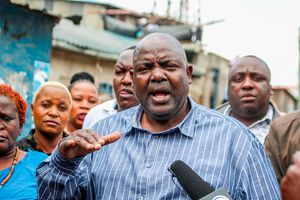
National Treasury and Economic Planning Cabinet Secretary John Mbadi has declared that ODM’s political direction for 2027 hinges squarely on its leader, Oburu Oginga, and the party’s internal organs, casting the Siaya Senator as the decisive voice in any future alliances and coalitions.
The former ODM National Chairman said the party’s next steps will be guided not by internal pressure but by Dr Oginga’s counsel and the institutional decisions of ODM’s top organs.
Speaking during an exclusive interview on NTV, Mr Mbadi dismissed claims that ODM was drifting or undecided on its 2027 posture, arguing that the party’s roadmap remains intact and anchored on structured consultations.
He said Dr Oginga, as the party’s senior-most figure after the death of Raila Odinga, plays a central role in providing political direction at a time when the country’s coalition landscape is rapidly shifting.
CS Mbadi on Kenya's economy, goon economy and ODM after Raila's death
Mr Mbadi added that the party will make its choices based on what strengthens the movement and protects its identity.
In the wide-ranging interview, touching on ODM succession, corruption, the economy, and governance reforms, Mr Mbadi was emphatic that while the party is experiencing expected internal turbulence, the final authority on political alliances and strategy remains with its leadership.
Pressed on the visible public contradictions within the ODM leadership, Mr Mbadi dismissed the disquiet as normal in any political transition.
“In every democracy, divergent views are encouraged because they enrich decisions. What has happened in ODM was expected,” Mr Mbadi explained.
He likened the moment to a natural disruption that follows the exit of a towering political figure: “You don’t expect such a towering leader to vacate the scene and everything remains the same. It’s like dropping a stone in water – it must stir. Or a big tree falling – there must be casualties and birds scattering.”
According to the CS, the party is not in chaos but in a natural moment of realignment, and the turbulence is already beginning to settle.
He points to the party’s constitution, which explicitly vests political authority in the party leader, now Dr Oginga, Raila’s elder brother and a long-standing ODM strategist.
“The tradition and our constitution say the party leader is the only person allowed to negotiate any arrangement, be it a coalition or the political direction of ODM,” said Mr Mbadi.
“All the rest will give their views, but finally, the party leader has to give direction.”
This clarity, he adds, should end speculation about competing factions, divergent messaging, or leadership confusion.
“Dr Oburu Oginga will finally announce to the country the direction we are taking, after consulting the party organs.”
He acknowledged that the Secretary-General, Mr Edwin Sifuna, and one deputy party leader, whom he did not mention, may hold diverging views, but insisted that the rest of the central committee – including the chairperson, director of elections, and two deputies – are aligned on the general direction ODM should take ahead of 2027.
Nairobi county Senator Edwin Sifuna speaks during a church service at Jesus Teaching Ministry (JTM) in Nairobi on held on August 24, 2025.
Photo credit: Billy Ogada | Nation Media Group
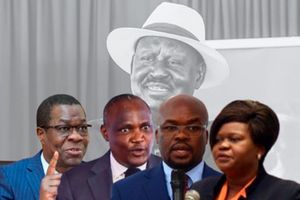
The three ODM deputy party leaders are Governors Abdulswamad Nassir (Mombasa), Simba Arati (Kisii), and Vihiga Senator Godfrey Osotsi.
On Thursday, Mr Osotsi and Mr Sifuna were summoned by Luhya elders to discuss the region’s stake in ODM post-Raila.
During the meeting, the Daily Nation learnt, the elders sought updates on the happenings in the party and alleged sidelining in the broad-based government arrangement.
Led by Mzee Patrick Wangamati and former Cabinet Minister Noah Wekesa, the elders said they had not been briefed about the broad-based government deal despite the community being fully behind the ODM party.
For a party that has been built around Raila’s personality for nearly two decades, the transition was bound to be emotionally and politically charged.
Mr Mbadi’s comments during his NTV interview are the first authoritative attempt to calm the waters and define order.
Siaya Senator Oginga Oburu during an interview with NTV at Serena Hotel Nairobi on Thursday, October 30, 2025.
Photo credit: Dennis Onsongo | Nation Media Group
He characterises Raila’s departure from active party leadership as “a big tree falling” – shaking the ecosystem and forcing political fauna to scatter before stabilising again.
To him, the transition is a necessary phase – one made smoother by the party’s established structures and Dr Oginga’s legitimacy as both party leader and institutional memory.
ODM, Mr Mbadi argues, is not “leaderless” but “in a process” – and that process will culminate in a coherent 2027 strategy under Dr Oginga’s command.
Mr Mbadi insisted that ODM’s internal debates must not be mistaken for fragmentation. The noise, he says, is part of a transition – but the compass remains clear.
“What is important is what the top leadership finally says. And the top leadership is led by the party leader.”
And for avoidance of doubt: “As it is today, the party leader is Dr Oburu Oginga. He will announce the direction ODM takes in 2027.”
Away from ODM politics, Mr Mbadi turned his attention to corruption, referencing former President Uhuru Kenyatta’s claim that Kenya could be losing Sh2 billion daily to graft.
He clarified that his statement was not based on personal research but on the authority of a former Head of State who had full access to intelligence tools, including NIS and DCI.
“A President with all the machinery publicly said we lose Sh2 billion per day. I had no reason to doubt it,” he said.
But, he argues, the real tragedy was the government’s failure to act decisively after the revelation.
“Where we dropped the ball is this: after speaking about the two billion, no steps were taken to sort it out or reduce it.”
He insists that had serious measures been implemented four years ago, Kenya would not today be burdened with expensive foreign debt or fiscal distress.
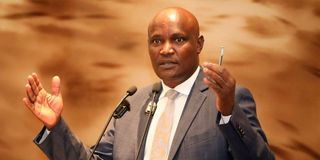
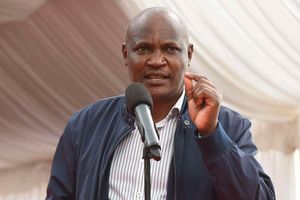
Treasury and National Planning Cabinet Secretary John Mbadi.
Photo credit: Jared Nyataya | Nation Media Group
Now as Treasury CS, Mr Mbadi says he is championing reforms that directly cut corruption opportunities – and that the resistance these reforms have triggered is proof they strike at the heart of entrenched graft networks.
Among the key reforms he mentioned is the e-Procurement System, which he noted will address procurement corruption – “the largest chunk of corruption in this country.”
By digitising tendering, price manipulation, bribery and favouritism will be significantly reduced, he said.
He also emphasised that the Treasury Single Account (TSA), where he is pushing all government entities, including Parliament, into the TSA framework, will also help address issues of graft.
“It will stop cherry-picking of suppliers. If you requisition money to pay X, you will pay X – not divert it to Y,” he said.
He also mentioned human resource payroll integration, stating that a unified Human Resource Management Information System (HRMIS) is being rolled out to eliminate ghost workers and payroll fraud.
“The days of incremental and opaque budgeting are ending. Zero-based budgeting will deal with budgeted corruption,” Mr Mbadi said.
“In the next one year, we will be fully ZBB.”
“You cannot say this administration is doing nothing. We are doing more than any previous government.”
Mr Mbadi revealed that when the Kenya Kwanza administration took over, the economy was “almost at the point of collapse” based on global assessments.
“We were categorised as a country likely to collapse. That is not an economy you fix in one, two, three years.”
Without macro stability, he argues, there is no microeconomic relief for ordinary citizens.
Mr Mbadi attributes the cash-flow struggles among Kenyans not to salary reductions but to job scarcity.
To fix this, the government, he noted, is reviving development projects – but in innovative ways that do not burden the Exchequer.