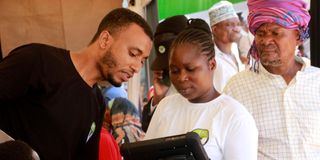
Independent Electoral and Boundaries Commission clerks register voters at Shimoni Fish Port in Kwale County on March 30, 2026

For the past six electoral cycles, Ms Mwanajuma Rashid Hamisi has not been participating because of her community background.
Ms Mwanajuma is from the Pemba community, which has been living in the country for many years without being recognised as citizens, hence denied the opportunity to elect any political leader.
But on March 30, she was among those registered in the Enhanced Continuous Voter Registration Exercise (ECVR), which was launched by the Independent Electoral and Boundaries Commission (IEBC) in Shimoni, Kwale County.
"I have been yearning to have the opportunity to elect political leaders, but I never had an identification card since we were regarded as stateless," she said.
“I have seen at least three presidents, but I did not participate in the electoral process; today I have been registered as a voter,” she added.
Mr Yusuf Ali Abdalla, 38, another member of the Pemba community, said all his nine siblings have never voted, but they are delighted the government recognised them, and they can make their choice in August next year.
“I have five brothers and four sisters; all have failed to vote due to lack of ID cards. Today, I am happy to be among those who have been registered,” said Mr Abdalla from Kichaka Mkwaju, Pongwe Kikoneni Ward in Lunga Lunga Constituency.
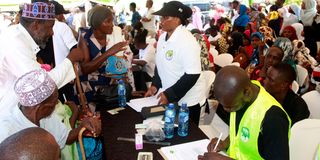
IEBC chairman Erastus Edung Ethekon and his deputy Fahima Araphat Abdalla led electoral body commissioners in the launch, at an area with more than three marginalised communities, which include the Shirazi, Makonde and Pemba.
In July 2023, President William Ruto and government officials launched the issuance of birth certificates, national IDs and passports to over 7,000 members of the community, primarily in the coastal regions of Kilifi, Kwale and Mombasa Counties.
Receiving national IDs has also enabled the Pemba community to access essential government services, education, and employment besides the ability to register for voter participation.
Fishermen from Zanzibar
The community, traditionally fishermen from Pemba Island in Zanzibar, had been living in Kenya since the 1960s, but were not considered citizens until this recent official recognition.

Independent Electoral and Boundaries Commission Chairperson Erastus Ethekon and Kwale Governor Fatuma Achani at Shimoni Fish Port during the launch of Enhanced Continuous Voter Registration exercise in Kwale County on March 30, 2026.
Other minority groups that are also given priority during the launch of the exercise are members of the Makonde community, who have also been stateless after migrating from Mozambique. The community was formally recognised as the 43rd tribe in Kenya in February 2017.
In 2016, President Uhuru Kenyatta ordered the registration of the Makonde community, and in 2017, thousands officially received their citizenship documents.
Despite this progress, some members, particularly youth who have recently come of age, have experienced delays in receiving their IDs and continue to lobby for land ownership.
The Shirazi, on the other hand, are an ethnic group primarily inhabiting the East African coast (Tanzania, Zanzibar and Kenya). While many have integrated into the broader Swahili community and hold Tanzanian or Kenyan citizenship, others have historically faced challenges regarding recognition and documentation.
However, challenges can arise in obtaining national IDs for some coastal minorities due to vetting processes, which are sometimes seen as discriminatory or arbitrary by minority communities.
Follow our WhatsApp channel for breaking news updates and more stories like this.