Stakeholders have raised concerns that they say must be addressed to accelerate business growth and streamline operations at the Port of Lamu as a new General Manager assumes office.
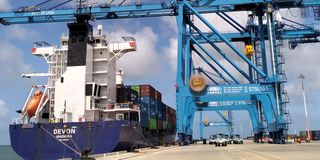
The Sh310 billion Lamu Port, located in Kililana, Lamu West, was launched by the national government on May 20, 2021.
Despite being Kenya’s second-largest port after Mombasa, it has experienced sluggish growth with only about 110 ships docking since its inauguration.
Numerous investor delegations, both local and international, have visited the port. However, few of these visits have resulted in tangible commitments.
This month, the port welcomed a new General Manager, Captain Abdulaziz Mzee, who replaces Mr Vincent Sidai. He becomes the third GM since 2021.
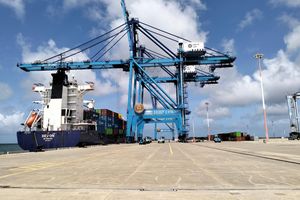
Maritime stakeholders have praised the construction and design of the port, particularly its deep and wide berths, natural harbour and ample yard space, which can accommodate ultra-large container vessels (ULCVs). Despite these advantages, operational challenges persist.
Governor Issa Timamy (right) and newly appointed Lamu Port General Manager, Captain Abdulaziz Mzee on July 17, 2025.
Photo credit: Kalume Kazungu | Nation Media Group
Chief Executive Officer of the Kenya Ships Agent Association, Elijah Mbaru, acknowledged the port's strong infrastructure but stressed the need for complementary road and rail connections to unlock its full potential.
“With support from the government to complete the rail, roads, and storage facilities, Lamu will become a preferred port of call for most shipping lines,” said Mr Mbaru.
He also cited labour shortages and inefficient cargo-handling equipment as major bottlenecks. Mr Mbaru urged the Kenya Ports Authority (KPA) to recruit more dockworkers to improve cargo turnaround times.
Another challenge is the lack of return cargo, which increases operational costs for shipping lines.
“Imagine a ship calling at Lamu Port to offload trans-shipment units, then proceeding to Mombasa to offload import containers. That ship incurs double vessel-related charges,” he explained.
Mr Mbaru also called for the removal of non-tariff barriers such as complex customs procedures and overlapping regulations, which he said hinder smooth port operations. He criticised the presence of multiple government agencies handling cargo inspection and clearance, blaming them for delays and extra costs.
He further urged the government to support KPA in acquiring additional quay infrastructure to alleviate operational inefficiencies.
Officials from the Kenya International Freight and Warehousing Association attributed the slow growth of Lamu Port to high charges and centralised operations.
According to the association’s Mombasa and Coast Region chair Hamis Rajab, the said port charges in Lamu are almost equivalent to those at Mombasa Port which is already well-established.
“Lower the costs if you want to attract clients like us,” Mr Rajab said.
He also criticised KPA for failing to decentralise key operations, many of which are still managed in Mombasa. He said there is need for full staffing and increased marketing efforts for the Lamu facility.
The new Lamu Port General Manager, Captain Abdulaziz Mzee.
Photo credit: Pool
“Engage us. We are ready to discuss how best we can invest in Lamu Port,” he added.
Truck drivers and logistics professionals stressed the urgent need to complete the Lamu-Ijara-Garissa Access Road, a key part of the Lamu Port-South Sudan-Ethiopia Transport (Lapsset) Corridor. The incomplete 453-kilometre road is considered vital for cargo movement.
Mr Salim Farah, a truck driver, said insecurity along the corridor and delays in road completion have discouraged port usage.
“We need guaranteed security. That would build trust and confidence among investors,” he said.
Truck drivers also raised concerns over night travel restrictions on the Lamu-Witu-Garsen road imposed in July 2014 following al-Shabaab attacks.
Mr Rashid Juma, another driver, also called for the lifting of the night ban.
Mr Mzee acknowledged the work done by his predecessors in laying the foundation for the port’s development. He revealed that some international carriers plan to dock at Lamu Port up to three times a week.
Modern cargo-handling equipment
He also noted that efforts are underway to procure modern cargo-handling equipment and improve navigation safety systems.
“We are targeting to handle over 4,000 trans-shipment containers per month starting August,” he said.
Captain Mzee brings over 34 years of experience in marine operations. He began his career as a cadet officer at KPA Mombasa in 1991 and most recently served as VTS and Harbour Inspectorate and Manager of Pilotage at Mombasa Port.
“My goal is to ensure full operationalisation of Lamu Port and make it a recognised second national port,” he stated.
Meanwhile, Lamu County Commissioner Wesley Koech assured stakeholders that the government is committed to ensuring security and development in the region.
“We are working closely with the Kenya National Highways Authority (KeNHA), Lamu County Government, Kenya Revenue Authority (KRA), and other key players to resolve bottlenecks affecting port operations and cargo transport,” Mr Koech said.