Illegal logging and charcoal burning have sharply declined in Boni Forest following sustained security operations targeting terrorism. According to the Kenya Forest Service (KFS), the practices have reduced by more than 90 per cent compared to previous years.
Between 2014 and 2018, charcoal production and timber logging were lucrative trades carried out deep in the expansive woodland, even as Al-Shabaab attacks escalated in the county.
By March 2018, security agencies declared the activities dangerous, warning that proceeds were being used to fund militants hiding in the dense forest. Officials argued that areas where the trade thrived were also hotspots of recurrent terror attacks.
Frequent crackdowns by multi-agency security teams followed, leading to numerous arrests and prosecutions.
“The declaration of charcoal burning and logging as activities funding Al-Shabaab scared away many traders. No one wants to be associated with terrorism,” said Lamu County KFS Conservator Samuel Lodiro.
He also credited the 2018 government ban on logging for reinforcing compliance. In February that year, the State imposed a nationwide moratorium on logging in public and community forests after finding it posed a major threat to the country’s tree cover.
Boni Forest.
Photo credit: Kevin Odit | Nation Media Group
Although President William Ruto lifted the ban in July 2023 in an effort to create jobs and stimulate economic growth, Mr Lodiro said the earlier directive had left a lasting impact. “Up to today, people respect the ban. That is why we put the reduction of charcoal burning and logging in Lamu at 90 per cent. The remaining 10 per cent is largely individuals making small quantities of charcoal within their compounds or cutting poles for house construction. Even that requires a permit. Inside Boni Forest, such activities are a thing of the past,” he said.
The change has altered livelihoods. In Maleli village, Witu Division, former charcoal burner Rama Menza said he was forced to abandon the trade once it was declared a financier of terrorism. “I used to produce and sell over 20 bags of charcoal weekly.
The business was doing well and I used the proceeds to educate my children. But I had to quit. I tried sneaking back into the forest, but the fear of getting caught was overwhelming. I finally gave up and now I farm,” he said.
In nearby Ziwa Kengo, also in Witu, former logger and timber seller Musa Tenee recounted a similar shift. “I did not have the courage to continue after being told that our logging and charcoal burning inside Boni Forest was being used to buy food and water for Al-Shabaab. I was not ready to be linked to those criminals. I quit to remain a law-abiding citizen,” he said.
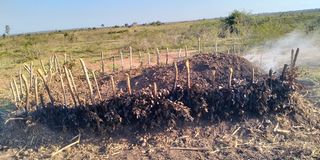
Charcoal burnt at Boni forest on Sunday, August 31, 2025.
Photo credit: Kalume Kazungu| Nation Media Group
Community leaders emphasise that conservation has long been part of Lamu’s culture. County Community Forest Associations chair Abdulrahman Aboud said residents have historically embraced tree protection, a practice reflected in Lamu’s leadership in mangrove cover. The county accounts for more than 61 per cent of Kenya’s mangrove vegetation.
The Emergency Operation Centre (EOC) with Amina Mohamed (seated) and other residents at Mswakini Village in Boni Forest on July 24, 2024.
Photo credit: Kalume Kazungu | Nation Media Group
Conservationists point to visible gains in restoration. Swabra Mohamed, a forest restorer from Matondoni village, said depleted sites in Lamu had been successfully rehabilitated.
Registrar of the Judiciary Winfridah Mokaya, who has followed the progress of forest protection initiatives in the region, recently emphasised that conservation is not only about preserving resources but also about safeguarding lives. She noted that no amount of compensation could replace lives lost to conflicts connected with environmental exploitation.
Boni Forest, which spans about 1,339 square kilometres, has been at the heart of Kenya’s fight against terrorism since it was declared a security operation zone. It is home to the Boni, Aweer and Sanye indigenous communities, who traditionally depended on hunting, gathering and small-scale farming.
Kenya Defence Forces (KDF) soldiers patrol Kotile area on the border of Lamu and Garissa within Boni forest.
Photo credit: Kalume Kazungu | Nation Media Group
The forest’s remoteness and thick cover have made it a hideout for Al-Shabaab militants crossing from neighbouring Somalia. The government has consistently argued that disrupting illegal trade within the forest is a crucial part of weakening the militants’ supply lines.
Security operations such as Linda Boni, launched in 2015, specifically targeted the forest to flush out militants and cut their lifelines. The designation of logging and charcoal burning as terror-financing activities added a new dimension by linking environmental crimes with national security. Officials say the move helped deter locals who might otherwise have engaged in the trade for quick income.
The broader environmental benefits have been equally significant. With reduced tree felling, regeneration in many sections of the forest has accelerated. KFS officials say satellite monitoring and ground patrols confirm a resurgence of tree cover.
Local conservation groups have complemented this by encouraging alternative livelihoods such as farming, bee-keeping and eco-tourism.
Nationally, the push for tree planting has gained momentum under President Ruto’s administration, with a pledge to grow 15 billion trees by 2032 as part of climate change mitigation. Lamu’s high mangrove cover has positioned it as a model county in this initiative. Environmental experts argue that mangroves play a critical role in carbon sequestration, coastal protection and fisheries, making their preservation vital.
Security officers on patrol inside Boni Forest in late March 2018.
Photo credit: File| Nation Media Group
Despite the successes, challenges remain. Security agencies warn that a few people still attempt to exploit the forest secretly. Climate pressures, including drought, also strain local communities, increasing the temptation to revert to charcoal production. Conservationists argue that continued vigilance and community empowerment are key to sustaining gains.
For residents like Menza and Tenee, the transition from logging and charcoal to farming has not been easy, but they acknowledge the long-term benefits. “Farming is tough, but at least I sleep without fear of being branded a terrorist sympathiser,” Tenee said.