Lamu’s floating restaurants are a dreamlike fusion of Swahili charm and ocean serenity.
Bobbing gently on the calm waters of the Indian Ocean, these floating gems offer more than just a meal. They deliver a once-in-a-lifetime experience. At some, guests might not be cautioned about drink-driving but may come across humorous notices like “don’t drink and dive”.
Two decades ago, Lamu had neither floating restaurants and bars nor cruise boats or dhows for leisure. Today, the county of islands boasts more than four floating restaurants and bars, established in various locations across the Indian Ocean.
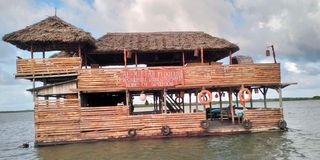
One such attraction is the Al-Miftah Floating Restaurant, about 100 metres offshore from King Fahd County Referral Hospital. Established in 2023, the restaurant embraces Lamu's culture and tradition through its menu of seafood and Swahili dishes.
The Al-Miftah Floating Restaurant in Lamu Island in this photo taken on Friday, July 25, 2025.
Photo credit: Kalume Kazungu | Nation Media Group
Here, revellers are not allowed to bring alcoholic drinks, and the restaurant only serves juice, soda, and water. The proprietor, Fat’hi Salim Masoud, said the joint targets religiously and culturally observant individuals who avoid clubs and pubs that serve alcohol.
“You can enjoy any kind of juice and soda but not alcohol. Even chewing miraa or muguka is prohibited at my restaurant. Lamu is a Unesco World Heritage site. We’re, therefore, spreading and maintaining the culture and traditions of our community even here at sea,” he said.
Visitors enjoy the calm coastal waters and scenic views, making the experience more than just about food. The restaurant provides a boat service for clients.
“Those coming here can be picked either at the Lamu Town, Manda, Mokowe, Shella or King Fahd jetties at very subsidised boat fares,” said boat coxswain Mohamed Bausi.
The Al-Miftah Floating Restaurant in Lamu Island in this photo taken on July 25,2025.
Photo credit: Kalume Kazungu | Nation Media Group
About 800 metres away floats the Lamu Floating Pub, established in 2007. Located about one kilometre from Lamu Old Town and Shella, it is among the few venues near Lamu Island where alcohol is available.
“This place is like paradise. We have delicacies of different kinds. At the back of the pub, you’ll enjoy sitting and swinging your feet in the water while watching the fish swim or viewing the sun directly as it goes down,” said Floating Pub owner Fridah Njeri Njogu.
In Lamu East sub-county, the Pate Tourist Banda, built in 2019, has also gained popularity. Developed by the Pate Resources and Tourism Initiative (PRATTI), a community-led organisation, the structure attracts both domestic and international visitors.
Haji Ramadhan, a PRATTI member, said investors are adopting unique ideas to appeal to tourists in what he called a “slippery” tourism and hospitality sector.
Breathtaking views of the Indian Ocean
“As the trend gains momentum, it’s completely reshaping the way we think about dining and leisure, especially if we, the investors, are to cope with or remain afloat in this slippery tourism and hospitality industry,” said Mr Ramadhan.
Other floating restaurants are under development at Ras Kitau near Shella and the Kitangani area near Mokowe.
Willis Mbura, a visitor from Nakuru, said he enjoys being near water when dining or celebrating.
“Every time I visit Lamu, I like revelling at the Floating Pub. I always feel good being closer to water. Being at the floating restaurant, therefore, means I am right on top of the water and it’s nice,” said Mr Mbura.
Ciarra Leonardo, a tourist from Italy, said her visits to Lamu feel incomplete without dining at one of the floating restaurants. She praised the concept for offering breathtaking views of the Indian Ocean.
The Pate Tourist Banda in Lamu East Sub-County.
Photo credit: Kalume Kazungu | Nation Media Group
“This is the tenth time I am visiting Lamu. Whenever I land here, I’ve ensured once or twice I spend my quality time at the Floating Pub. The fact that it’s in the middle of the ocean provides an unobstructed view of the sea, making it a desirable place worth visiting,” said Ms Leonardo.
Ghalib Alwy, Patron of the Lamu Tourism Association (LTA), said floating venues have become key attractions for the region. Mr Alwy noted that revellers appreciate the serene and unique setting, especially compared to city restaurants.
He revealed that plans are underway to introduce floating massage parlours as a way to further boost Lamu’s appeal.
“I encourage fellow investors in the tourism and hospitality industry to be creative by coming up with more floating restaurants and pubs. In two months’ time, we shall also be having a floating massage parlour within Lamu. Such unique floating ventures provide a novel setting distinguishing them from traditional land-based establishments,” said Mr Alwy.
“You can imagine having diners that are drawn to the allure of eating on water, where the sound of lapping waves, and panoramic views create a serene and romantic atmosphere. These floating venues offer an escape from the hustle and bustle, particularly for urban dwellers, hence, making them a preferred choice for special occasions,” he added.
Twalib Sagaf, an architectural expert based in Lamu, said designing and constructing a floating restaurant requires far more than setting up a dining space on a boat. He said functionality, sustainability, and appropriate materials must be considered — and that these costs deter many would-be investors.
“Compared to constructing a restaurant on land, a floating restaurant is costly. Additionally, the choice of materials is crucial; they must be durable, water-resistant, and capable of withstanding the humid marine environment,” said Mr Sagaf.