At the onset, it was never going to be an easy task for Kenya to build a security wall separating the country with the war-ravaged Somalia; it sounded like the proverbial mission impossible.
The wall was to ward off the Al-Shabaab militants who maimed and killed Kenyans. The mission? To build a permanent barrier along the 700-kilometre border with Somalia from Mandera down to the Indian Ocean, at an estimated cost of Sh8 billion.
The decision was informed by a spate of terrorist attacks in Kenya’s North Eastern region, the coast and in Nairobi.
From the biblical walls of Jericho and the iconic Great Wall of China to the separation barrier along Palestine’s West Bank and the US border wall with Mexico, Kenya saw the need to join the list.
The project began in 2015 under the Ministry of Defence and not the Ministry of Interior that conceived it.
But in unclear circumstances, the plan changed from erecting a wall to a chain-link fence- a far cry from the mega-wall that was initially promised.
Four years later, the project, heavily criticized for its cost and limited progress, had only achieved a small fraction of the intended fencing upon reports of damage and vandalism.
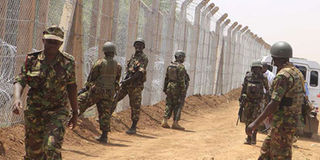
Security officers stand guard at the Kenya-Somalia border on March 30, 2018.
Photo credit: Manase Otsialo | Nation Media Group
Only 10 kilometres had been done by 2019 at a cost of Sh3.4 billion the National Assembly was told, at which rate the project would have gobbled up over Sh200 billion.
The project was divided into three parts including the northern sector from Mandera to Elwak covering 160 kilometres at a cost of Sh3.5 billion, a central sector from Elwak to Libat about 445Kilometres to cost Sh1.8 billion and Southern sector from Libat to Kiunga about 105 kilometers at a cost of Sh2.6 billion.
The wall was designed to feature security posts, surveillance cameras and checkpoints, and regulate immigration as well as prevent militants from crossing.
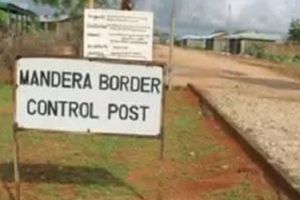
Today, there is free movement of people, vehicles, motorcycles and donkey carts between Mandera in Kenya and Bula Hawa in Somalia.
The official custom point remains deserted with three illegal points recording a beehive of activity.
In this file picture KDF personnel inspect the fencing on the Kenya-Somalia border in Mandera County.
Photo credit: File | Nation Media Group
“There is nothing like restricted movement of goods and people between these two countries. That issue of the border being closed only exists on paper but not on the ground,” Mr Dekkow Hussein, a resident of Mandera said.
According to Mr Hussein, residents of both countries have since adapted to uncontrolled movement.
“In the morning you will witness many people crossing into Mandera from Somalia and in the evening the same people return into Somalia. Who will need to produce a passport to cross either side?” he asked.
He only encourages the government to declare movement through the official point but not to preach the false gospel of reopening a closed border.
“There is nothing like a closed border here. Tell me, are those people not coming in from Somalia?” he asked this writer while at one of the illegal points.
From Kismayu, trucks arrive in Bulahawa where goods are offloaded, loaded on donkey carts and transported into Mandera town.
While supporting re-opening of the border, Mr Yusuf Mohamed, a clan elder in Mandera town said the government needed to regulate importation of substandard goods into Mandera.
“We are getting foodstuff from Somalia but nobody checks the quality of what is coming in because smuggling has become part of our lives. We need to have the official point open so that the Kenya Bureau of Standards can allow only quality goods in our market,” he said.
“The fencing was a good idea because it could have controlled movement of bad elements from gaining access into Mandera. It was people from Bula Hawa who pulled down the fence,” he said.
Poles on a section of the vandalised border wall in Mandera on May 10, 2016.
Photo credit: File | Nation Media Group
Despite Mr Mohamed blaming his neighbors, residents of Mandera had protested the disruption of social and business activities by the border fencing.
“Both sides played a role in demolishing the fence. Business cartels in Mandera incited and even paid residents of Bula Hawa to vandalize the chain-link and barbed wire fence,” a security source speaking on anonymity said.
For four years, the project faced significant setbacks, including funding issues, logistical challenges, and vandalism.
Speaking in parliament in 2019, some members of the national assembly questioned the effectiveness of a wire fence in keeping militants out of the country.
Mr John Mbadi, Minority Leader in Parliament then, now Cabinet Secretary for Finance, said a physical wall was a waste of funds, adding: "Kenya should not be funding such a project but we should invest in intelligence-gathering technology to limit attacks caused by al-Shabab."
It was during this session that the MPs blocked any further allocation of funds to the project and demanded that the state account for the billions spent.
Under this cloud of suspicion, the Ministry of Defence later handed over the project to the Interior Ministry.
Asked during the recently concluded Jukwaa la Usalama meetings about the progress of the project, CS Kipchumba Murkomen denied being in charge of the project and promised to engage his Defence counterpart Soipan Tuya on the same before giving an update.
The project was to be completed by 2015 but a visit to the site shows no sign of a meaningful project but broken concrete poles – clear sign that there was vandalism.
In November 2015, National Youth Service (NYS) personnel downed their tools claiming their allowances, slowing the project.
And in 2018, the project stalled as Kenya and Somalia held discussions over the same including the rationale in having a wall, its effects on daily activities and the fate of residents on both sides.
“That barrier would have separated many families. We have people in this town with families across the border. A man has a wife in Somalia and another in Mandera. Our livestock were being denied to graze on either side,” Mr Hussein Ali, a resident of Mandera said.
He said the official point for the crossing of goods is needed for the government to collect relevant levies but not a fence that would hinder people’s movement.
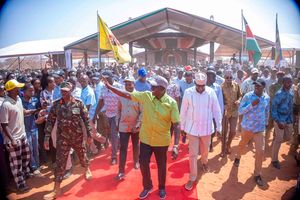
While in Mandera last week, President William Ruto announced that Kenya's border with Somalia will re-open in April almost 15 years after it was shut due to attacks by the Al-Shabaab militant group.
This was the second time President Ruto’s government announced a plan to re-open the border since 2022. In 2023, the phased plan failed due to further attacks by the ragtag militants in counties bordering Somalia.
While in Mandera, President Ruto said the intention to re-open the border followed years of security assessments adding that there will be a heavy deployment of security forces to ensure the move does not compromise safety.
But despite President Ruto's assurance of Kenyans’ safety, a security analyzing organization (Hiraal Institute) in Somalia warned that Al-Shabaab was growing in strength and had regained most of the territory in central areas it lost in a government led offensive in 2022.