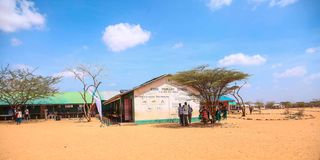
A sense of hope lingers as learners make their way to Korr Primary and Junior School in the arid landscape of Marsabit County yet the pursuit of education here is marked by hardship, resilience and determination.
Korr Sub-County reflects a wider crisis affecting Northern Kenya, where prolonged drought has disrupted livelihoods, education and access to basic services.
Starving learners in Northern Kenya skip classes as school feeding programme collapses
When schools reopened on January 5, there was an influx of learners. However, the severe drought has affected school retention as pupils struggle to attend lessons consistently due to hunger.
According to headteacher Mr Skai Leaduma, the school has a population of 705 learners.
"It’s already February, and we are yet to receive food rations from the government," he said.
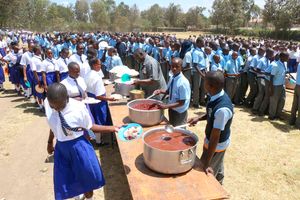
Food supplies under the school feeding programme have been unreliable, with quantities declining over the years.
"In 2025, the school received food supplies only in the first term. Unfortunately, in the second and third terms, we had no food and had to rely on well-wishers," Mr Leaduma explained.
Korr Primary and Junior School which has a population of 705 learners.
Photo credit: Pool
In 2023, the school received no food aid, while in 2024, it only got a few bags of rice and beans that lasted a single term.
"Usually, food comes very late, maybe in the fifth or seventh week when schools are almost closing, and it’s very little," the headteacher said.
Teachers report that many learners are physically present, but are unable to concentrate due to hunger and fatigue.
"Concentration is very low. Many of these children struggle to stand for a long period. We have cases of girls fainting. Pupils lack energy and hardly participate in sports activities," Mr Leaduma.
Currently, classes run from 7am to 1pm. Learners do not return to school after breaking for lunch.
The drought has also affected Kurtider Nomadic Primary School, where the number of pupils has dropped significantly.
Every day, Early Childhood Development and Education (ECDE) pupils report to school with plastic containers, hoping to receive food that they do not have at home. The optimism in their voices hides the struggle of keeping their dreams alive in such a harsh environment. Some walk more than five kilometres on empty stomachs, with the hope of finding porridge at 11am and lunch of rice and beans.
The headteacher of Kurtider Nomadic Primary School, Mr Joseph Kombe, said that enrollment of learners has fallen from 247 pupils to 160.
"How do you expect a child to walk more than 10 kilometres in the scorching sun on an empty stomach? ECDE learners risk dropping out completely," he said.
Before the current crisis, the school received regular aid under the government feeding programme. But in 2024, they did not receive any food, and since reopening in January, the school is yet to get any supplies.
"Sometimes we get food only once a year. That is the trend,” Mr Kombe said.
The half-empty classrooms at the school reflect the struggle of learners. Pre-primary classes end at 12.30 pm, yet the little ones linger, food containers in hand, hoping for a meal. One by one, with sunken faces, they return home empty-handed.
"Initially we had 70 ECDE learners, but currently we have only 22. The majority don’t come to school because there is no food," Mr Kombe said, adding that lack of water is another challenge.
The prolonged drought has also affected Manyatta Lengima Primary School, where pupils are forced to miss classes so that they can search for food.
At St Dominic Xavier Primary School, teachers arrive each morning hoping that learners will show up, but only a few do.
The deputy headteacher, Mr Moses Leado, says that the number of pupils has declined from 113 last term to just 80 this term. Parents have withdrawn their children from school because of lack of food.
When Daily Nation visited the school, most classrooms were empty, while others had only five or six learners. Only seven Grade-One pupils had reported, out of an expected 30.
For years, the school had a feeding programme, which encouraged children to attend classes. The last government food distribution was done in July 2024.
Korr Primary and Junior School learners in class.
Photo credit: Pool
"In 2025, the school received no food at all. So far, there is still nothing. It is becoming increasingly difficult for teachers to retain learners," Mr Leado says.
The school kitchen stands cold and deserted. Teachers once contributed part of their salaries to feed pupils, but this became unsustainable. ECDE classes are hardest hit, with only five out of 39 learners attending regularly.
"In most cases, the food provided at school is the only meal that a child gets in a day. There is nothing at home," said the teacher.
The budget for the government feeding programme, which keeps more than 2.6 million children in school, was slashed by nearly Sh2 billion this financial year.
With reduced funding, schools in Asal areas are struggling to sustain the programme, leaving thousands of learners vulnerable. The National Council for Nomadic Education in Kenya, under the Ministry of Education, continues to provide meals in arid public schools, but the support is inconsistent.
Teachers say the feeding programme is no longer reliable. Efforts to get explanations from the Ministry of Education were unsuccessful, with county officials declining to comment and CS Julius Ogamba and PS Julius Bitok declining to respond at a press briefing.
Meanwhile, thousands of learners in ASAL areas continue to face a daily battle for survival. They are left to fend for themselves amid severe hunger as drought continues to ravage their communities.