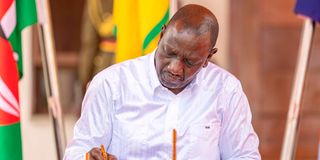
County assemblies will now enjoy financial autonomy from county executives after President William Ruto signed into law a bill granting fiscal and administrative independence to the assemblies.
The development follows the President’s assent to the County Public Finance Laws (Amendment) Bill, 2023, at the State Lodge in Homa Bay County on Wednesday.
President Ruto said the legislation strengthens the independence, effectiveness and accountability of county assemblies, enhancing the separation of powers between the two arms of devolved governments.
“Autonomy will ensure MCAs operate without undue influence from governors or county executives—just like the national Parliament is independent from the national Executive,” said the President.
County assemblies act as the primary legislative and oversight arms of county governments but have long been constrained by a lack of financial independence, leaving them vulnerable to governors’ influence.
The new law amends public finance provisions to allow county assemblies to access funds directly from the National Treasury. It also creates a County Assembly Fund, to be administered by the assembly clerk.
Currently, assemblies must requisition money through the County Executive Committee (CEC) member for Finance, a process critics say turns them into “lapdogs” of the county executive.
Meru Senator Kathuri Murungi, who sponsored the Bill, said the change will prevent governors from starving assemblies of resources when political differences arise.
President William Ruto joins women leaders from Nyanza counties in a dance at Homa Bay State Lodge on August 12, ahead of the start of the Devolution Conference.
Photo credit: PCS
“When a county assembly wants funds to carry out oversight or programmes, they must beg the CEC for Finance—who is a puppet of the governor. If an assembly disagrees with the governor, money will never be released,” said Mr Murungi during Senate debate.
He added that many assemblies fail to perform their oversight role because they are at the mercy of the county executive.
“The Senate and National Assembly would not function if they relied on the Executive for funds. We must treat the 47 county assemblies the same way the national government treats Parliament,” he said.
Kericho Senator Aaron Cheruiyot said the Bill ensures assemblies can access allocated funds without relying on county treasuries, ending the practice of MCAs “going with a begging bowl” to governors.
“It is extremely wrong for us to allow our colleagues in county assemblies to be manipulated through control of resources. This Bill will ensure serious oversight and accountability,” said Mr. Cheruiyot.
Migori Senator Eddy Oketch added that “it is very hard to oversee anyone who controls your funding.”
On his part, Nairobi Senator Edwin Sifuna argued that governors currently keep assemblies “on a short leash,” withholding funds from those who defy them.
Exercise oversight authority
“I have seen cases where governors try to control who leads the Assembly. If you don’t toe the line, the governor can bring all your activities to a halt,” said Mr Sifuna.
Narok Senator Ledama Olekina said the amendment to the Public Finance Management (PFM) Act is timely, as the current system forces clerks to depend entirely on the executive for approvals.
“This change will allow assemblies to exercise oversight authority without dependency on the Executive,” he said.
Machakos Senator Agnes Kavindu said the County Assembly Fund will also boost development at the ward level.
President William Ruto joins women leaders from Nyanza counties in a dance at Homa Bay State Lodge on August 12, ahead of the start of the Devolution Conference.
Photo credit: PCS
“I have seen MCAs struggle because they have to dance to the governor’s tune. Those who don’t are denied development—no roads, no water, nothing,” she said.
She added that MCAs who raise concerns in the Assembly are often accused of fighting governors, making them reluctant to speak out.
“The MCAs cannot perform their oversight role if doing so means their wards will be neglected,” Ms Kavindu said.
The principal object of the Bill is to amend the Public Finance Management Act, Cap. 412A, to provide for the establishment of a County Assembly Fund in each county.
The primary purpose of the Fund shall be to defray the administrative expenses of a respective county assembly and to facilitate the acquisition of assets, such as land and buildings, by a county assembly.
Presently, section 34 of the County Assembly Services Act, Cap 265D, provides for the establishment of a County Assembly Fund, but does not contain comprehensive provisions relating to the management of the Fund, sources of the Fund and the process of requisition of Funds from the Fund.
The Bill therefore seeks to establish the County Assembly Fund within the framework of the Public Finance Management Act and to set out more elaborate provisions on management and access to this Fund.
The Bill proposes that the Clerk of a respective County Assembly shall be the administrator of the Fund and shall ensure that the earnings and accruals of the Fund are retained in the Fund and spent only for the purposes for which the Fund is established; arrange for the monies of the Fund to be kept in the Central Bank of Kenya; and ensure that all money authorised to be paid by the County Assembly for a public purpose is paid from that account without undue delay.
The establishment of the Fund further ensures that any unspent monies at the end of the financial year is retained in the Fund for use by the respective County Assembly.
Notably, the Bill provides that one of the sources of the Fund shall be monies appropriated by the County Assembly from the County Revenue Fund established for each county.