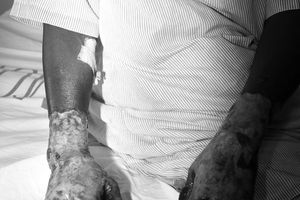
It was around 7.30pm on November 25, 2024, and Alfine Anyango was attending to customers at her shop in Saria area, Awendo sub-County, when a familiar face walked through the door.
It was Margaret Atieno Otieno, her co-wife.
Nothing about the visit initially appeared threatening. Margaret lingered briefly inside the shop and, at one point, answered a phone call, telling the person on the other end that she was on her way.
Then, without warning, the evening descended into horror.
According to evidence presented before the Rongo Law Courts, Margaret suddenly splashed a corrosive substance onto Alfine’s face.
Alfine described the liquid as feeling “hot like water”. Within moments, her face began to swell as the substance ran down her body, burning her back and breasts.
Overwhelmed by searing pain, she collapsed onto the floor, screaming for help.
Her cries drew neighbours and passersby to the shop. Among those who rushed to her aid was her elder daughter, Brenda Atieno Otieno, who is also Margaret’s stepdaughter.
Brenda told the court that she had been taking supper to her mother at the kiosk when she encountered Margaret leaving the shop, carrying a jug under her armpit. She was wearing blue jeans and a brown sweater.
Moments later, Brenda heard screams.
She rushed into the shop and found her mother sprawled on the floor, her face burnt and rapidly swelling.
Victor Otieno, an employee of George Otieno Odembo, the husband of both women, also responded to the screams.
He testified that earlier that day, Margaret had approached him and asked about Alfine’s whereabouts. He directed her to the kiosk and minutes later, he heard Alfine screaming.
When he arrived at the shop, he found her writhing in pain on the floor with her face burnt by acid. He told the court that Margaret fled into the woods when she saw him.
Mr Otieno took Alfine to Dede Dispensary before she was transferred to Migori County Referral Hospital.
Alfine fell unconscious and was admitted to Migori County Referral Hospital for two weeks before being transferred to Ombo Mission Hospital. She was later referred to Kisii Chiron Hospital for specialised plastic surgery, where she spent another two weeks.
She was finally discharged on December 24, 2024, nearly a month after the attack.
The court heard that she sustained severe chemical burns and scars on the left side of her face, hands and breasts, with the burns assessed at eight per cent.
Her ordeal, however, did not end when she left hospital.
The court noted that Alfine has never fully recovered, particularly after suffering an eye injury that required another operation. The court was told she can no longer work or carry out her daily duties as she did before the attack.
Nearly two years after that November evening, the attack has now earned Margaret a lengthy prison term.
Rongo Law Courts in Migori.
Photo credit: File| Nation Media Group
Rongo Principal Magistrate Chrisphine Orwo sentenced the Migori County woman to 25 years in prison after finding her guilty of attempting to kill Alfine, a woman with whom she shares a husband.
Mr Orwo said the court was satisfied that Margaret unlawfully splashed the corrosive substance on Alfine in an attack that nearly claimed her life and left her permanently disfigured.
Investigating officer Erastus Musa, who is attached to Awendo Police Station, told the court that the incident was booked under OB No. 02/26/11/2024.
Margaret was arrested on November 26, 2024, by members of the public who, according to evidence presented in court, wanted to lynch her.
The prosecution produced several exhibits, including photographs of Alfine’s injuries, a certificate of photographic printout and the brown and white dress she was wearing when she was attacked.
During the hearing, Margaret denied the charges. In her defence, she claimed she was at Dede in Saria village at the time and that a fight had broken out after her co-wife insulted her.
The court, however, rejected her defence, finding that the prosecution had proved its case beyond reasonable doubt.
Margaret was convicted of attempted murder contrary to Section 220 of the Penal Code and grievous harm contrary to Section 234 of the Penal Code.
Mr Orwo said that, for a conviction for grievous harm under Section 234 of the Penal Code, the prosecution had to establish several essential elements beyond reasonable doubt.
These included proof that the victim suffered grievous harm, that the harm was inflicted unlawfully and that the accused caused or participated in causing it.
Section 4 of the Penal Code defines grievous harm as harm amounting to maiming or dangerous harm, serious or permanent injury to health, permanent disfigurement, or permanent or serious injury to an external or internal organ, membrane or sense.
Medics who treated and examined her confirmed that she suffered extensive chemical burns to her face, neck, chest, breasts, upper limbs and back.
Alfine also endured prolonged hospitalisation, specialised treatment and skin-grafting surgery.
In sentencing Margaret, the magistrate said he had considered submissions in mitigation from the defence and prosecution, as well as the circumstances of the attack and the lasting injuries inflicted on Alfine.
“I have taken into consideration mitigation by counsel for the defence and prosecution in rejoinder. I have also taken into consideration the circumstances of the case and the injuries the complainant suffered. The injuries were life-threatening, which left permanent disfigurement on the face of the complainant and her life,” Magistrate Orwo said.
He added: “I will, however, in sentencing, instead of sentencing the accused person to the mandatory life sentence, I will sentence the accused person to 25 years imprisonment with 14 days right of appeal.”