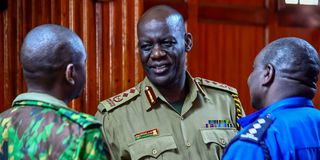
For a police officer entrusted with protecting judges and senior government officials, Lazarus Opicho knew the sensitivity of seeking information about a judge’s whereabouts.
Yet in September 2024, that responsibility landed the senior officer in court, where he was ordered to explain himself to the very judge whose movements he had sought to establish.
Opicho, a Senior Assistant Inspector-General of Police and former commandant of the Security of Government Buildings (SGB) and VIP Protection Unit, died on Monday at a Nairobi hospital where he had been receiving treatment.
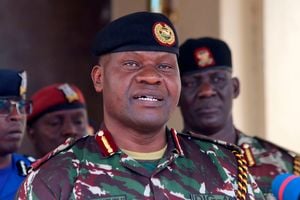
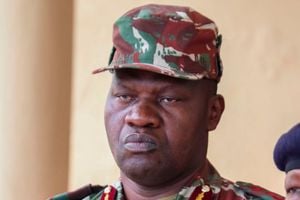
His death brought messages of condolence from senior figures in the security and justice sectors, including Inspector-General of Police Douglas Kanja and Chief Justice Martha Koome.
Chief Justice Martha Koome.
Photo credit: Billy Ogada | Nation Media Group
But one of the more unusual episodes of his career had unfolded two years earlier, when his work protecting the Judiciary briefly placed him on the other side of the courtroom.
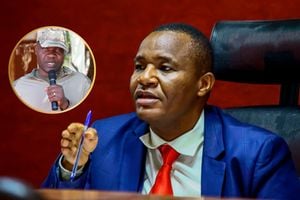
At the time, Opicho was commandant of the SGB and VIP Protection Unit. He contacted officers assigned to protect High Court Judge Lawrence Mugambi, seeking information about the judge’s whereabouts.
Justice Lawrence Mugambi.
Photo credit: Wilfred Nyangaresi | Nation Media Group
The calls came shortly after Principal Magistrate Monica Kivuti was shot inside a courtroom at the Makadara Law Courts in Nairobi by Chief Inspector Samson Kipchirchir Kipruto, then the OCS of Londiani Police Station. Kipruto was shot dead by court orderlies, while Ms Kivuti died days later while receiving treatment.
Against that tense security backdrop, Justice Mugambi, who was handling proceedings involving Deputy Inspector-General of Police Gilbert Masengeli, took exception to Opicho’s calls to his driver and bodyguard.
The judge directed the senior officer to appear personally and explain why he had sought the information, describing the conduct as “unbecoming” and bordering on intimidation.
He told the judge that his actions had been prompted by security concerns following the Makadara shooting and apologised for the calls.
“After the Makadara Law Court shooting incident, I found it prudent to personally call the police assigned to the judge for a briefing,” Opicho said.
He also pointed to a long professional relationship with judicial officers, dating back to his tenure as the pioneer commandant of the Judiciary Police Unit.
“I endeavour to serve you diligently and all the judicial officers and this will not happen again,” he told Justice Mugambi.
The episode offered a rare glimpse into the delicate responsibilities Opicho carried in assignments where vigilance could easily be perceived as overstepping.
Much of his career, however, was spent building security structures rather than appearing before the courts.
Before taking charge of the SGB and VIP Protection Unit, Opicho served as the inaugural commandant of the Judiciary Police Unit, established in 2021 to provide specialised security for judicial officers, staff, court users and Judiciary premises across the country.
He helped establish the unit from its formative stages, laying the foundations for a dedicated security structure within an institution whose officers routinely handle sensitive and sometimes volatile disputes.
In her condolence message, Chief Justice Koome described Opicho as a distinguished police officer who devoted many years to public service and protecting institutions and the people who served within them.
His subsequent appointment to the SGB and VIP Protection Unit placed him in charge of another specialised arm of policing responsible for protecting government buildings, senior officials and other VIPs, including judicial officers and dignitaries requiring specialised security.
Mr Kanja remembered Opicho as a dedicated officer who served the National Police Service with commitment and integrity. His career was largely lived away from the public spotlight, in the demanding world of protecting institutions, officials and people whose safety was considered critical to the functioning of government.
For a brief moment in 2024, however, the officer accustomed to protecting those in court found himself standing before a judge and explaining his own actions. In death, the police service and Judiciary are remembering a career defined largely by the protection of others.