Six Iranians arrested in the Indian Ocean with Sh8.2 billion worth of methamphetamine, commonly known as meth, have rejected a Baluchi-English interpreter linked to the US.
The interpreter had been provided by the US Naval Criminal Investigative Service (NCIS) to help the suspects follow proceedings at the Shanzu Law Courts in Mombasa, and to enable the court to understand them.
However, the suspects — Jasem Darzaen Nia, Nadeem Jadgai, Imran Baloch, Hassan Baloch, Rahim Baksh and Imtiyaz Daryayi — unanimously rejected his services, accusing him of failing to communicate effectively.
“We reject him, we do not understand him,” the suspects said in unison, as translated by another interpreter.
Five of the six Iranians accused of trafficking meth when they appeared at the Shanzu Law Courts on October 28, 2025.
Photo credit: Wachira Mwangi | Nation Media Group
Mr Amin Ahmed Juneja, another interpreter sourced by the Judiciary, informed the court that the suspects did not want his colleague to continue, alleging that he was withholding information.
“The suspects are complaining that the court says something lengthy, but the interpreter only relays a very brief version,” said Mr Juneja, who replaced the NCIS interpreter.
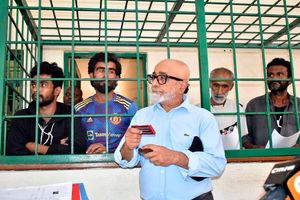
Interpreter Amin Ahmed Juneja at the Shanzu Law Courts in Mombasa on October 28, 2025.
Photo credit: Wachira Mwangi | Nation Media Group
On Monday, the US-linked interpreter had facilitated translation during a brief court session before the prosecution requested time to verify his documents and confirm his competence.
As the verification was ongoing, the court sourced Mr Juneja, who has long served as an interpreter in cases involving Pakistanis and Iranians who speak Urdu, Baluchi, or Farsi.
Confirmation of US involvement
Shanzu Chief Magistrate Anthony Mwicigi was forced to accept and continue with Mr Juneja’s services, leaving the NCIS interpreter stranded in court.
An NCIS representative had earlier told the court that the interpreter had been contracted by the agency to assist with the suspects' communication.
“He has been contracted to work for NCIS. I have a copy of his contract,” the officer said.
The presence of the NCIS official in court confirms American involvement in the case, which touches on one of the largest narcotics hauls ever intercepted in Kenyan history.
On Saturday, people believed to be foreign security agents were also spotted at the Port of Mombasa during the press briefing announcing the navy's interception of the vessel with 769 packages of crystalline substances weighing 1,035.986 kilogrammes.
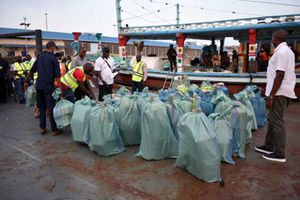
Some of the 1,024 kilogrammes of synthetic drugs seized from six Iranian crew members aboard a vessel. The haul, estimated to be worth Sh8.2 billion, was seized about 650 km off the shore of Mombasa.
Photo credit: Wachira Mwangi | Nation Media Group
During the briefing, Director of Criminal Investigations boss Mohamed Amin said the operation was carried out by a multi-agency team comprising the Anti-Narcotics Unit, the Kenya Navy, the Coast Guard, Port Police, the National Intelligence Service, the Kenya Revenue Authority and the Kenya Ports Authority Police, in cooperation with "regional partners".
From left: Nacada CEO Dr Anthony Omerikwa, DCI boss Mohamed Amin and Brigadier Sankale Kiswaa address the press at the Port of Mombasa after seizing meth from an Iranian vessel.
Photo credit: Wachira Mwangi | Nation Media Group
The stateless vessel had been under international surveillance before its interception, suggesting the involvement of foreign governments.
On Tuesday, the Shanzu Law Courts granted officers from the Anti-Narcotics Unit permission to detain the six Iranians for 30 days to conclude investigations into the record-breaking seizure.
After the Kenyan Navy intercepted the Iranians' unidentified vessel in the Indian Ocean, it was escorted to Kilindini Port on October 24, 2025 where officers, acting on a search warrant, seized the narcotics.
Finding the consignment’s owner
According to an affidavit by Inspector Shadrack Kemei of the Anti-Narcotics Unit, investigators are analysing seven electronic devices, including phones, found on the suspects to trace the consignment’s owner.
Inspector Kemei said the devices are believed to contain vital information linking the suspects to financiers and accomplices in a sophisticated transnational drug network.
He further told the court that two suspects lacked identification documents, prompting police to seek assistance from the immigration department to verify their nationalities.
The suspects, who did not have legal representation, did not oppose the State’s application to detain them. They told the court, through the interpreter, that they had provided the police with all necessary information to facilitate investigations.
They also requested to be served boiled rice without cooking oil and bread, adding that they preferred a balanced diet during their detention.