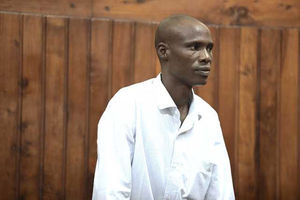
A deliberate chain of apologies before the High Court in Mombasa, starting with God and moving through grieving families, the State and the international community, ultimately altered the fate of a convicted police officer sentenced to 90 years for a triple killing inside a police station.
Rather than contest his guilt, Police Constable Harrison Kipng’etich Langat mounted a calculated plea for mercy, invoking repentance and proportionality to persuade the court to revisit the three consecutive 30-year sentences that had effectively condemned him to die in prison.
On the night of March 16, 2003, Kipng’etich loaded his G3 rifle, walked into the report office at Mtwapa Police Post, now Mtwapa Police Station in Kilifi County, and opened fire.
Mtwapa Police Station.
Photo credit: Kevin Odit | Nation Media Group
Within moments, three people lay dead. They were Doreen Wawira and Alice Katonye, civilians who had gone to lodge a report, and Police Constable Jacob Nderi, who was manning the report desk.
The perpetrator was reportedly intoxicated when he entered the station where he was employed and gunned down the trio. Three other individuals, Mr David Kyalo, Mr Jonathan Kigame and Mr Anwar Nassir, survived the shooting.
Witnesses testified that after the attack, he fled to his residence, where he was disarmed and subsequently arrested.
The legal proceedings were protracted, initially downgrading the murder charges to manslaughter before reverting them to murder.
He first faced charges of manslaughter at the Magistrate’s court in Mombasa, but the trial was halted midway following an escalation of the charges.
The convict defended himself by stating that he was drunk at the time and could not recall what transpired on the material night.
“I was intoxicated at the time. As I left the patrol base, I overheard people shouting that I should be apprehended and detained,” he stated.
Presidential clemency later spared him the hangman’s noose, commuting the sentence to life imprisonment. That sentence was subsequently revised to 30 years on each count, with the terms ordered to run consecutively.
Last year, Kipng’etich returned to the High Court, not as a defiant executioner, but as a penitent man draped in remorse, asking not for exoneration but for redemption, insisting that punishment without hope had extinguished the very purpose of sentencing.
In his application for a review, he argued that the three consecutive terms translated into a life sentence disguised as numbers, amounting to 90 years in prison for a man now aged 48.
Such punishment, he contended, mocked rehabilitation and erased any realistic prospect of reintegration.
He did not deny his crimes. Instead, he framed his plea around repentance, proportionality and the philosophy of punishment. He told the court that the sentence condemned him to “permanent isolation”, stripped prison reform of meaning and rendered any skills acquired behind bars useless.
“I admit before the Lord that I am a sinner, but sinners are creatures who still maintain their images and remain to be the objects of attention and love of God,” he swore, invoking scripture and repentance theology to anchor his plea.
He then apologised methodically and expansively, to God for violating divine decrees, to the families traumatised by his actions, to the State whose laws he betrayed, to the global community appalled by the crime and to his young family, now living in destitution because of his incarceration.
“Sinners can reform, that is why he who does a wrong is taken to a prison not only to stay forever but to discover his or her wrong deeds and call for repentance, which shall invite forgiveness, as forgiveness make all of us better persons,” he said.
He made it clear that his plea did not mean he was not a wrongdoer, but rather that he was a sinner seeking forgiveness from the people of the world and a second chance to reintegrate with his family, who had expressed willingness to accept him back.
Kipng’etich urged the court to view the murders as arising from a single transaction, committed in one place, at one time and under one state of mind, arguing that the law allowed such sentences to run concurrently.
He cited sentencing principles that emphasise rehabilitation alongside retribution and warned that a punishment extending beyond life expectancy defeats justice rather than serves it.
A picture of the Mombasa Law Courts| Pool
Photo credit: Pool
“In the current matter, the convict was taken to a line of permanent isolation which lost the meaning of rehabilitation. In comparison of the life span currently experienced with the age line am yet shall be 130 years, as now am 48 years old,” he said.
He further faulted the sentencing court for failing to fully credit the years he had already spent in custody, from his arrest in 2003 through prolonged pre-trial detention, intermittent bail, re-arrest and eventual conviction in 2019, contrary to mandatory provisions of the Criminal Procedure Code.
According to the convict, there is no limit to reform other than being in prison since 2003, coupled with the many apologies he has made and the regrets he has endured in custody.
“My prayer to this court is to term me as a sinner who has repented and ready for reintegration to the community,” he said.
Kipng’etich also asked the court to consider the circumstances under which the offence was committed and conclude that all sinners are equal before the Lord and that there is no sin that cannot be forgiven before the Lord.
The High Court reviewed the case and held that the sentencing process was legally flawed, finding that failure to comply with the law resulted in an unlawful and manifestly excessive sentence.
The court said the omission denied the accused credit for time already spent in custody and warranted judicial intervention to correct the irregularity.
In revisiting the sentence, the court said it was guided by the fact that the three murder counts arose from one continuous incident, committed on the same day, at the same location and over a short, uninterrupted period.
It noted that the evidence revealed a clear unity of purpose, continuity of action and commonality of witnesses, bringing the case squarely within the meaning of a single transaction under Section 135 of the Criminal Procedure Code.
The court observed that although the convictions were properly entered on their merits and remained undisturbed, the sentencing court had failed to adopt a global approach.
As a result, it imposed consecutive sentences based on identical facts, evidence and circumstances, a move the judge said amounted to procedural unfairness and exposed the accused to cumulative punishment that did not reflect the true character of the incident as a single criminal episode.
“The convictions on all three counts are upheld, as they were properly entered on the merits. The sentences of 30 years on each count shall run concurrently, not consecutively, to reflect that the offences arose from one continuous incident,” the court said, in a November 2025 ruling.
The High Court ordered that the sentence shall run from the date Kipng’etich was first arraigned in court in 2004, less the four years he was out on bond, and directed the trial court to issue a revised committal warrant in line with the decision.