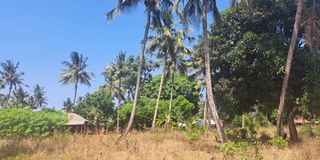
Mature coconut and mango trees, their trunks thick with age, stood as living witnesses to generations of cultivation, transforming into powerful cultural markers that ultimately secured indigenous squatters 300 acres at no cost, protecting them from being rendered homeless.
The National Land Commission’s Historical Land Injustice Committee affirmed that the natural and cultural markers were more than scenery; they constituted evidence of a community’s longstanding relationship with the land located in Bamburi.
“Oral and written evidence shows that some residents, particularly from the Kashani area, have occupied the land since the early 1900s. Historical events such as a survey conducted in 1920, graves dating back to 1962, and the cultivation of mature coconut and mango trees substantiate long-term presence,” stated the committee comprising Commissioners Prof James Tuitoek, Esther Murugi, Hubbie Al-Haji, and Tiya Galgalo.
While acknowledging that Thathini Development Company Limited legally acquired the land in 1979, the committee noted that indigenous communities with established ties deserve priority in the regularisation of their occupation and issuance of title documents.
“Although the firm is the legal owner, long-term occupation by squatters creates a moral and social dilemma, even if it does not meet the legal requirements for adverse possession,” the committee observed.
The committee recommended that Thathini cede 300 acres to facilitate resettlement of indigenous residents at no cost.
“Indigenous residents will be allocated 300 acres free of charge on the land they currently occupy. There will be no evictions or demolitions on the three parcels,” it added.
Some of the settlements in the 4,200 acres of land belonging to Thathini Development Company Ltd. Squatters have been occupying part of the land since the 1900s.
Photo credit: Brian Ocharo | Nation
Non-indigenous residents were instructed to enter individual sale agreements with the firm, with a minimum purchase price of Sh500,000 per 50x100 plot, payable within 90 days (extendable to six months).
All public institutions within the parcels are to retain their land free of charge, with implementation to be overseen by the national and county governments alongside the firm.
Some of the public schools on the land were commissioned by former President Uhuru Kenyatta. Other institutions on the land, which include health centres and religious facilities, must also be protected, the committee noted.
Following investigative hearings conducted by the committee this year, the Environment and Land Court, in October, adopted the Commission’s recommendations, bringing a decades-long dispute to a close.
Anthony Murithi, the company’s projects advisor, pledged full compliance with the court’s directives, ensuring indigenous residents receive their 300 acres free and facilitating a straightforward process for non-indigenous buyers.
“As a firm, we will faithfully and meticulously implement the court's directive to ensure this long awaited resolution is realised smoothly and justly,” he said.
For the indigenous residents, the decision was not merely about land, but about recognition, dignity, and the validation of a history written in the soil, the trees, and the memories of those buried beneath them.
The squatters, organised under the GAMAKA Community-Based Organisation representing Gandini, Maunguja, and Kashani, alongside Ujeri Uhumika and Magwanda Farmers, argued that the land was their ancestral heritage, occupied since at least 1901.
They filed the claim against the firm, the Attorney-General, Mombasa County and the Ministry of Lands, Housing and Urban Development, arguing that their forefathers had lived on and cultivated the land as early as 1901, long before the arrival of colonial powers.
Some of the settlements in the 4,200 acres of land belonging to Thathini Development Company Ltd. Squatters have been occupying part of the land since the 1900s.
Photo credit: Brian Ocharo | Nation
According to them, the British and Arab colonial authorities dispossessed their ancestors and later allocated the land to private entities, including Thathini, without the consent or involvement of the indigenous community.
They maintained that the allocation to Thathini perpetuated historical injustices initiated during colonial rule. They insisted that their continuous occupation, the presence of graves, and long-term cultivation of the land were proof of their ancestral ownership.
Thathini, representing over 800 members, maintained that it lawfully acquired the 4,252-acre property in 1979. The firm accused settlers of unlawful invasion, subdivision, and sale of land, noting that prior efforts, including a 2018 proposal to the Ministry of Lands to purchase the property for squatters, had failed.