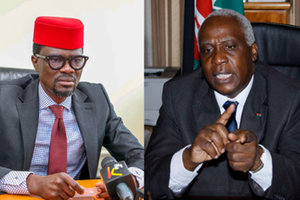
A defamation case by Mombasa businessman and politician Abubakar Joho has taken a new twist, after the defence challenged the authenticity of a document, claiming that the message is a computer-generated fabrication of unknown origin.
The document, allegedly linking Ms Matilda Maodo Kinzani to a social media post that accused businessman Abubakar Joho and his brother, Mining and Blue Economy Cabinet Secretary Hassan Joho, of defrauding Mombasa County of more than Sh40 billion, has now triggered a fresh dispute at the High Court.
Ms Kinzani, the defendant, has challenged the admissibility of the document, arguing that it lacks the mandatory certification required under the Evidence Act and should therefore be excluded from the trial.
Mombasa businessman Abubakar Ali Joho testifies in a Mombasa court in a case where a woman is accused of defaming him.
Photo credit: Mkamburi Mwawasi | Nation Media Group
Through her advocate, she told the High Court that the contested material was irregular, unsupported and legally defective. She argued that although it was presented as a forensic report, it lacked the basic features of a valid forensic document.
“What was produced was said to be a report by Chief Inspector Joseph Kolum, but it had no author. It was not dated, not signed and did not specify the name of the author. It had no laboratory reference number and no exhibit memo from the investigating officer,” the defence said.
She maintained that the authenticity of the document was in serious doubt, noting that no forensic equipment or device accompanied the report to allow independent verification, and further argued that the document failed to meet the legal threshold for electronic evidence.
“The document has no certificate of electronic evidence as required by the Evidence Act. There is no chain of custody and no compliance with admissibility guidelines,” she added.
Through her advocate, Ms Kinzani also pointed out that the document was purportedly addressed to the Government of Kenya, which is not a party to the proceedings, and that it was not mentioned in any earlier forensic reports presented by the prosecution.
The High Court temporarily halted her prosecution, and is expected to rule on whether the contested document will remain on record or be struck out. On Wednesday, the High Court granted the prosecution 21 days to respond to Ms Kinzani’s application, which also seeks to have the criminal trial declared null and void.
The suspect is facing four criminal charges under Section 23 of the Computer Misuse and Cybercrimes Act for allegedly disseminating false information online.
According to the charge sheet, she also circulated a message titled To the Government of Kenya and the Gen Z, in which she allegedly accused Mr Abubakar of drug trafficking, illegally acquiring land belonging to Kenya Railways in Mombasa and stealing containers from the port. Prosecutors say the claims were intended to damage the reputation of the complainant.
During proceedings before the magistrates' court, she had challenged the use of the document linking her to the allegations, questioning its source. The lower court nonetheless allowed it to be produced, ruling that production did not amount to admissibility.
Mr Abu Joho. Autoport Freight Terminals, a firm closely associated with the Mombasa businessman, had enjoyed an almost monopolistic grip on transit cargo destined for South Sudan.
Photo credit: Mkamburi Mwawasi | Nation Media Group
That decision prompted her to move to the High Court to challenge the legality of the document. Before the High Court, Ms Kinzani said admitting the document would violate her right to a fair trial.
In his testimony, Chief Inspector Kolum said he was assigned to establish the source of a document circulated on social media that allegedly contained false information. He told the court that the document was forwarded to him by the investigating officer and that his role was limited to identifying its author.
According to Mr Kolum, his analysis showed that the document originated from a computer associated with Ms Kinzani and that the author details pointed to her name. He stated that the origin of the document remained traceable even after it had been widely circulated online.
Mr Kolum added that several electronic devices recovered from premises linked to Grain Bulk Limited were examined, and the information retrieved from them showed that Ms Kinzani was an employee of the company and a regular user of some of the devices.
He stated that although the specific device used to generate the document was not physically recovered, the data he analysed linked the document to Ms Kinzani. He also told the court that she left the country shortly after the document was authored.
Mr Abubakar has also testified in the case, linking his tribulations to business rivalry with Mohamed Jaffar, whom he accused of monopolising business at the Port of Mombasa.