One of the longest chapters of the book, that is Cyrus Jirongo — the former Lugari MP set to be buried on December 30, 2025 — involves his complicated polygamous family life.
In a twist of irony, at the time of his death, Jirongo was living separately from all his four wives. While he still lived in the leafy Gigiri suburb in Nairobi, the house was not his. It belonged to an old politician friend, who is among those who did not desert the former MP and Cabinet minister even at his lowest moments.
With the money and political power Jirongo once wielded long gone, he still remained optimistic that things would get better. In Gigiri, the man who made a name from leading the Youth for Kanu ’92 lobby that campaigned for President Daniel arap Moi, lived only with his personal driver and chef as he plotted a way out of the financial abyss, which had become synonymous with him in the past decade.
Kenya was in the thick of it in 1986, implementing World Bank and International Monetary Fund-imposed reforms in order to qualify for loans to ease the cash crunch brought about by an economic crisis. Jobs were scarce, money even more so.
Many 25 year olds were either fresh graduates looking for white collar jobs, or people who were already in the job market but barely making ends meet.
Then, there was Cyrus Shakhalaga khwa Jirongo, swimming upstream against the tide. He was doing well enough to rent a house in phase two of Ngei Estate in Nairobi’s Lang’ata Estate, buy a BMW Salon car and afford some of the finer things in life.
Joan Chemutai Kimeto, the widow former Lugari MP Cyrus Jirongo speaks during an interview at her home on December 19, 2025.
Photo credit: Francis Nderitu | Nation Media Group
A year earlier, Jirongo had met Ms Joan Chemutai Kimeto. She was a neighbour and a sister to two of his close friends in Ngei Phase II.
More importantly, Ms Kimeto had stolen his heart. When visiting his friends in December, 1985, they introduced Jirongo to Ms Kimeto, an 18-year-old who had just completed her high school education.
Ms Kimeto, backed by her family, wanted to go and study in the US. Until Jirongo swept the young woman off her feet.
The two knew that Ms Kimeto’s family would not approve of their love, and things got more complex when she became pregnant in 1986.
To their minds, love gave a simple solution which would help them avoid telling Ms Kimeto’s family anything, and continue doing life together — eloping.
“We actually eloped. We took off to Mombasa. My parents were not amused about it. I had plans, you know, to go abroad and further my studies. But when I met Cyrus, things changed,” Ms Kimeto said in an interview with the Nation in Nairobi on Friday.
Ms Kimeto’s family had resourceful persons, whom she said were able to track their whereabouts.
From nearly 500 kilometres away, Jirongo owned up, telling Ms Kimeto’s family that she was pregnant and he was responsible.
A ceasefire was brokered to allow the couple to return to Nairobi and have their families talk it out.
“And that's the time Cyrus said to my parents, ‘I know, but I'll take responsibility, and I'm not going to let her down’. So, we came to Nairobi, and we met with my parents,” Ms Kimeto said.
Jirongo’s family also travelled to Nairobi and negotiated dowry, clearing the path for the couple to get what they wanted.
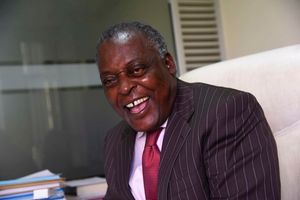
Former Lugari MP Cyrus Jirongo.
Photo credit: Evans Habil | Nation Media Group
At the time, if you asked Jirongo for his contacts, he would likely leave you with three phone numbers, something that was a status symbol at the time. Not many people owned landlines at the time, let alone three. Neither did Jirongo. The phone numbers rang in three public phone booths — two along Moi Avenue in the Nairobi city centre, and another in Otiende Estate.
During office hours, Jirongo would be in one of those locations and would rush to pick the phone at the first ring, when a call was made to the phone nearest to him at a specific point in time.
Those were his offices and, despite being public property on paper, the phones were practically his.
“He didn't have an office. There was this famous phone booth that used to be along Moi Avenue. So he used to give out the number of that phone booth as his contact line, and when people called him, he would rush, pick it and do his business deals,” Ms Kimeto added.
Those phone booths helped put money in his pocket, feed and house his young family.
“You can say Cyrus was a hustler. He was doing all sorts of businesses, and that is the time he was just beginning to rise,” Ms Kimeto said.
In January, 1992 Mr Joe Kimkung, Mr Fred Kiptanui, Mr Joe Mwangale, Mr Sammy Kogo Boit and Victor Kebenei hatched a plan to form a youth wing of Kanu to campaign for President Daniel arap Moi’s re-election.
The five, veteran Nation journalist, Mr John Kamau wrote, elected Jirongo chairman of that youth outfit. That would become Jirongo’s big break, but also his big fall.
One night, Jirongo returned home to Ms Kimeto and revealed that he planned to go into politics. Not one for a public life, Ms Kimeto had to ask her husband if he was sure of that decision. Suddenly, their quiet life was gone. Their home was now open for all and sundry.
Widows of former Lugari MP Cyrus Jirongo (from left) Christine Nyokabi, Anne Kanini and Anne Lanoi during a funeral meeting at the family home in Gigiri, Nairobi on December 14, 2025.
Photo credit: Evans Habil | Nation Media Group
Jirongo was never one to turn anyone away, be it relatives, politicians, supporters or business associates.
“I had my reservations, and I asked him — ‘are you sure you want to get into this?’ He said ‘yes’. So, I told him, ‘okay’. As a wife I supported him. And knowing that he was now getting into politics and there was all this publicity, it was a bit scary. He was that sort of a person who could not say “no” to anyone who went to him with a problem. He would not chase anybody away. He was very friendly and kind. He had his intrigues, but Cyrus had a big heart,” Ms Kimeto said.
No matter how busy his in-tray was, Jirongo always went home for lunch, which he loved having with his family.
Suddenly, there was more than enough money for Jirongo to take care of his family, nuclear and extended, and anyone else that he cared for.
He finally got an office at Development Bank House, where his Cypper Enterprises operated from. Ms Kimeto was also a director in the firm, which went under later when Jirongo’s fortunes turned for the worse.
In the late 1990s, things started to change. In politics and business, the regime of the day had turned against Jirongo. President Moi disbanded YK’92 after retaining his seat in the 1992 elections, and then his administration targeted Jirongo.
Suddenly, his contracts were stuck, money owed by government to his businesses was not forthcoming, and a protracted hide-and-go-seek game with auctioneers began.
One by one, Jirongo started to introduce more and more women to Ms Kimeto as his wives. It became a polygamous marriage.
Ms Kimeto said this shocked her, as she had been used to life with only her husband and their children.
At one point, 18 women had been introduced as wives. The shift took a toll on Ms Kimeto, who sought to take a break from Jirongo.
She got an opportunity to further her studies in the US, and travelled early in the year 2000. Ms Kimeto was surprised by Jirongo’s reaction when she revealed the study plan.
“So I told him, ‘I would like to travel to the US to further my studies’. He was very supportive. He paid for everything. And I travelled to the US. I saw this as an opportunity for me to further my studies because I didn't get to do it immediately after high school, I just got into marriage,” Ms Kimeto said.
By the time Ms Kimeto left for the US, four women had become Jirongo’s wives.
Ms Ann Kanini, Ms Christine Nyokabi and Ms Ann Lanoi had joined Ms Kimeto in Jirongo’s life.
In a 2010 interview with the Nation, Jirongo supported polygamy, but maintained that it should be in consultation with the first wife and with her consent.
For the duration that Ms Kimeto was in America, her children lived with Jirongo and one of the other wives.
Ms Kimeto returned to Nairobi in 2005, and opted not to return to the US as she wanted to remain close to the children.
She said that Jirongo treated all his children from the different women in his life, equally and loved them equally. He ensured that they all had a decent roof over their heads, attended good schools and had enough to eat, Ms Kimeto said.
In the past decade or so, Jirongo struggled with debt, even as he still worked to get back to being the wealthy man who once had the Sh500 note nicknamed after him.
The debts piled up as Jirongo tried to reinvent himself. Auctioneers got hold of many of his assets, including the matrimonial home in Gigiri.
Ms Kimeto said that despite living separately, she and Jirongo kept in touch. She last met and spoke with Jirongo in his Westlands office three weeks ago.
But the contents of that meeting, Ms Kimeto said, remain strictly for her and Jirongo — a man with his quirks, but who was a friendly, enterprising and loving husband and father.