Nearly 50 per cent of Grade 9 learners who sat the Kenya Junior Secondary Education Assessment (KJSEA) this year have been placed in the Science, Technology, Engineering and Mathematics (STEM) pathway in senior school, according to a breakdown from the Ministry of Education.
With 49 per cent securing STEM pathway placements, 40 per cent secured slots in the Social Sciences pathway, while the other 11 per cent were placed in the Arts and Sports pathway.
Basic Education PS, Prof Julius Bitok.
Photo credit: File | Nation Media Group
Basic Education Principal Secretary Prof Julius Bitok revealed that 512,000 learners secured slots in STEM schools, 420,000 were placed in Social Sciences institutions, and 115,000 joined Arts and Sports pathways. At least 83,000 Special Needs learners were also placed to various institutions. .
Cluster One schools, formerly national schools and with the highest infrastructure and specialisation capacity, took in 105,000 learners.
Cluster Two, formerly extra-county schools, absorbed 254,000 learners, while Cluster Three, formerly sub-county schools, enrolled 288,000 learners.
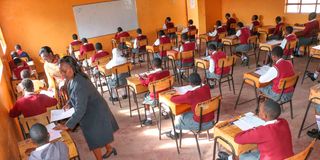
Grade Nine candidates take KJSEA English language paper at Moi Nyeri Complex Primary School in Nyeri County on October 27, 2025.
Photo credit: File | Nation Media Group
Cluster Four schools, which form the largest group and consist of sub-county schools that are mostly day schools, received 399,000 learners, accounting for the biggest share of placements.
According to the ministry, learners will be required to report to their respective senior schools by Monday, January 12, 2026.
Prof Bitok, the Basic Education PS, explained that placement into senior secondary schools follows a structured, merit-based framework under the Competency-Based Education (CBE) system.
“The selection of learners is guided by a clear framework that considers their choices, performance in the Kenya Junior School Education Assessment, and the availability of spaces in their preferred schools and subject combinations,” Prof Bitok said.
According to the PS, placement into senior schools is guided by three main considerations: learners’ preferences, KJSEA performance, and the vacancies available in the chosen schools.
“Each pathway has specific subject tracks, and learners are placed according to their academic performance in relevant learning areas and the school’s specialisation and capacity. The final allocation also considers approved school capacity and sub-county quotas, computed using a modified County Revenue Allocation formula to ensure fairness across regions,” Prof Bitok said.
He further noted that the placement portal will remain open for a week to enable learners to revise their choices.
During this period, candidates who feel uncomfortable with their assigned pathway or school will be allowed to reapply, subject to available space and merit.
The ministry said it will publish a list of senior schools with vacancies, categorised by pathway and cluster, to guide parents and candidates during the revision period.
Prof Bitok reiterated that all revisions will be processed transparently and equitably, in line with placement guidelines, as the government implements the new senior school structure.
“I want to urge parents not to worry. The portal will be open for one week for admissions, and you can still revise and get the pathway you really like. When you go to the system, you will see the schools that are open, and you can now apply through your junior school. Learners will be allowed to revise their choices based on pathways, including switching from STEM to social sciences,” said Prof Bitok.
The placement marks the transition of the first cohort of learners from junior school to senior secondary school under CBE, with learners expected to report to senior schools in January.
“This is the first cohort of learners under CBC transitioning to senior secondary school and eventually to higher education in 2029. Those joining senior school in January are being placed now, and by noon they are expected to start checking where they have been selected. This new generation of students will arrive at universities with different skills, expectations and a stronger proficiency in practical application and critical thinking shaped by the competency-based curriculum,” said Education Cabinet Secretary Julius Ogamba during Kenyatta University’s 58th graduation ceremony on Friday.
Speaking to Sunday Nation, Mr Ogamba emphasised that the ministry places a high premium on equity, fairness and transparency in the placement of learners.
Grade Nine candidates start KJSEA English language at Moi Nyeri Complex Primary School in Nyeri county on October 27, 2025.
Photo credit: Joseph Kanyi | Nation Media Group
To ensure equitable access, the ministry applied a modified County Revenue Allocation Formula to determine sub-county quotas for senior school placements.
“The ministry applied the modified County Revenue Allocation Formula to determine sub-county quotas for placement into senior schools. The indices of this formula were population, equal share, geographical size, poverty and income distance,” said Mr Ogamba.
“These were used to calculate the raw share for each sub-county that was used to allocate available spaces in senior schools. This ensured balanced regional representation and safeguarded opportunities for learners from historically marginalised and less-resourced areas,” he added.
Under the CRA formula, 42 per cent of the placement consideration is based on county population, allowing larger counties to receive a proportionate number of slots. Learner performance contributes 22 per cent, reflecting academic results such as KCSE scores to place students according to merit.
Poverty levels account for 14 per cent, ensuring that learners from marginalised or economically disadvantaged areas are given support. Distance to school makes up 13 per cent, reducing travel barriers and promoting accessibility. Finally, school size and infrastructure contribute 9 per cent, helping to match students to schools that have adequate facilities to accommodate them.
According to the ministry’s document, all schools, both public and private, will admit Grade 10 learners through NEMIS, the Education ministry’s portal, and principals will not be allowed to enter a learner into the system before they physically report to school. The ministry will monitor learner reporting daily.