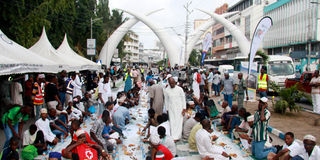
A few minutes before sunset, the air along the famous Mapembeni junction on Moi Avenue in Mombasa begins to change.
The aroma of freshly fried Swahili dishes, snacks and beverages drifts through the street as volunteers hurry to spread long plastic mats across the pavement.
Trays of dates are passed from hand to hand. Cups of tamarind juice, water, and coffee, locally known as ‘kawaha thungu’, are lined neatly on cardboard tables. At the same time, large cooking pans of rice and Swahili dishes arrive one after another to feed Muslims and non-Muslims.
Slowly, people begin to gather as a section of the busy road towards the port of Mombasa is shut down for a few hours to allow hundreds of residents to break their fast.
Mombasa residents break fast on the 2nd Friday of the Holy Month of Ramadhan, which was hosted by the County Government at the Elephant Tusks area along the Moi Avenue, in this photo taken on February 27, 2026.
Photo credit: Kevin Odit| Nation Media Group
Office workers loosen their ties after a long day, boda boda riders park their motorcycles nearby, tuk-tuk drivers line up by the roadside and elderly men walk in quietly with prayer beads in their hands. Even street children find a place among the crowd and a meal, thanks to the spirit of Ramadhan.
Within minutes, hundreds of people have settled on the mats, shoulder to shoulder, waiting patiently for the Maghrib call to prayer that will signal the time to break the fast. For a brief moment, the usually busy stretch of Moi Avenue falls into an unusual calm.
For many residents, the communal iftar at Mapembeni has become a cherished Ramadhan tradition, a place where strangers sit together and share a simple meal at the end of a long day of fasting. This happens every Friday during Ramadhan, with the road section remaining closed for motorists from around 4pm to 7pm.
“We have partnered with the community, individuals and corporates to showcase the importance of religion and diversity,” said Ms Rukia Janwala, director of the Swahilipot Hub Foundation, which organises the street iftar.
“This is the beauty of Ramadhan, sharing and ensuring everyone has something to eat. You get to rub shoulders with who's who. Regardless of who you are, you get to pray and share a meal with anyone,” she adds.
Hundreds of Muslims break their fast in the Pembe ya Ndovu area along Moi Avenue in Mombasa County.
Photo credit: Kevin Odit| Nation Media Group
Ms Janwala said the gathering is organised largely by volunteers and local youth groups who begin preparations hours before sunset. Some collect donations from well-wishers while others arrange the food and guide people to the seating areas.
On this evening, 26-year-old volunteer Abdallah Salim moves quickly between the mats, placing dates and water in front of those waiting to break their fast.
“We start preparing around 4pm,” he said with a smile.
“People donate whatever they can — dates, juice, rice or even money. Our job is simply to make sure no one goes without breaking their fast,” he explains.
As sunset approaches, the lively conversations gradually fade. A quiet anticipation spreads across the crowd.
Some people raise their hands in prayer while others sit silently, their eyes fixed on the sky. Then the Maghrib adhan echoes across the city.
Mombasa residents break fast on the 2nd Friday of the Holy Month of Ramadhan, which was hosted by the County Government at the Elephant Tusks area along the Moi Avenue, in this photo taken on February 27, 2026.
Photo credit: Kevin Odit| Nation Media Group
Almost instantly, the calm breaks. Hands reach for dates, plastic cups of water and beverages are lifted, and murmured prayers of gratitude fill the air.
For a brief moment, the busy street feels like a giant family dining table.
“We started this street Iftar initiative so that anyone who wishes to donate can bring whatever they have, money or food, and break the fast together as brothers and sisters,” said Mahmoud Noor, founder of the Swahilipot Hub Foundation.
He said the main aim is to bring people together. The initiative was borrowed from a tradition in the Middle East.
Mr Noor said the initiative is also feeding those who are not fasting and helping the less fortunate get a meal.
He added that the organisers hope the initiative will inspire other counties to adopt similar programmes.
However, the growing popularity of the gathering has also attracted criticism from some quarters. Some business owners and motorists say the crowds occasionally disrupt movement along the street, particularly during peak hours.
Many have questioned why it has to be done on the road, while Mombasa boasts of attractive open spaces such as the Mama Ngina Waterfront, beaches and even a park right next to the Elephant Tusks along the Moi Avenue.
“It is unfair to block the road just for breaking the fast,” said motorist Morris Kioko.
“Mombasa is a busy city, especially along the road that leads to the port,” he added.
Mombasa Governor Abdulswamad Nassir defended the communal iftar, saying it promotes harmony and coexistence. Here, people from all walks of life and different faiths gather together.
Mombasa Governor Abdulswmad Nassir among hundreds of Muslims, breaks fast at the Pembe ya Ndovu area along the Moi Avenue, which was sponsored by Swahili Pot and the County Government of Mombasa, in this photo taken on March 6, 2026.
Photo credit: Kevin Odit| Nation Media Group
“This initiative brings the spirit of togetherness, which is what Ramadhan is all about. Muslims and non-Muslims come together to break the fast. It also shows that the county is peaceful and secure,” he said.
The governor added that those concerned about traffic disruptions should look at the initiative from a positive angle. He said apart from uniting communities, they also need to consider the economic benefits of the event.
“This initiative has created opportunities for traders selling food along the street for people to break their fast. We are not disrupting the economy because the road is only closed for a few hours. Besides, most businesses along this street are offices,” he explained.