When word spread that John Kawira, 43, had been lynched on February 8, 2026, his wife, Alice Wanjiru, collapsed in shock.
Mr Kawira was a familiar face in Murang’a town, where he worked as a tuk-tuk operator whose clients included traders travelling between Nairobi, Machakos, Embu, Kirinyaga and Kiambu counties.
When she regained consciousness at Murang’a Level Five Hospital, Ms Wanjiru spoke through tears.
“One day God will reveal the truth….My husband was not a criminal. You have left me a widow for no reason,” she said.
She described a man who had struggled through life with determination. Though he finished only Class Eight in 1999, he took up any work he could, becoming a broker, farmer and boda boda rider before finally earning a living ferrying passengers and goods in his tuk-tuk. The couple married in 2003 and had three children together.
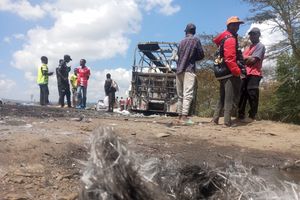
According to a police signal filed by Murang’a police boss Kemboi Kimaiyo, Mr Kawira was intercepted at Ngaî-inî village on the border of Murang’a and Kirinyaga counties near Sagana. town
“A report was received that at about 4:30 pm members of the public stopped a tuk-tuk carrying three occupants. They were suspected to be livestock thieves,” the report stated.
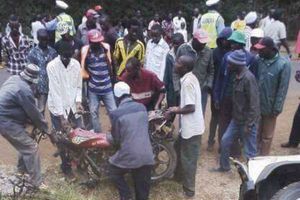
What followed was captured in chilling footage now circulating online. One suspect is seen sprinting away into the bushes, another is pinned to the ground and beaten beside the vehicle, and Mr Kawira, still seated behind the steering wheel, is questioned by an angry crowd.
“My God knows the truth,” he pleads. “That man outside called me to transport three goats to Murang’a town. I was to be paid Sh1,500. I’m only a transporter.”
The man being assaulted offers a different story, claiming he was merely a mechanic summoned to repair the tuk-tuk.
John Karimi, 43, was lynched on February 8, 2026, in Kiharu constituency in a suspected incident of mistaken identity.
Photo credit: Pool | Nation
Mr Kawira, growing desperate, challenges the crowd to check phone records.
“Ask him to show his call logs. I never called him. He is the one who has been calling me for the last three hours,” he says.
The mechanic responds that he has no phone, alleging the calls were made through the handset of the man who escaped.
“This is going nowhere. Even if you kill me, I know nothing about theft. I’m just doing my job,” Mr Kawira shouts before moments later the situation spirals into horror.
The mob drags him out of the tuk-tuk, overturns it, and Kawira is forced onto the ground, face up. Petrol is then poured over him, and the tuk-tuk, and then the match is struck.
The crowd erupts in cheers as flames engulf the vehicle and the man beneath it. Mr Kawira writhes in agony, his screams fading into silence as life is burned out of him.
At his burial in Gathambara village on February 17, 2026, Kawira’s mother, Florence Kabura, stood before mourners in grief and resignation.
“I leave everything to God but this is what happens when the country is ruled by jungle justice. ,” she said.
Police say the incident is being treated as murder, though the whereabouts and fate of the other two suspects remain unclear.
A postmortem report revealed the brutality of Mr Kawira’s final moments with a broken skull, fractured limbs, burst lungs from toxic fumes and burns covering 78 percent of his body.
When Nation visited Ngaî-inî village days later, residents responded with the heavy silence of a community unwilling to confront its own guilt.
Only one man, Mr Simon Karimi, spoke cautiously.
“If we are honest, the identification was chaotic. The mob was actually after the mechanic but the intelligence was poorly framed and people thought the suspect was the one driving,” he admitted.
He explained that no names or photographs had been provided, and in the confusion of an ambush, mob psychology took over.
“The driver died because he couldn’t give the answers they wanted,” he said.
Mr Karimi claimed the village had suffered heavily from livestock theft in recent months, losing 10 cows, 18 goats, three donkeys, six pigs and more than 60 hens.
“When we report, nothing happens even though the suspects are known,” he added.
Ms Grace Waweru, chairperson of the Gaturi Unity Forum, said residents had repeatedly petitioned authorities over the growing crisis.
“Small lorries, cars, motorbikes and tuk-tuks are being used to ferry stolen livestock and crops. People feel abandoned, and they are taking matters into their own hands. In the last year alone, about eight suspects have been lynched in Gaturi ward. It is now up to the government to decide whether this lawlessness continues or whether it fulfils its duty to protect lives and property,” she said, warning that mob justice was becoming routine.
Crime Index data (2025) shows that livestock and crop theft accounts for 70 percent of reported crimes in the area.
Murang’a Senator Joe Nyutu has described the situation as “a county disaster,” worsened by the deadly rise of mob justice.
Even Central Region Commissioner Joshua Nkanatha has recently declared, yet another campaign against livestock theft and vigilantism, one of many promises residents say they have heard before.
For Kawira’s widow, Alice Wanjiru and her three children, those promises come too late.
Her husband, she insists, was never a thief but only a man trying to earn a living in a place where suspicion can become a death sentence.