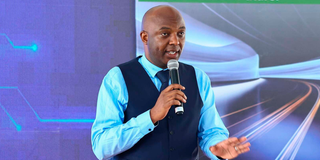
In the face of a lean budget, irregular and delayed disbursement of the equitable share by the National Treasury, as well as crushing debts from the Social Health Authority (SHA), Murang’a County has still found innovative ways to remain a leading force in the country’s public healthcare.
Reflecting on the challenges he has encountered, Governor Irungu Kang’ata said achieving healthcare standards under an unreliable budget cycle is an uphill task.
Dr Kang’ata said so far he has invested Sh3.6 billion in the health sector, which employs about 2,300 people across all cadres.
He explained that the county’s biggest consumer of resources is the wage bill, which takes up over 51 per cent of the estimated Sh10 billion gross revenue, with the health sector alone consuming Sh470 million.
Murang'a Governor Irungu Kang'ata (right) and Social Health Authority Acting CEO Robert Ingasira during the signing of a Memorandum of Understanding (MOU) at SHA Headquarters in Nairobi on December 31, 2024. Dennis Onsongo | Nation Media Group
Despite the constraints, the governor has managed to build over 30 new and fairly equipped health facilities at a collective cost of more than Sh1.5 billion, keep health workers out of trade disputes, and roll out health insurance for the poor, even as SHA owes the county Sh200 million.
“As of 2025, about 40,000 households were accessing essential healthcare services without financial strain through the Kang’ata Care insurance scheme, against a target of 100,000. The beneficiaries receive comprehensive care, including inpatient and outpatient services, dental and optical care, chronic illness management, and emergency treatment,” Dr Kang’ata said.
The governor said the programme also covers up to Sh500,000 for overseas medical procedures, Sh100,000 as a last expense cover for the principal member’s family, and Sh25,000 for secondary school fees for dependants in the event of the principal member’s death.
He said he first had to secure budgets to jump-start stalled infrastructure projects initiated by his predecessor.
“Facilities that had stalled for years under the previous administration have been completed and commissioned, restoring public confidence in government delivery. New dispensaries and health centres have been constructed across underserved areas, reducing travel distances for communities and easing pressure on referral hospitals,” Dr Kang’ata said.
Murang’a Level 5 Hospital, the only referral facility in the county, has undergone upgrades, including the establishment of a modern Mother and Child Unit to address the county’s maternal and neonatal health priorities.
The new ICU Centre at Murang'a Level Five Hospital.
Photo credit: Joseph Kanyi | Nation Media Group
The county has also rolled out telemedicine services, allowing patients to interact with specialised health practitioners through digital platforms, as well as a mobile dialysis truck.
“We have also stepped in to bridge the gap created by the withdrawal of the Linda Mama health cover for expectant mothers by offering both pre- and postnatal interventions,” Dr Kang’ata said.
He noted that developing a county budget remains a challenge, given that the wage bill is projected to exceed the 35 per cent ceiling recommended by the Salaries and Remuneration Commission (SRC).
“Part of the remedial measures is to freeze new hiring, except in critical sectors like health. For healthcare, I will endure all hardships because it is a do-or-die sector for me and the people of this county. My focus is to continue growing our own revenue beyond the current Sh1.3 billion so that we can sustain healthcare funding,” Dr Kang’ata said.
The question of how the county can upscale service delivery amid dysfunctional collaboration with the national government has remained a key issue in the 13 years of devolution.
“If only this county had been receiving its equitable share allocation in full and on time, many remarkable things would be happening. If, despite irregular funding, Governor Kang’ata has made a strong case for healthcare, I would like to see how much further he could go with proper collaboration with the national government,” said Kariara MCA Mr Gichobe Mbatia.
Murang'a Senator Joe Nyutu.
Photo credit: Lucy Wanjiru | Nation Media Group
Senator Joe Nyutu said Murang’a is among the counties with great potential to deliver transformative services.
“As a senator responsible for oversight of Murang’a, I can report that we are doing relatively well despite the odds. Where we identify gaps, we summon the governor and his team to relevant Senate committees, and so far, progress has been made,” he said.
Mr Nyutu urged Dr Kang’ata to refine his approach and extend the progress made in healthcare to other areas of service delivery.
He also called on county technical teams to improve internet connectivity, noting that system failures often disrupt patient services, including registration, access to critical data and confirmation of payments.
The senator added that the county should balance service delivery, pointing out that many residents are affected by poor feeder roads, which limit mobility.
“We also need to focus on job creation. This is a critical area where cottage industries can play a key role. Many families depend on subsidised healthcare due to lack of livelihoods. Creating jobs can significantly improve even healthcare outcomes. Job creation should be treated as an urgent priority,” Mr Nyutu said.
Murang’a has digitised most of its service platforms, including achieving 100 per cent digitisation in the healthcare sector. However, whenever internet connectivity is unstable, services are disrupted.
According to Health Chief Officer Mr Eliud Maina, the county has fully deployed an integrated Hospital Management Information System (HMIS) across all 170 public health facilities.
“This has made Murang’a the first county in the country to achieve complete HMIS coverage at this scale. The results are tangible: reduced patient waiting times, more accurate medical records, real-time data for decision-making, improved supply chain oversight, and enhanced revenue collection. We are working on partnerships to ensure stable connectivity,” Mr Maina said.
He added that the county’s telemedicine services serve an average of 21,000 patients per month – particularly the elderly and those with chronic conditions – enabling them to consult clinicians remotely without the cost and difficulty of travelling to main hospitals.
“Tele-radiology has further enhanced diagnostic capacity, allowing imaging results to be interpreted in real time by remote specialists, significantly shortening the time from scan to clinical decision,” Mr Maina said.
The Chief Officer also addressed concerns about postmortem services, noting complaints of extortion by some practitioners and police officers.
“We have made it policy that no postmortem fees shall be paid to police officers, as they do not provide services on behalf of the county government. All payments must be receipted. No mortician should receive cash payments or payments via personal mobile phones,” he said.
He added that police officers present during postmortems are not county employees and their role is limited to compiling National Police Service investigative reports.
“As such, no family should pay officers any money within the scope of postmortem services, unless it is a private arrangement. Police should not be paid for postmortem services,” he said.
According to Dr Kang’ata, his strong focus on healthcare is guided by the belief that leadership is about people and their sustained prosperity.
“To have a productive population, people must be healthy. Achieving that requires clear policies that ensure preventive, curative and nutritional healthcare systems function effectively. My dream is a Murang’a where falling ill is not something that scares people,” he said.
Dr Kang’ata said he envisions a county where all patients can access care without out-of-pocket expenses.
Murang’a Governor Irungu Kang’ata cuts a tape to officially open the 100-bed capacity Kirwara Hospital in Gatanga.
Photo credit: File | Nation Media Group
“I imagine a county where health insurance works as it should. That is why I developed the Kang’ata Care scheme, where the elderly and vulnerable families access treatment for free. I would like to see a county where a pregnant mother walks into a hospital and leaves with her bundle of joy, and where even mortuary fees are minimal or free,” he said.
The governor added that the county’s healthcare system is undergoing reforms that, if fully realised, could set a national benchmark.
“We aspire to establish specialised hospitals where cases are handled based on specific needs – respiratory, cardiac, mental health, orthopaedic, paediatric, specialised surgeries and even cancer care,” he said.
Dr Kang’ata said the only reliable way to expand healthcare services is through local revenue mobilisation, which remains a gradual process.
“But with the modest budgets we have, I can assure you that we are steadily working towards this vision. For the time I serve as governor, I promise to leave a lasting impact,” he said.
Water and Environment Chief Executive Officer Ms Muthoni Magochi said the county has been experiencing waterborne and airborne diseases due to poor management of water and waste.
“We have increased our capacity to enforce environmental hygiene. We have introduced strict monitoring policies to ensure that water pipes do not run alongside sewer lines. We have achieved zero incidents of contaminated water reaching consumers,” Ms Magochi said.
She added that the county is partnering with development partners to roll out a Sh100 million anti-open defecation programme, especially in rural areas.
“We want all residents of Murang’a to use proper sanitation facilities. About 16 per cent of our rural population still lacks access to dignified sanitation. We are reaching out to support them,” Ms Magochi said.
“Carbon emissions have severely affected many households, particularly women and children. The county is partnering with stakeholders to distribute about 200,000 clean cooking stoves. This will help conserve forests while protecting the health of our people,” she said.