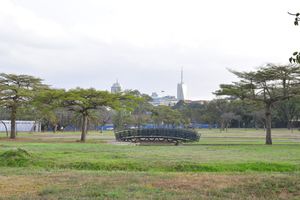
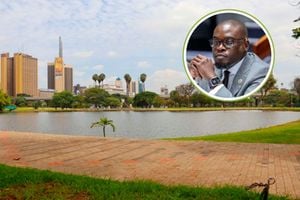
For thousands of Nairobi residents seeking a quiet place to relax, exercise or escape the city's congestion, Uhuru Park and Central Park have for many years offered a rare refuge.
But a Nairobi county government's plan to lease designated spaces within the two public parks to private operators has raised questions about how the historic green spaces will be managed and who will benefit.
The Environment and Land Court has now barred the county from implementing the leasing plan until it conducts meaningful public participation and complies with the applicable laws.
Justice Oscar Angote’s October 8, 2026 judgment ordered Central Park opened immediately and directed the county government to prepare park-management rules within 12 months. The judgement partly allowed a Green Belt Movement petition challenging closures and the county’s December 2024 leasing decision.
Uhuru Park was established and officially opened by the late President Jomo Kenyatta on May 23, 1969. It is located on the western edge of Nairobi’s central business district along Uhuru Highway. The neighbouring Central Park contains the Kenyatta Monument and the Nyayo Monument.
Both green fields have historically served as public recreational and gathering spaces, hosting political rallies, religious meetings, cultural events and national celebrations, while providing green spaces for relaxation.
The court dispute was triggered by the county government’s prolonged closure of Central Park since 2021, intermittent closures of Uhuru Park and a December 3, 2024 county government's resolution approving the leasing and renting of designated spaces in the two parks.
The Green Belt Movement sought court orders declaring that public access to the parks is part of the constitutional right to a clean and healthy environment.
It also sought orders compelling the reopening of Central Park, stopping the leasing plan until public participation and legal requirements were met, and requiring the county to establish laws and guidelines governing public green spaces.
In response, the county argued that the proposed leasing of designated spaces in two parks was intended to attract private investment, improve facilities and generate revenue. It added that no lease or public-private partnership agreement had been signed and no park had been transferred to a private entity.
A family relaxes at Uhuru Park Nairobi on January 1, 2025.
Photo credit: Wilfred Nyangaresi | Nation Media Group
The county maintained that the constitutional right to a clean and healthy environment did not guarantee unrestricted access to parks at all times, saying closures were linked to rehabilitation works and that commercial arrangements could improve public amenities.
The plan intended to introduce “recreational facilities, eateries, and event spaces for public enjoyment”. A public tender notice was subsequently issued in January 2025 inviting bids to lease park space and rent units, including containers, a pond and ablution blocks, for three years.
The court, however, said no lease or partnership agreement had been executed. It nevertheless barred implementation of the county's resolution until meaningful public participation and applicable legal requirements, including the Public Private Partnerships Act where relevant, are met.
"A permanent injunction is hereby issued restraining the respondents … from implementing Resolution No. 3 of the County Executive Committee communiqué published on December 3, 2024, concerning the leasing and renting of designated spaces within Uhuru Park and Central Park, until meaningful public participation has been undertaken and the applicable constitutional and statutory requirements, including the provisions of the Public Private Partnerships Act, 2021, where applicable, have been complied with," said the judge.
The Green Belt Movement argued residents had not been told which spaces would be leased, who might rent them or how the county reached its decision.
It said there was no evidence of public consultation, a feasibility study, an environmental impact assessment or County Assembly approval. The Law Society of Kenya supported the petition, citing environmental rights and public oversight.
The county argued the case was premature because no lease had been signed and no part of either park transferred to private ownership.
It said public participation was not required at every stage of internal deliberations and regulated commercial services could improve amenities without breaching public trust.
The court rejected the county's objections to the petition’s standing and precision, finding that the Green Belt Movement had sufficiently identified the alleged violations.
The court also ruled that regulating park access through unpublished or arbitrary directions without a clear legal basis was inconsistent with Article 10.
“The county remains bound by Articles 42 and 69 of the Constitution to protect existing public green spaces and to address their provision and accessibility through lawful urban planning," the court stated.
On Central Park’s closure, the county told the petitioners in an October 7, 2024 letter that the park had not been formally handed back by the Ministry of Defence and rehabilitation remained incomplete.
Outstanding works included water and sewer connections to ablution blocks, irrigation, drainage, electrical works, walkways, podium-stage works and pumps and plumbing at the skating rink.
The court said the county had not explained the project’s original timeline, progress, reasons for delay or expected completion date. Nor had it shown why the entire park had to remain closed.
“The prolonged closure of Central Park infringes the rights of Kenyans secured under Articles 42 and 69 of the Constitution,” the court stated.
The court held that “the right guaranteed under Article 42 of the Constitution encompasses the right of the public to access and enjoy public parks, including Uhuru Park and Central Park.”
The court dismissed the claim that the county violated the right to information because its October 2024 letter disclosed the stated reasons for closure.
It declined to order a large green space in every sub-county or require court approval before every future closure. The county may restrict access for lawful maintenance, rehabilitation, conservation or safety reasons, but must act reasonably and transparently.
The county must also submit proposed legislation, policies or guidelines on managing and protecting public parks to the County Assembly within 12 months.