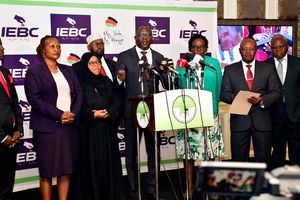
The electoral commission is projecting at least 9,000 additional polling stations ahead of the August 10, 2027 General Election, even as its proposal to increase the maximum number of voters per polling station from 700 to 1,000 faces resistance in the National Assembly.
An official Independent Electoral and Boundaries Commission (IEBC) paper presented to Parliament projects an increase in polling stations from the 46,229 used in the 2022 General Election to 55,393, based on the commission’s target of registering 6.3 million new voters before the next election.
However, the proposed expansion faces legislative hurdles, with MPs pushing to retain the current legal limit of 700 voters per polling station.
A proposal in the Elections (Amendment) Bill, 2024, to raise the cap to 1,000 voters per polling station was approved by the Senate in December 2024. However, it has encountered resistance in the National Assembly, which wants the lower limit retained.
The commission estimates that it will require 59,959 Kenya Integrated Elections Management System (KIEMS) kits to support election operations, with an additional 3,959 reserved exclusively for training constituency election officials.
The Independent Electoral and Boundaries Commission Chairperson, Erastus Ethekon.
Photo credit: File | Nation
IEBC chairperson Erastus Ethekon said the final locations of the additional polling stations would be determined after the voter registration exercise, as preparations for the 2027 elections gather pace.
“The new polling stations will be set out in areas where the existing polling stations and voter registration centres go beyond the maximum 700 voters,” Dr Ethekon said, adding that distance and the need to bring polling stations closer to voters would also be considered.
The projected increase in polling stations forms part of the commission’s baseline guidelines for preparing for the next General Election.
Section 38A of the Elections Act provides that, “for the purposes of providing efficient and effective conduct of elections”, the number of voters per polling station shall not exceed 700.
The IEBC wants the provision amended to allow up to 1,000 voters per polling station. However, the National Assembly’s Justice and Legal Affairs Committee (JLAC) has signalled opposition to the proposal.
“I must confess here that we have a slight problem with this provision and a few of the other provisions. We will be making proposals to amend these provisions when this Bill comes to a third reading,” said Tharaka MP George Murugara, who chairs the committee.
Tharaka Member of Parliament Gitonga Murugara.
Photo credit: Alex Njeru I Nation Media Group
Dr Ethekon also revealed that the commission plans to retain the existing register of 22.3 million voters and add the projected new voters, bringing the anticipated total to 28.63 million.
“Continuous voter registration will continue as mandated by the Constitution, and an enhanced mass voter registration per year. Verification of the voter register will be done six months before the 2027 general election,” the IEBC document states.
In its bid to register 6.3 million new voters by 2027, the commission is moving away from using census data to set registration targets, opting instead for information from the National Registration Bureau (NRB) and the Directorate of Immigration Services (DIS).
The commission says the traditional census-based model has “proven inaccurate, unsustainable and not verifiable”, prompting a shift towards a data-driven approach based on the number of citizens with the documents required to register as voters.
The 6.3 million target was initially calculated using the voting-age population (VAP) model, which estimates the number of people who will have attained the age of 18 by election day.
The IEBC now favours a voter-eligible population (VEP) model that draws on records of national identity cards and passports issued by the NRB and DIS.
“The commission observed that the VEP model utilises data from NRB and DIS, thereby narrowing the target setting on disaggregated identity cards and passports issued,” a report by the Constitutional Implementation Oversight Committee (CIOC) on the IEBC’s implementation of the Constitution, presented to the House, states.
The report adds that “this actual national identity card/passport data-driven targeting approach ensures that resources are deployed efficiently and performance benchmarks are realistic and attainable”.
Article 83 of the Constitution sets out the qualifications for voter registration, including possession of a national identity card or a valid Kenyan passport.
Under the previous model, the IEBC used census data to estimate the number of people who would have attained the voting age of 18 by the time of the General Election.
However, the commission says census figures include people who are ineligible to register as voters, including non-citizens, undocumented citizens and refugees. This, it argues, inflates registration targets because the figures do not distinguish between those who meet the legal requirements and those who do not.
To meet its target and ensure that “no Kenyan is disenfranchised”, the IEBC plans to adopt several voter registration strategies.
These include continuous voter registration at all 290 constituency offices, registration services at Huduma Centres, ward-based enhanced registration drives and continuous registration in institutions of higher learning.
IEBC constituency offices will continue to serve as registration centres where eligible citizens can enroll as voters and update their particulars. This will allow first-time voters to register at any time after obtaining a national identity card or passport.
The commission says the revised approach is intended to produce more realistic registration targets, improve the deployment of resources and widen access to voter registration ahead of the 2027 General Election.