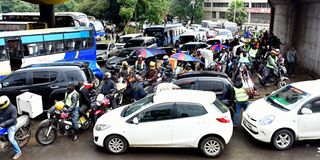
It's barely sunrise on Waiyaki Way, Nairobi, and the morning rush has already begun. Cars are lined up bumper-to-bumper; matatus hoot as conductors shout for passengers to board. Bodabodas weave dangerously between lanes while hawkers move from car-to-car selling water, snacks and newspapers.
Nairobi’s traffic jams are now a normal part of city life, with thousands of commuters spending long, frustrating hours on the road each day.
More cars, limited road space and an overstretched public transport system have come together to create one of the most stubborn urban headaches in the country.
A survey by the Nation has found that much of the city's congestion builds up around interchanges and roundabouts that connect major roads. These junctions, meant to ease movement, have instead become notorious choke points where traffic from several directions converge.
For instance, areas such as Nyayo Stadium roundabout, Haile Selassie Avenue near the Railway bridge, Globe Roundabout and the junctions along Uhuru Highway and Waiyaki Way experience endless traffic build-ups during peak hours.
User controls Click
Loading traffic data...
Traffic legend Tip: Pinch to zoom, drag to pan the map.
Map & traffic © Mapbox. Incident/flow data © TomTom.
Map developed by: Geoffrey Onyambu
Road class: Auto-detect Highway Arterial Local
—
Hourly traffic volume (vehicles/hour)
Low → Green · Severe → Red
Cars from feeder roads struggle to merge onto the main highways, creating overlapping lanes as traffic officers battle to maintain order.
Generally, the roads most affected by gridlocks on a daily basis are Thika Superhighway, Mombasa Road, Ngong Road, Jogoo Road, Lang’ata Road, Outer Ring Road, Uhuru Highway and Waiyaki Way.
Eastleigh - Cars, double parking and roadside vendors
Eastleigh remains one of the city’s most gridlocked areas, especially during the day. Its narrow roads, lined with shops and street traders, struggle to accommodate the steady flow of matatus, delivery trucks and private vehicles.
Double parking and roadside vending worsen the situation, leaving little room for movement.
A road in Eastleigh, Nairobi.
Photo credit: Lucy Wanjiru | Nation Media Group
Traffic officers are often overwhelmed as vehicles crawl through jam-packed streets like First Avenue, General Waruinge Road and Jam Street, where business deliveries and shoppers compete for space. Despite frequent complaints from motorists, congestion in Eastleigh shows no sign of easing.
Thika Road - wide road, narrow bottlenecks
Meanwhile, on Thika Road, matatu driver Peter Muchiri says traffic builds up quickly in the mornings as vehicles converge at major junctions entering the city. These include Allsops, Roysambu, Survey and Ngara junctions.
Heavy traffic towards the city center at Ngara, Nairobi.
Photo credit: File | Nation Media Group
“Traffic is always heavier in the morning, especially at junctions like Allsops and Roysambu,” he says.
“Everyone is rushing to get into town, and the lanes just can’t handle that many vehicles at once.”
He notes, however, that the situation isn't as bad in the evenings, as city residents head out of the city centre into the estates.
Roads and Transport Cabinet Secretary Davis Chirchir admits that previous interventions have fallen short because the country lacked an integrated and well-coordinated transport system.
According to the CS, Nairobi’s congestion is not merely a local nuisance but a national economic burden.
“When transport systems do not work together, the result is chaos on the road congestion, delays, and high costs that slow economic growth,” he said.
Peak vs off-peak - does it matter anymore?
For many Nairobians, the idea of “off-peak hours” has become meaningless over time. Traffic jams don't always adhere to the early morning and evening patterns. Now, a gridlock can appear at mid-morning, early afternoon or even late at night.
“These days there’s no such thing as off-peak,” reckons Lucas Mwangi, a resident of South B who commutes to Westlands daily.
“You can leave home at 10am thinking the roads are clear, only to find yourself stuck for an hour before you even reach town.”
Speaking to the Nation , a taxi driver who operates routes on Mombasa Road and Eastlands shared the same frustration. A stalled lorry or heavy rains can turn a short trip into an hour-long wait.
“Even at night, you can get a jam out of nowhere,” he said.
'Friday evenings are the worst'
While early mornings and evenings are generally marked by congestion in Nairobi, Muchiri reckons there's one day that takes the crown.
“Friday evenings are the worst,” Muchiri says.
“Everyone is either rushing home, heading out of town or doing last-minute shopping. By 4pm, the whole city just locks up.”
Beyond the lost hours, Nairobi’s traffic takes a heavy toll on people's health and the environment. The constant idling of vehicles fills the air with fumes that settle over the city.
Commuters spend long hours breathing in the pollution, and many report persistent headaches, fatigue or irritation from the smog.
Speaking to the Nation , a section of matatu drivers from Nairobi believe part of the solution lies in reimagining how vehicles flow through the Nairobi CBD. They say that during former Governor Mike Sonko’s tenure, they proposed introducing a one-way traffic system for the CBD to ease congestion.
Under the plan, major arteries such as River Road would serve as entry routes into town, while Tom Mboya Street would handle outbound traffic linking back to Murang’a Road and Thika Superhighway.
Over the years, authorities have tried to address the problem. New bypasses have been built to divert long-distance traffic away from the city centre. Roads such as Thika Road and Ngong have been widened. It seems to help the situation, but only for a little while.
Another intervention is smart traffic lights have been installed at major intersections to improve flow. The Nairobi Expressway, which runs above Mombasa Road, has provided some relief for motorists who can afford it.
The Green Park Terminal was meant to organise matatu operations and reduce congestion within the CBD, though its progress has been gradual as many operators and city residents have shunned it.