Since last week, parts of the country have been hit by heavy downpours, causing property damage, loss of life and widespread disruption. Social media has been awash with posts from residents asking whether they can take legal action against the government over the floods.
Opinions remain divided. Some argue that the floods are a natural calamity, acts of God, while others blame poor waste management, blocked drainage systems and weak urban planning. To understand the legal options available, Nation Lifestyle spoke to several lawyers on whether Nairobi residents can hold the county government accountable.
Sharon A. Atieno, a senior associate at Roba & Associates Advocates LLP and an advocate of the High Court of Kenya with experience in civil litigation, says residents may pursue legal action if they believe their constitutional rights have been violated.
Article 42 of the Constitution guarantees every person the right to a clean and healthy environment, which includes proper sanitation and safe living conditions.
“If that right is violated, a person is entitled to move to court,” Ms Atieno says. “Article 70 of the Constitution allows individuals whose environmental rights have been infringed to file a suit, including against the county government.”
According to her, liability may arise if it can be shown that authorities failed in their planning and infrastructure responsibilities.
“The County Governments Act places responsibility on authorities to undertake proper physical and socio-economic planning,” she says. “If someone can prove that poor planning or failure to maintain infrastructure contributed to the damage caused by floods, then there could be a valid legal claim.”
“In court, the claimant would need to present strong proof, including photographs, expert engineering reports on drainage systems, and records showing whether the county failed to maintain or properly design infrastructure,” she says.
“There is no absolute protection preventing people from suing a county government where constitutional rights have been violated,” she says. “However, procedural protections exist, such as those under the Government Proceedings Act regarding execution of judgments.”
A matatu lies on top of a private car as a result of heavy rainfall in the Grogan area in downtown Nairobi on March 7, 2026.
Photo credit: Thomas Mukoya | Reuters
On whether residents must notify authorities before suing, she explains that the requirement depends on the type of case filed.
“If it is a civil suit based on negligence, litigants usually issue a demand letter under civil procedure rules,” she says. “But if it is a constitutional petition, there is generally no requirement to give prior notice.”
Previously, Section 13A of the Government Proceedings Act required litigants to give the government a 30-day notice before filing a suit. That provision has since been declared unconstitutional.
A key legal distinction in such cases is whether flooding qualifies as an “act of God” or negligence.
“An act of God refers to extraordinary natural disasters beyond human control,” she says. “But if flooding results from blocked drainage systems, poor maintenance or illegal construction approvals, then negligence may be inferred.”
She adds that governments are expected to anticipate normal rainfall patterns and put appropriate infrastructure in place.
“If rainfall is within predictable patterns and the county failed to prepare adequately, then the argument of negligence becomes stronger,” she said.
Ms Atieno notes that courts have previously intervened where poor drainage planning exposes residents to flooding. She cites the recent case of Visram and three others v Nairobi City County Government & three others; Runda Association (Interested Party), where residents complained that a stormwater drainage system along Ruaka Road had been designed in a way that discharged water into their property.
“The court issued an interim mandatory injunction compelling the respondents to implement immediate containment measures, including temporarily sealing or diverting the drainage outlet to stop water from flowing into the private plots,” she says. “The court also directed the authorities to take reasonable emergency measures to assist the applicants in the event of flooding, including clean-up support and temporary shelter if displacement occurred.”
Purity Muhindi, an associate advocate at Muri Mwaniki Thige & Kageni LLP, says Nairobi residents can take legal action if they believe the county failed to perform its statutory duties related to drainage and storm-water management.
“Under the Fourth Schedule of the Constitution and the County Governments Act, counties have a duty to provide county public works and services, including storm-water management systems in built-up areas,” Ms Muhindi said. “Failure to properly perform those duties can render the county liable for the resulting damage.”
Printwell Industries Limited's premises on March 9, 2026. The company counts losses running into the millions after last week’s heavy rains caused flooding that submerged heavy printing machinery, paper stock, and printed books.
Photo credit: Bonface Bogita | Nation
She says residents must demonstrate that the flooding was caused by negligence or breach of statutory duty.
“The county would be legally liable if residents can demonstrate that the flood-related damage resulted from negligence such as failure to maintain drainage infrastructure, poor urban planning, blocking natural waterways, or ignoring known flood risks,” she said.
Ms Muhindi notes that such cases can be difficult because courts require clear proof linking the damage to government failure.
“Claims against counties succeed occasionally but they can be challenging because claimants must prove that the flooding resulted from negligence rather than an ‘act of God’ such as extraordinary rainfall,” she said.
“Families of victims can seek damages for loss of dependency, pain and suffering, and loss of expectation of life,” Ms Muhindi said. “They may also claim violation of the constitutional right to life where negligence by public authorities contributed to the deaths.”
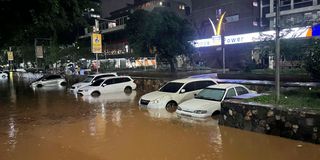
Vehicles on a flooded road in Nairobi after heavy rains on March 6, 2026.
Photo credit: Nation Media Group
“Courts can issue orders compelling counties to repair drainage systems, improve infrastructure or take measures to prevent further flooding,” she said.
Ms Muhindi cites past court decisions that highlight the importance of proving which authority is responsible for the infrastructure failure.
“In Aberdare Investments Limited v Kenya National Highways Authority (2024), the court awarded Sh2 million in damages after property was flooded due to poor drainage design linked to the Thika Superhighway project,” she said. “However, claims against Nairobi County were dismissed because there was no evidence connecting it to the specific infrastructure failure.”