A company linked to businessman and former President Daniel Moi’s aide Joshua Kulei will appeal the quashing of Sh22 million compensation awarded to the firm against the government, for constructing a road through its 44-acre multibillion parcel of land in upmarket Westlands.
In a notice of intention to move to the Supreme Court, Belgo Holdings Ltd said it was dissatisfied with the decision of the Court of Appeal early this month, quashing the award.
Although the judges of the Court of Appeal held that the 44-acre parcel of land on Peponi Road belonged to Belgo Holdings, the Environment and Land Court (ELC) was wrong in awarding the compensation and issuing permanent orders without ascertaining the actual position on the ground.
This was after Kenya Urban Roads Authority (Kura), through the Attorney-General, submitted that a link road from Waiyaki Way, connecting Westlands to Redhill in Kiambu County, had already been constructed on the land.
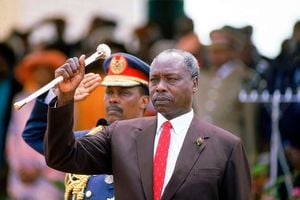
Former President Moi’s aide Joshua Kulei.
Photo credit: File | Nation Media Group
Justices Daniel Musinga, Francis Tuiyott and George Odunga said on matters where the actual position on the ground was disputed, and the subject of the dispute concerns the wider public, trial courts should confirm that position before granting orders, to avoid a situation where the enforcement may lead to unnecessary inconvenience to the public, particularly where alternative remedies may well suffice.
“Since there is no satisfactory evidence, that the appellants (Kura) trespassed on any other parts of the suit properties other than the portions gazetted, we find that the appellants were not liable in trespass. It follows, therefore, that the respondent was not entitled to the reliefs which were awarded by the learned Judge,” the judges said.
ELC judge Loice Komingoi had awarded Belgo Holdings a total of Sh22 million for general and exemplary damages for trespass.
The judge had also directed the state agency to vacate the land, a decision that prompted the Attorney General to move to the appellate court.
“In the premises, we find merit in the appeal, set aside the judgment in Nairobi ELC Case No. 545 of 2012) and substitute thereof an order dismissing the respondent’s (Belgo Hodlings) suit with costs,” said the judges.
The firm said it bought the land in 1995 from Lakeview Development Ltd and that it never received payment from the government, as compensation for compulsory acquisition as required by the law.
Belgo Holdings had accused Kura of encroaching on the land without compensating when it constructed the link road.
The land initially belonged to Jays Syndicate Ltd, which stated that it was allocated the parcel in 1974.
In July 1980, Jays Syndicate sold the property to Lakeview Development Ltd for Sh4.5 million.
The government, at the same time, sought to acquire a portion of the land for the construction of a road.
Lakeview stated that before the purchase, it had made a search at the Lands Registry in Nairobi and found no reference that the government had acquired portions of the property.
All was well until August 2011, when the owners saw earthmovers on the land with plans to construct the road.
Kura, on its part, said the government acquired the portions of the land for a link road from Waiyaki Way to Redhill Road in 1975 and paid for the same in 1976.
According to the state agency, the compulsory acquisition was known to the previous owners as it was well captured in the approved subdivision plan and confirmed through the minutes of the Physical Planning Committee of the City Council of Nairobi.
The government said records showed that it acquired the land for a link road through Gazette Notice Nos. 942 and 943 of March 21, 1975, respectively and payments were made in 1976.
Justice Komingoi, however, ruled that the government did not table evidence to confirm that it indeed paid Jays Syndicate for the acquisition of the portion.
The appellate disagreed and faulted the trial judge for issuing a permanent injunction without independently confirming the position on the ground.