The Office of the Director of Public Prosecutions (ODPP) has moved to clarify its decision to charge several individuals under the Prevention of Terrorism Act, amid growing public concern over the legality and implications of the move.
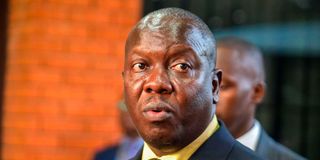
In a press statement, DPP Renson Ingonga addressed the widespread debate sparked by its legal action against suspects linked to violent incidents during the demonstrations held on June 25 and July 7, 2025.
"The ODPP upholds the vital role of a free press and a vibrant civil society in fostering accountability and strengthening democratic governance," the statement read, reaffirming its commitment to democratic rights amid criticism.
According to the him, preliminary investigations revealed that the attacks on government institutions during the protests were deliberate and targeted. The intent, it said, was to cripple critical state operations.
The targeted facilities included police stations, courts, and public offices.
The DPP expressed concern that the nature of the attacks went beyond physical destruction and were instead intended to instill fear and undermine public trust in democratic institutions.
“These were not spontaneous demonstrations.They were calculated and coordinated acts of violence aimed at crippling essential government operations, instilling fear, and eroding public trust in democratic institutions,” he said.
One of the key incidents highlighted was the arson attack on Kikuyu Law Courts, which was torched during the protests.
Chief Justice Martha Koome described the attack as “not merely an act perpetrated by criminal elements, but an act of terrorism” during her visit to inspect the damage.
Citing Sections 2 and 4 of the Prevention of Terrorism Act, Mr Ingonga stated that any actions intended to seriously disrupt essential services, intimidate the public or government, or create widespread fear through targeted destruction, fall within the legal definition of terrorism.
He said that while it fully respects the rights to free speech, peaceful protest, and political expression, such rights must be exercised within the confines of the law.
“Charges under the Prevention of Terrorism Act should be understood within the framework of established legal thresholds and national security imperatives,” the statement explained. “They should not be interpreted as efforts to suppress legitimate political expression.”
The decision has ignited a fierce national debate, with civil society groups and some political leaders warning against the potential misuse of anti-terror laws to stifle dissent. Critics argue that the government may be weaponizing security legislation to clamp down on protests fueled by economic frustrations and governance grievances.
In response, the ODPP reiterated that the legal actions taken are based on specific, evidence-backed investigations and are not arbitrary.
As the country grapples with the aftermath of the protests and the ensuing legal battles, public attention now turns to the courts, where the accused individuals are set to face trial. Human rights organizations, legal experts, and political observers are closely monitoring the proceedings, viewing them as a litmus test for Kenya’s adherence to justice, national security, and democratic freedoms.
“The ODPP remains committed to executing its constitutional mandate in accordance with the law, public interest, and the administration of justice,” the statement concluded.